| Rome | Venice | Bologna | Florence | Padua/Verona/Vicenza |
Venice
Venice is the capital city of the Veneto region which was a independent kingdom before Italy became a unified country. It would not be right to have a Veneto webapge without mentioning this important city. I have some old photos taken in 2000.- St. Mark's Basilica.
Venice's No. 1 address.
- History from Wokipedia.
- Entrances to the Basilica.
- Inside the Basilica. The main altar. One of the side alters.
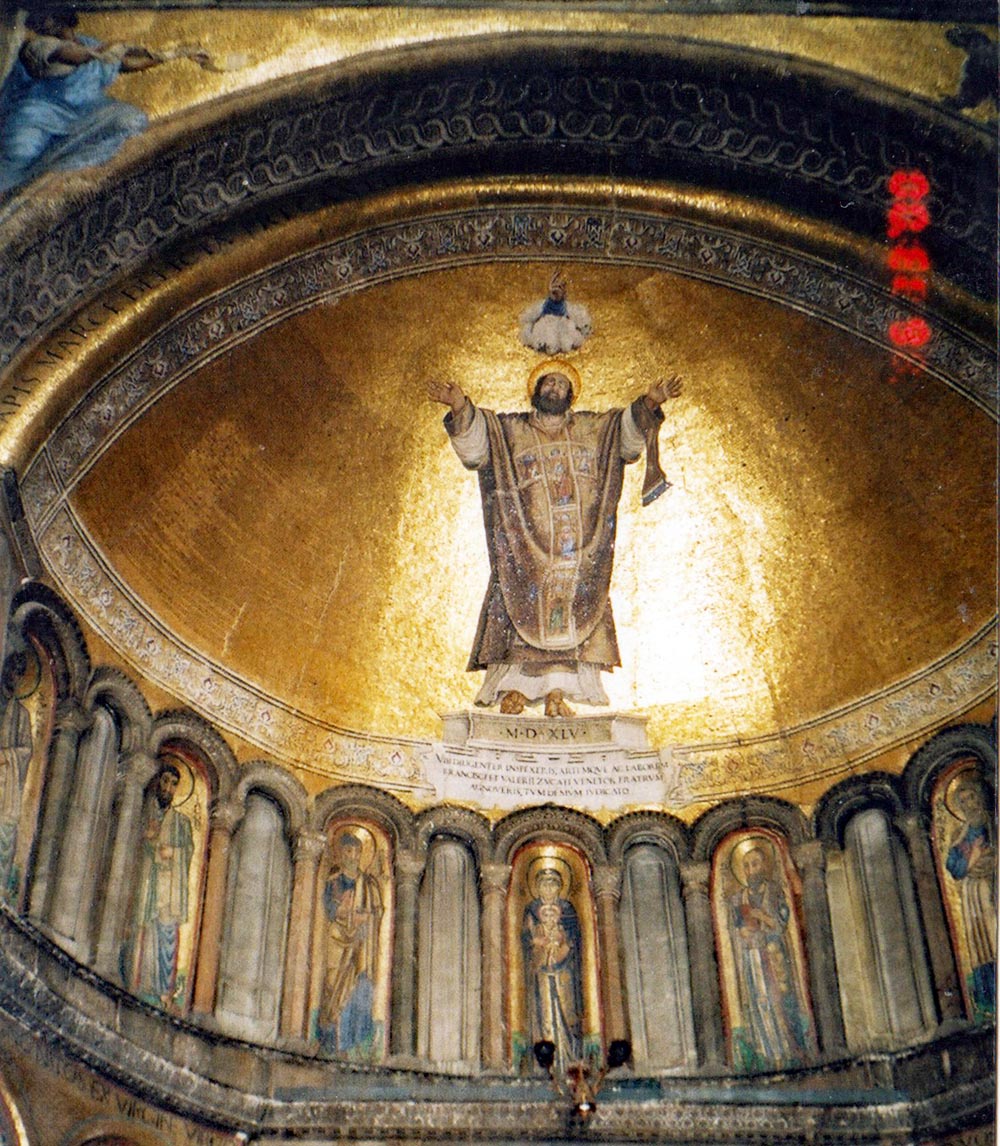
- Image of the Lord on the dome ceiling.
- Domes of the Basilica seen from
the
Bell Tower at St. Mark's Plaza.
- Crowd in front of the Basilica.
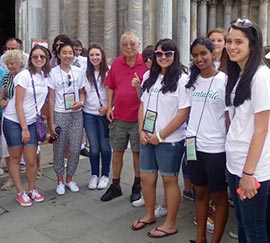
I was very happy to meet this group of high school
students from California, USA (2014).
- Clock Tower front-north of Basilica.
- Doge's Palace south of the Basilica, seen from the harbor. This Islamic-style building was once used as the king's residence palace, when Venice was an independent country. Click here for the history of this palace.
- People at the St. Mark's Plaza, viewed from the
entrance of the Basilica.
- The Plaza seen from the top of the Bell Tower. What are those small dots?
- Two senior citizens
surrounded by the pigeons.
- The Venice Columns seen from the Plaza. The Bell Tower of the San Georgio Maggiore Island is seen. At the top of the eastern column is the Venice Lion, and stutue of St. Theodore is at the top of the western column.
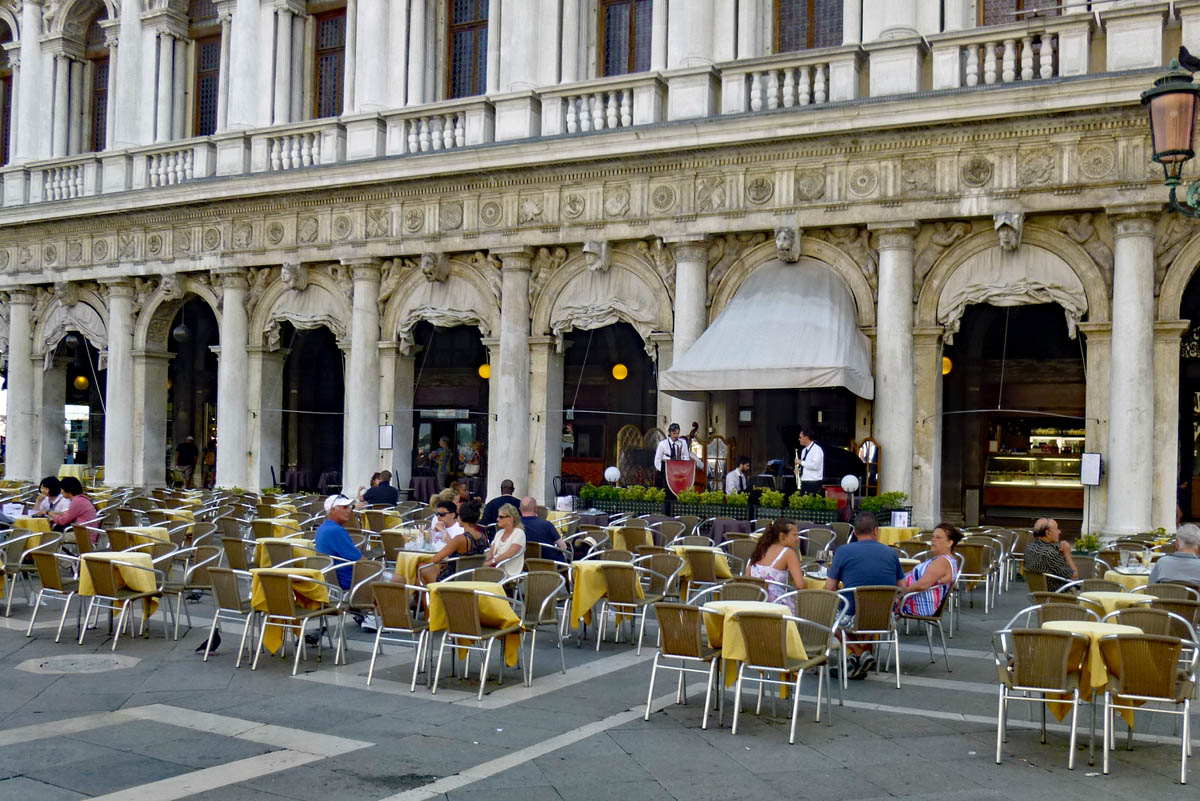
- One of the dining areas getting ready for
for the evening hours.
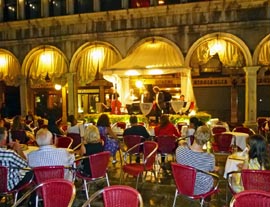
- Diners during the evening hours, while enjoyng music.
- More effective way to enjoy music.
- Visitors watching a talent show.
-
Russians dance at the Plaza. The Russian music is provided by an
Italian band.
- Click here for the dance performed by a professional group at the front plaza of Moscow State University, overlooking the city of Moscow. This high ground is called Sparrow Hill. During the communist era, this place was called "Leninsky Gory." Anoter video.
- The same dance performed by Mexicans.
- Click here for more Russian folk songs and folk dances.

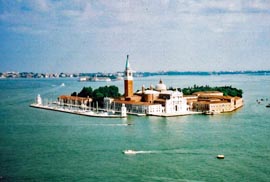
- The Campanile (Bell Tower) at St. Mark's Plaza.
- The Tower seen from the Plaza.
-
The Tower with the Basilica
seen from the Grand Canal .
- Entrance to the Bell Tower.
- Domes of the St. Mark's Basilica seen from the top of the Tower.
- People and pigeons at the Plaza seen from the Tower.
- San Giorgio Maggiore Island seen from the Bell Tower at St. Mark's Square. The same photo of professional quality from Wikipedia.
- Horizontal view of this island. Photo taken at the waterfront of St. Mark's Plaza.
- The Basilica del Santa Maria della Salute seen from the Bell Tower.
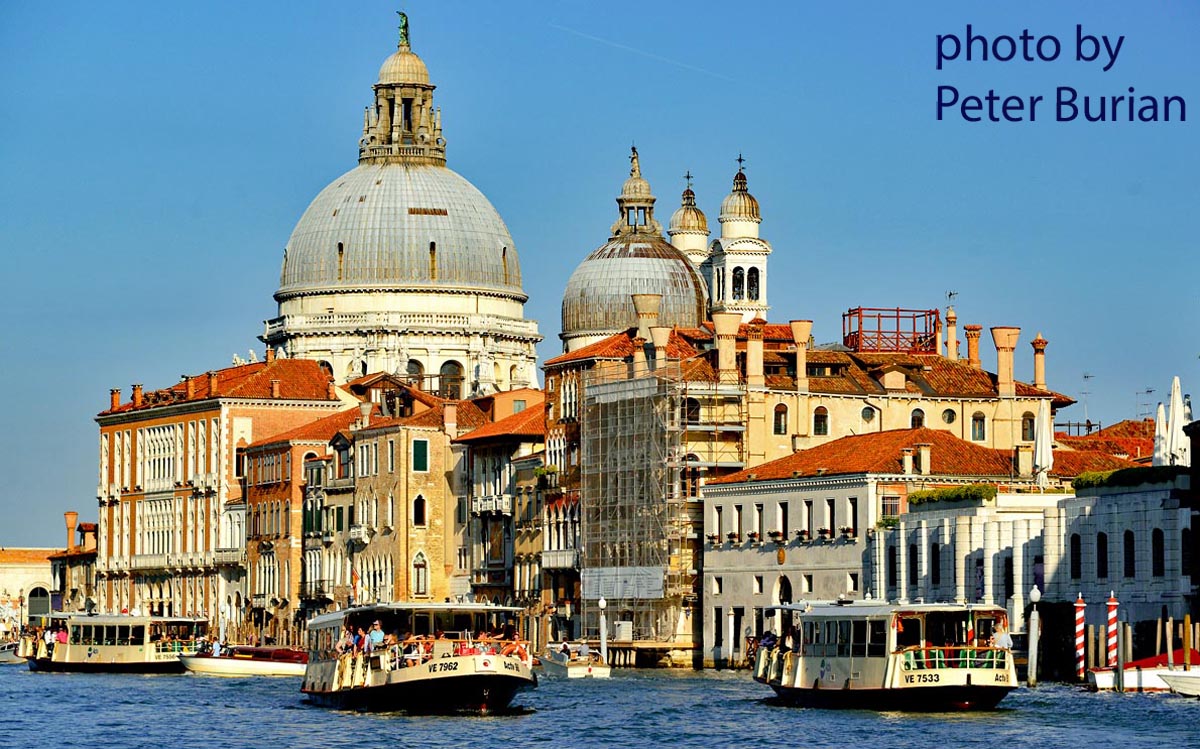
- Horizontal view of this Basilica and its surroundings, seen from the entrance to the Grand Canal.
- Front view of this Basilica from the Grand Canal.
- Islamic Influence. A building
next to St. Mark's Cathedral. Venice was developed as a trading
port with the Islamic world in the medieval age. This building
was originally built for the king of Venice.
- Islamic-style entrance to St. Mark's basilica.
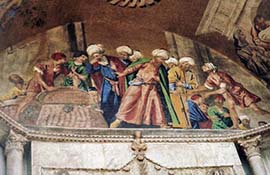
- Fresco of Islamic Traders above this Islamic entrance.
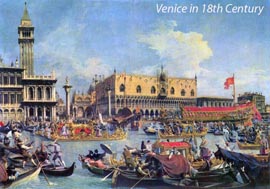
- Venice used to be a busy trading harbor.
Trading with the Islamic world. This is one of the paintings of St. Mark's
Square of the 18th Century.
- One of the Islam-style buildings seen from the Grand Canal.
- Another building with beautiful Islaminc windows.
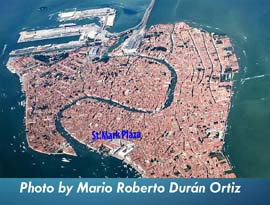
- Venice is an island
connected to the mainland by a long bridge.
This island is diveded into two by the
Grand Canal.
At the northern entrance
of the Canal is a modern harbor, and the southern
entrace is the old harbor at St. Mark's Plaza as shown
on this map.
- As the map shows, the Grand canal serves as the main street of Venice.
- This map shows a modern harbor at the northern entrance of this
Canal. There
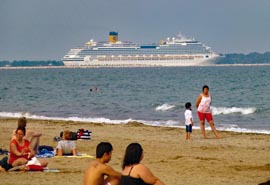
are giant cruise ships, which also serve as oceanliners.
Canal. Here is another photo.
This is a moving oceanliner
seen from the Lido Island, outside the Venice Lagoon.
The southern entrance of the Canal is in front of St. Mark's Plaza. St. Mark's Plaza seen from the southern entrance.
- The Basilica and Bell Tower seen
from the Canal.
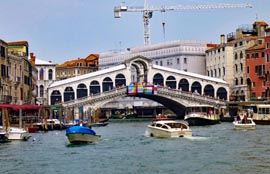
- Rialto Bridge. Maximum engineering application of the Romanesque concept (vector division of forces). Close-up view of the Bridge. What is going on at the top of the bridge? Rialto Bridge and the gondolas. This bridge has a rich history.
- Another busy bridge, called
Ponte dell'Academia.
- A peaceful waterway in the morning.
- Water buses and the waterbus station. Bus station in modern style.
- Motor boats. Gondolas are not fast enough, but there must be a speed limit on those speed boats.
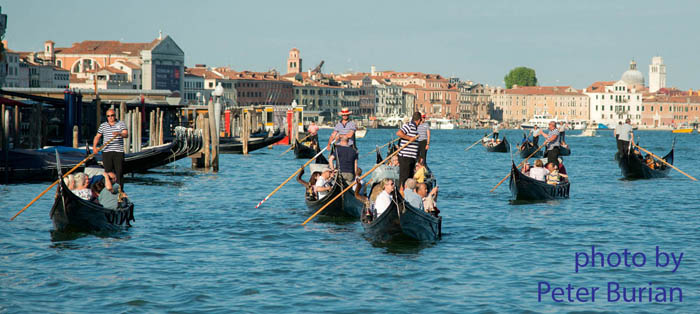
- Gondolas on the Canal.
- Idle Gondolas near the Rialto Bridge.
- Not enough gondolas at some places.
Using computers, Venice can improve the system of gondola distributions.
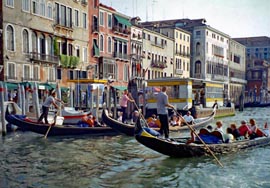
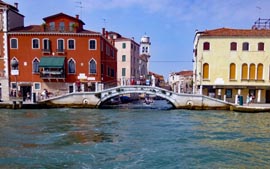
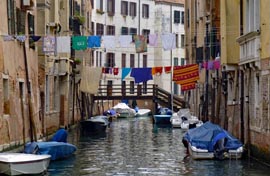
- Gondolas and Canal-side Shops.
Venice is meaningless without gondolas.
- Canal-side restaurant. There are many places like this.
- Buildings with Islamic windows, very popular style in Venice.
- Catholic Church built upon an
ancient Roman structure.
- Entrance from the Grand Canal to one
of narrow canals. There are many narrow canals in Venice serving many
useful purposes.
- Here is a bridge
connecting two buildings across a narrow canal (photo taken in 2000).
Here is The same bridge in 2014.
There are many narrow canals serving different purposes.
- One of the narrow canals serving as package delivery service.
- Another
creative use of the canal in the residential area. Instead of
private automobiles, every household owns a private boat.
- Canals serving as boundaries between the districts. The Jewish Ghetto was separated by canals from the rest of Venice.
- Bridge leading to St. Mark's Plaza from the hotel district.
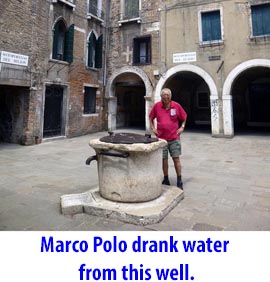
- Here is a bridge
connecting two buildings across a narrow canal (photo taken in 2000).
Here is The same bridge in 2014.
There are many narrow canals serving different purposes.
- Marco Polo
travelled around the world, but he spent his final years in Venice.
- He lived in this house, which now serves as museum.
- His house was on a canal side.
When I was there (2014), I noticed Lithuanian tourists passing by.
Lithuania is one of the major amber producing countries in the world,
and amber is called "Gintara" there. They became very happy when I
shouted "Gintara."
- Marco Polo used to drink water from this well.
- He was buried in the San Lorenzo Church of Venice.
- Marco Polo gift shop is nearby.
- The Venice Opera Theater is not far from the Marco Polo place. This is main lobby of the theater.
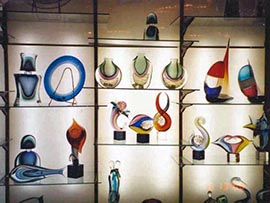
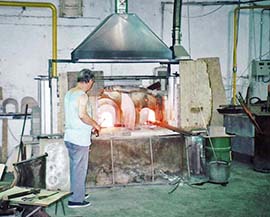
- Murano Island.
Venice's Murano developed glass industry more than one thousand
years ago. The glass products were major export items to the
Islamic world. Galileo's telescope lenses were produced in this
Island. Even these days, Murano crystals are top-class
items throughout the world.
- This map tells where this island is.
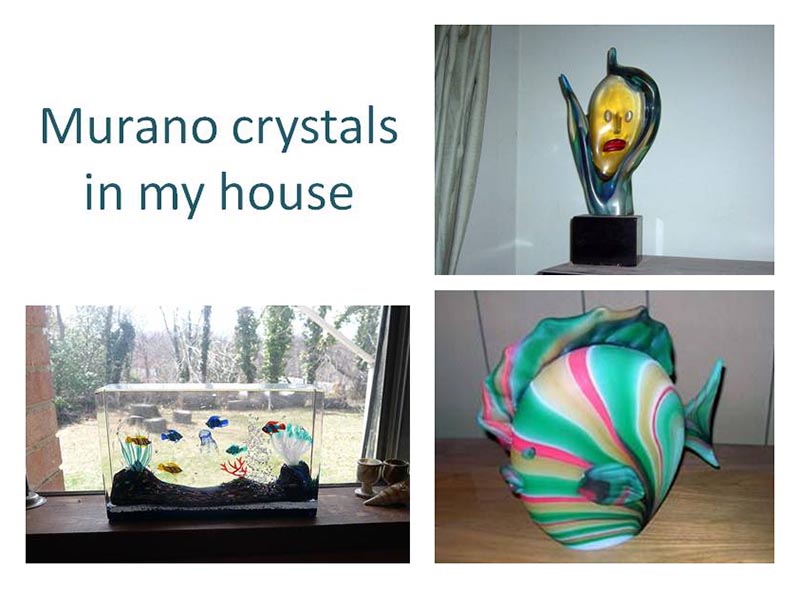
- I would like to brag about some Murano items I bought when I was there in 2000.
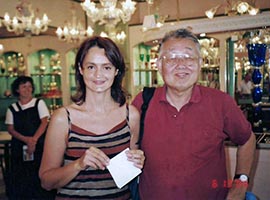
- I purchased these items from Murano's Signoretti Furnace and Store. At this store, the salesman led me to spend more than $4,000, while I was not planning to buy anything when I went to the store. A very skilful merchant of Venice indeed!
- looks like this from the ferry boat.
- They prepare glasses in this way, and make the final product in this way.
- Marco Polo Furnace is one of the many glass factories.
- This Italian lady was very happy to process my credit card (2000). I was at her glass store, and spent US$4,300 for these items, even though I was not planning to buy anything there when I went in. She now runs Murano's most prestigious glass store called Signoretti. When I was there in 2000, her father was running the establishment, and she was in charge of accepting money from the customers.
- Tyson's Galleria is a combination of an art a gallery and an expensive shopping center, near Washington, DC (USA). There are many Murano items on display. Price range: $5,000 -- $50,000.
- There are many interesting people
in Venice. It is not easy to meet Italians there. Among the many
tourists, more than one half of them came from the United States.
- American high-school students from California (2014). This photo was taken in front of San Marco's Cathedral. American students from Villanova University in Pennsylvania (2000). They seem to be coming from the wedding party of their friend.
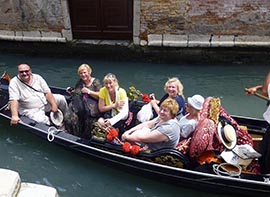
- Tourists from Lithuania, on the canal next to the Marco Polo house (2014). I asked them where they came from. They said Lithuania. I then shouted "Gintara," which means amber to them. Lithuania is the world's No. 1 amber-producing country and they are very proud of it. Gintara is also a common name for girls in Lithuania.
- Two Korean ladies at one of the crystal stores in Murano Island (2014).
- Two tall Russian ladies I met at
a narrow street (2014). I can open up the hears of Russian ladies by
reproducing the tunes of the Russian march entitled
Proschani Slavianki. My high school
band in Korea used to play this march.
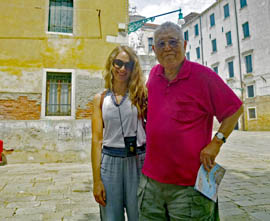
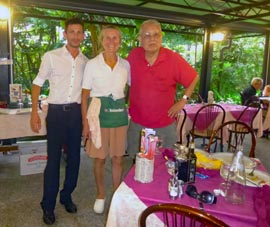
- I met this lady from Croatia while waiting for a ferry to the Murano Island. She became very happy when I mentioned Nikola Tesla who was born in Croatia. She sounded very smart. How do I know she is smart. The reason is very simple. I am a professor and taught many smart girls. Those smart ladies also know I am smart.
- Here is another photo at a different location. She came from Croatia with her friends.
- Malaysian students studying in London.
I met them not near the Marco Polo house (2014). I become very happy whenever
I meet students.
- Two service persons at a
restaurant in the Lido island (2014). They are Italians born in Venice.
Not many Italians are in this service industry these days. When I went to Venice in 1983, all service people were Italians, while all tourists are from different countries.
- Things are different these days. Most of them are from Eastern European
countries. They are highly educated, and they can talk about the world.
I enjoy talking about their countries.
Let me introduce to you a young lady from Ukraine. Her hair style was like that of Yulia Tymoshenko who once served her country as the prime minster. She used have her own hairstyle. I was looking for Ukrainian girls with her hairstyle, and I found one. When she was going home after her work, she looked like this.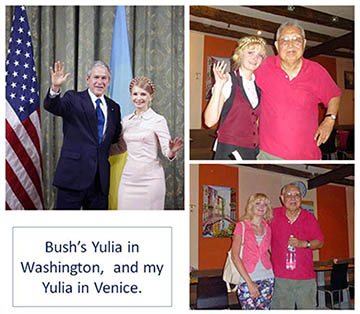
- George Bush had a photo with Yulia Tymoshenko when she visited the White House while Bush was the president. You are invited to compare Bush's Tymoshenko with mine.
- Jewish Ghetto.
Jews in Venice played a very important role in history. They invented
financial engineering. Because they were disliked by the Catholic Church,
they had to live in a restricted area in Venice. This confined area was
called the Ghetto.
These days, the word Ghetto is used for the area for the poor. However, the Venetian Jews lived well in their Ghetto because they had money. Since they were separated from the Christian world, they developed their own culture within their Ghetto. These days, this Ghetto is an open area. In June of 2014, I went there to learn how the Jewish community was created in Venice.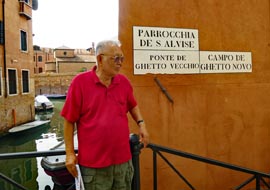
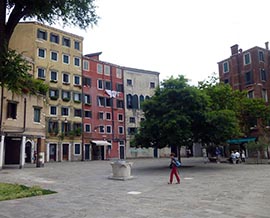
Before addressing the serious questions, let us look at some photos.
- Apparently there were two Jewish Ghettos. I am standing at a bridge connecting the Old Ghetto to the New.
- This bridge serves as the entrance the New Ghetto from the outside world. It is very easy to define boundaries in Venice. Use canals.
- There is a wide open plaza between
these two brides. This area now is surrounded by Jewish shops, museums,
restaurants, as well as an information office.
- In addition, there was military post with two Italian armed soldiers at the corner of this plaza. I asked one of them why they are there. He said "I don't know." This was a typical Italian answer.
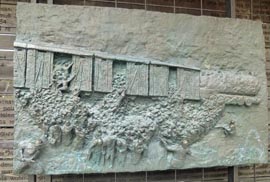
- This plaque tells how Jews were led to the concentration camp during the Nazi occupation.
- The Old Ghetto is also a neat place. This is one of the narrow streets there.
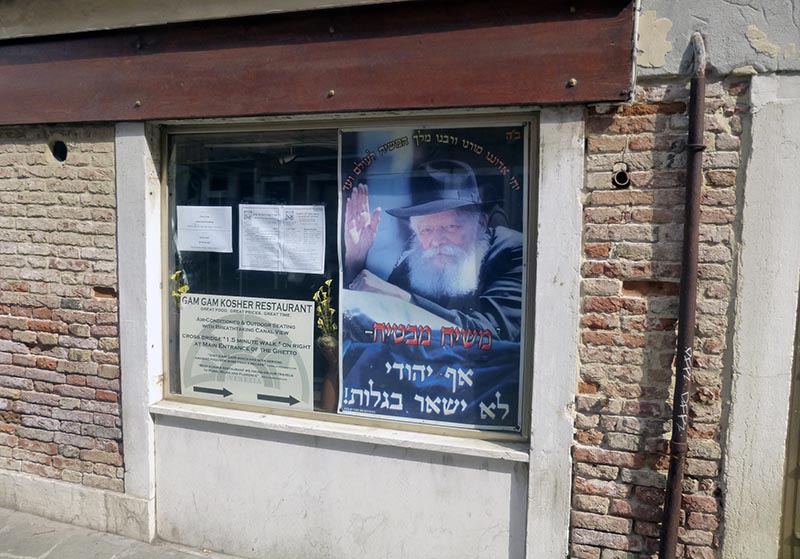
- There are many traditional Jewish restaurants in the Old Ghetto. This is one of them. Here is is another one.

- There is of course a
Jewish museum. This museum is in the Jewish house
of prayer located at the New Ghetto plaza.
- This is the entrance to the museum.
- These luxury items show Jews were very rich.
- They of course took their religion seriously.
- They also had many precious prayer
items.
- There is a map of Italy telling how Jews came to Venice from various areas.
-
After the destruction of the Temple of Jerusalem (70 AD), Jews
dispersed across the entire area of the Mediterranean and Europe.
They adopted the languages and traditions of the places where
they were living. They are known as
- Ashkenazim (from Ashkenaz, Germany) - Jews from central-eastern,
and western Europe.
- Italians - Jews from central and southern Italy
- Shepardim (Jews from Shepharad Spain) - Jews from the east (Levantini) or from Spain (Ponentini).
- the Italian and German Jews formed the German nation,
- the Levantine Jews formed the Levanine nation,
- the Spanish Jews formed the Ponentine nation.
In Venice,
The three nations of the University of Jews.
- Indeed, this map raises the following questions.
- Venice served as a port for trade with the Islamic world.
Why didn't Jews come directly from their original land,
while they went to North Africa and Spain with Moslems as
equal partners?
- Mathematics, astronomy, as well as judicial philosophy came
from the Islamic world. Did Jews play any role there?
This is an important question, since the United States became the center of physics research thanks to those Jewish physicists who migrated from Europe to America during the first half of the 20th Century.
Einstein came to U.S.A in 1933. Click here for an Einstein story. Here is another story.
- Venice served as a port for trade with the Islamic world.
Why didn't Jews come directly from their original land,
while they went to North Africa and Spain with Moslems as
equal partners?
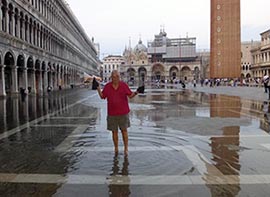
- Alas! Venice is sinking. The St. Mark's
is covered with water during the high tide.
- Gondolas are climbing to the ground.
- However, let us look at this map.
- This map tells us the water level can be controlled with a moderate
amount of engineering.
- All they need is one honest politician.
- Gondolas are climbing to the ground.

|

|

|












- copyright@2015 by Y. S. Kim, unless otherwise specified.
All photos were taken by him during the period: May 26-30 (2008).
- Click here for his home page.
- Click here for the
rest of the world.

| |
|