Korean War (1950-53)
In 1950, I was fifteen years old and was a ninth-grade student in Korea. The Korean war started on June 25, 1950 and lasted until July 27, 1953. During this period, I was adding many memory cells to my brain, and I still retain vivid memories of what happened during that period. Based on what I observed and what I experienced, I have written many articles since 1992. Yet, I still have to order them chronologically and transform into a webpage by adding relevant photos.
- Click here for my
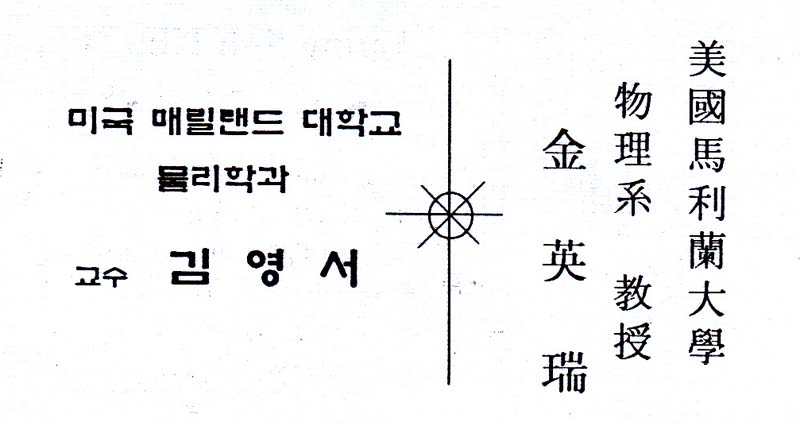
home page. My Korean name is given in the business card I prepared
when I went to China in 1995. My passport name is KIM YOUNG SUH.
My pen name is Y. S. Kim. With this name, I published my first paper in 1961. There is a more famous person in Korea who is using the same name, but newspaper reporters started calling him YS in 1978. Like to know how that happened? Click here.
|
Among the many questions about the war, I am able to address the following key issues.
|

| |

| |
| |

|
After World War II in 1945, Soviet troops came to Korea and then American troop. They occupied north of and south of the Korean peninsular respectively, resulting in two separate Korean governments. This is the beginning of the Korean War. This website consists of the pages covering the following periods.
- 1945-49
- Korea's geopolitical environment similar to that of Poland.
Click here for a story. - 1945. Division of the country along the 3th parallel.
- 1948. The UN-sponsored government in the South and Soviet-supported communist government in the North.
- Withdrawal of Soviet troops in 1948, and withdrawal of American troops in 1949.
- Construction of the North Korean People's Army in the North. Click here for a photo.
- Armed communist revolt in the South (1948) and continuing guerrilla wars.
- Korea's geopolitical environment similar to that of Poland.
-
1950
- U.S. Secretary of State Dean Achieson did not include Korea among the Far Eatern countries within the interest of the United Stares at a press conference in January of 1950.
- Second National Assembly election on May 30 (1950). Two prominent pro-American politicians lose elections. One was Chough Byung-Ok, and the other was Yoon Chi-Young. A number of neutralists gained seats in the Assembly. They were non-communist but were anti-American.
- U.S. Congress voted not to supply financial aids to (south) Korea. The United States had provided the aid of 150 million dollars to Korea in the previous year.
- Early signs of the war, and the lack of professionalism in the (south) Korean army. There were enough signals to indicate the North was preparing a tank war, but the South could not make sense out of them.
- Soviet-built T-34 tanks in the morning of June 25 (1950) and in the morning of June 29.
- American troops confront those tanks in July at Osan with toy guns. The 24th Division of the U.S. Army got destroyed by the North Korean tanks in Daejon. The first Cavalry Division replaced the 24th.
- The First Marine Division and other combat units came
from the American continent. These units were organized into
the 8th Army of the United States with Lt. Gen. Walton Walker
as the commander.
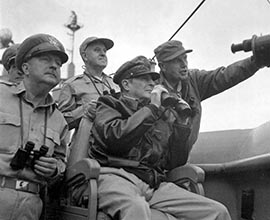
Gen. Douglas MacArthur commanding the Inchon landing (September 1950). - The 8th Army stopped North Korean advances at the Busan perimeter.
- MacArthur's Inchon landing on September 15, and the liberation of Seoul on September 28.
- March toward Pyongyang in October.
- Chinese communist army came to Korea, and pushed down American and Korean troops, occupying Seoul again.
- Lt. General Walton Walker died on Dec. 23 when his jeep crashed into a parked truck. Lt. Gen. Matthew Ridgway came to replace him as the commander of the 8th Army. He supervised the so called 1.4 retreat. Once again, Seoul fell into communists.
- 1951-52.
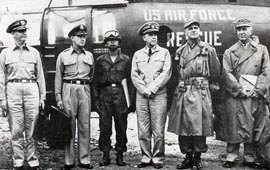
American delegates to the first cease-fire talk (top) headed by Vice Admiral C. Turner Joy. (south) Korea did not participate in the cease-fire process, but sent one liaison officer. The person in this photo is Maj. Gen. Paik Sun-Yup. The communist delagates included Gen. Nam Il, Gen. Lee Sang-Jo, and two Chinese delegates. 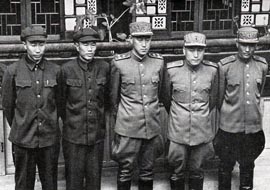
- The advancing Chinese army came down to Osan, but the re-organized Ridgway's army started to push back, recovering Seoul in March of 1951.
- MacArthur dismissed in April of 1951, replaced by Ridgway. Ridgway was replaced by James Van Fleet as the commander the 8th Army.
- Ridgway never trusted the Korean army, refused to aupply U.S.-made arms. Dr. Rhee gave a kihap to Ridgway.
- Van Fleet started strengthening the Korean).
- A cease-fire talk proposed by the Soviet Ambassador to the United Nations. First meetings of the cease-fire talk took place in Kaesong, but it was suspended due to reckless gun shots to American delegates by North Korean troops. The second phase of the talk took place at the battle-line village of Panmunjom.
- While talks went on the battle line stayed along the present cease-fire line, even though there were a number of bitter fights in the central mountainous areas.
- There was a presidential election in the United States in 1952, and Dwight Eisenhower won. During the election campaign, he promised to go to Korea and stop the war.
- 1953-54
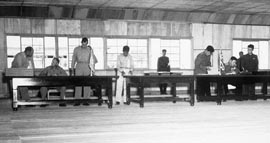
On July 27, 1953, the cease-fire document was signed by Lt. Gen. William Harrison of the U.S. Army and Gen. Nam Il of the North Korean People's Army. Korea (south) did not participate in the cease-fire negotiations. - (South) Korean government did not participate in any of the cease-fire talks.
During the talks, Americans were the winners on the major issues.
- The first issue how to draw the borderline. Americans insisted on the existing battle line, while the communists wanted have the 38th parallel. Americans won.
- The second issue was on the prisoners of war. The communists insisted on exchanging all prisoners according to the Geneva Convention, while Americans wanted to let anti-communist POWs to stay in the South. This was the most sticky issue, but Americans won.
- Americans insisted that no airfieds be constructed on either side, while the communists were against. Americans made a concession on this issue.
- The cease-fire agreement was signed on July 27, 1953.
- To North Koreans, the cease-fire was a brilliand victory. To Americans, it was an honorable end of the war. To (south) Koreans, it was a national day of humiliation.
- How about the NLL? Click here.

Dr. Rhee thanking Harry Truman (president of the U.S. 1945-53) for his help in establishing the UN-sponsored government in Korea, and also making a courageous decision to send American troops to Korea in 1950. Rhee went to Truman's house in Independence, Missouri during his visit to the United States in 1954. - The Panmunjom cease-fire agreement ended up with Korea's mutual defense treaty with the United States. People say
this and that about Dr. Rhee Seung-man, who was the founding president
of Korea. Among the many accomplishments he made, this defense
treaty was his most brilliant accomplishment. Thanks to this treaty,
Korea enjoyed 60 years of peace. During this period, Koreans were
able to elevate their country to one of the most admired countries
in the world.
- In 1954, Dr. Rhee visited the United States to work out the details of the defense treaty, and to discuss the re-construction of Korea's economy. While noting the progress Japan was making in their post-war reconstruction, the the Eisenhower administration originally wanted to let Japanese to do the job for Korea. Rhee was thoroughly against this idea, and asked Americans to educate Korean students in the United States so that Koreans could manage their own economy. Rhee was the winner during his 1954 negotiation with Americans, and later turned out to be the greatest winner in Korean history.
- (South) Korean government did not participate in any of the cease-fire talks.
During the talks, Americans were the winners on the major issues.



copyright@2013 by Y. S. Kim.
Unless otherwise specified, all photos are from the public domain, the Wikipedia fair-use domain, the North Korean propaganda literature, or from my personal collection.
Here is my home page.