Final Phase of the Korean War
- The Panmunjom cease-fire agreement was signed on July 27, 1953.
North Koreans celebrate the 27th day of July every year as the victory day.
However, they were not the real winners. The winners are the American
negotiators against their communist counterparts.
- The other important winner was Dr. Syngman Rhee, the president of (south)
Korea, against the Eisenhower administration of the United States.
Thanks to those winners, (south) Korea now is one of the most prosperous countries in the world, and is the most important ally of the United States in the Pacific area. Please read the following articles carefully.
Rhee releases Prisoners of War.
written (2005.4.21) coverted to webpage (2013.7.21)
| |
|
-
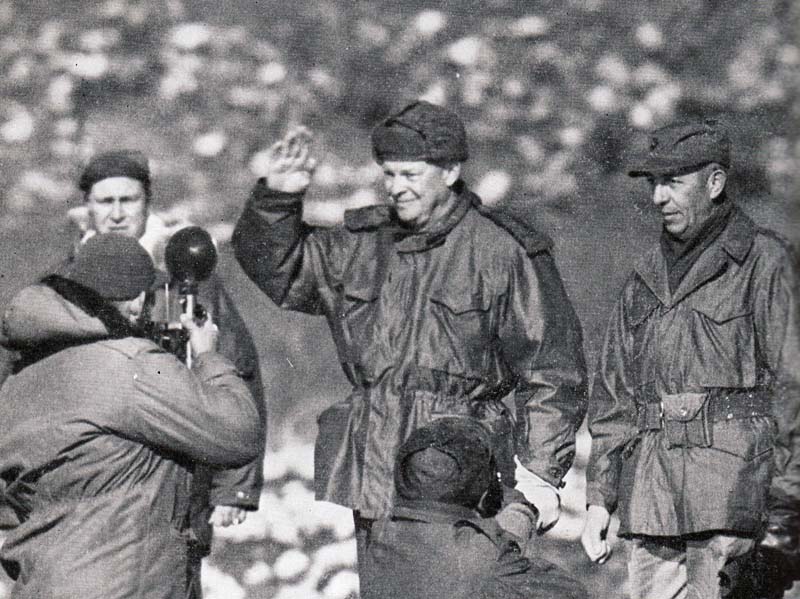
Rhee knew that he could not stop the cease-fire process. The best
he could get from Eisenhower was a mutual military treaty which
will commit the United States to the security guarantee of Korea.
His position was that American troops could go home once the
United States signed a paper guaranteeing the security of Korea.
- From the American point of view, it is unthinkable to have a formal
treaty with an inferior country like Korea. On the other hand,
Eisenhower's Republican administration had enough hard-liners against
the communist expansion in Asia. Thus, Rhee's insistence started
gaining support among those hard-line anti-communist politicians.
In order to make his point known to Americans, Rhee ordered Korean students to stage anti-cease-fire demonstrations throughout the country. This produced no effects on Americans.
Dr. Rhee liked this man. 
On June 25, 1953, at a public meeting, President Rhee introduced Gen. Paik Sun-Yup as the man who would occupy Pyongyang again. He pledged to continue fighting, while Americans were getting ready to sign the cease-fire agreement. He sounded crazy to Americans, but they could not ignore him. As for Gen. Paik, he was the commander of the First Division of the Korean army in 1950. In October of 1950, he led his Division to enter his home-town city of Pyongyang.
Click here for a very interesting story.

Korea's mutual defense treaty with the United States being signed in Seoul (September 1953). This was one of the biggest and sweetest packages Rhee obtained from the United States. - Still, the Eisenhower administration was silent about the mutual
defense treaty. As a last resort, on June 18 (five weeks before the scheduled
cease-fire day of July 27), Rhee ordered his Korean POW guards to
release all anti-communist North Korean prisoners of war.
There were approximately 120,000 POWs. About one half of them were anti-communists and were refusing to go back to the North. They had been separated from the die-hard communists and were kept in minimum security camps near Busan. It was an easy job for the Korean guards to let them go. About 28,000 POWs were released. Those POW guards relayed Rhee's message to them.
-
"I am your president. You are now free in your country."
- On June 25 of 1953 (one month before the cease fire), there was
a public meeting in Busan (capital city at that time) marking the third
anniversary of the 6.25 day. President Rhee said there that Koreans
would march northward after Americans left the country. He introduced
General Paik Sun-Yup to the crowd as the man (yi-saram) who first
reached Pyongyang (before Americans) with his Korean troops in
October of 1950.
- Since Americans and the Communists had worked out an elaborate procedure
for handling those POWs during the cease-fire talks, Rhee's action
created a great shock to them. The Communists were accusing Americans
of violating the agreement. As a consequence, the Eisenhower
administration had to send a special envoy to to Busan
(capital city of Korea at that time) to find out what Rhee really
wanted.
Rhee set out three conditions:
- to double the size of the Korean army equipped with U.S. arms,
- financial commitment to construct an industrial base,
- a written security guarantee in the form of mutual defense treaty.
Americans accepted Rhee's terms and Rhee's promise not to jeopardize the cease-fire process. The cease-fire was signed on July 27, 1953. Rhee's Korean government did not participate in the process and did not sign the cease-fire documents. In the South, the cease-fire was a national disgrace. Click here for the NLL issue.

Korean money looked like this in 1953. Korea's economy is infinitely stronger now. - to double the size of the Korean army equipped with U.S. arms,
- In 1953, the population of Busan was about one million. The
addition of 28,000 more Koreans meant a substantial population
shift. Yet, Koreans in Busan did not complain, and those "new"
citizens were accommodated comfortably in private houses. They
were given jobs. Korean girls did not mind marrying them.
We all say that Korea is much stronger country now because of its industrial production. On the other hand, I would say Korea is much weaker country. Why? There are now more than ten million people in Seoul. There is a possibility of 28,000 North Korean refugees coming to Seoul in one day. The city of Seoul has more than enough economic power to accommodate them. But, do the citizens of Seoul have enough hearts and minds to absorb them?


Cease Fire Agreement of July 27, 1953
written (2005.5.17) webapged (2013.7.16)

| |
| |
| |
- In order to break this stalemate, the Eisenhower administration
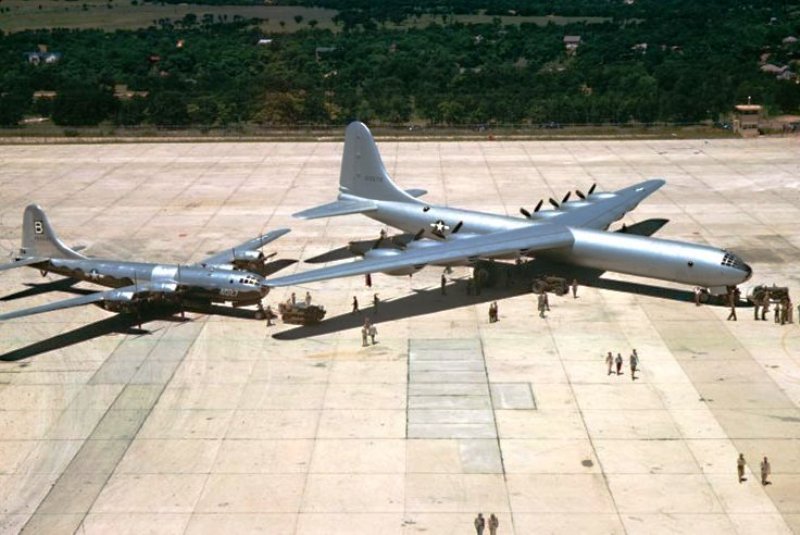
deployed B-36 bombers to Guam. This is a bailed nuclear threat to
China. The B-36 bomber was designed after World War II to carry
nuclear bombs. American used B-29 bombers to flatten Germany and
Japan during World War II, and North Korea during the Korean War. B
ut they were not designed to carry nuclear bombs. One of those B-29s
barely carried one nuclear bomb to Hiroshima in August of 1945.
Click here to see how big
the B-36 bomber is compared with the B-29.
The Communists had to give in, but insisted that a neutralist country be selected to examine the will of each individual. They agreed to invite India to send a group of delegates who would examine the true intention of each of those who did not want to go back.
- After this agreement was reached and both sides started
making preparations for the signing ceremony, President Rhee
released 2,8000 non-communist POWs
under his control, in violation of the agreement.
By doing so, Rhee showed to Americans that he was in a position to
seriously disrupt the cease-fire process Americans had worked out
with the Communist counterparts.
The Eisenhower administration had to send a special envoy to Busan (capital city of Korea at that time) to find out what Rhee really wanted. Rhee set out three conditions: (1) to double the size of the Korean army equipped with U.S. arms, (2) financial commitment to construct an industrial base, (3) a written security guarantee in the form of mutual defense treaty.
On July 27, 1953, the cease-fire document was signed by Lt. Gen. William Harrison of the U.S. Army and Gen. Nam Il of the North Korean People's Army. Korea (south) did not participate in the cease-fire process. Americans accepted Rhee's terms and Rhee's promise not to jeopardize the cease-fire process. The cease-fire was signed on July 27, 1953. Rhee's Korean government did not participate in the process and did not sign the cease-fire documents. In the South, the cease-fire was a national disgrace.

Click here to read what he said. - North Korean authorities took a different view. There was a big
victory celebration in Pyongyang on July 28, the day after the
cease-fire agreement. Kim Il-Sung made a speech thanking all
Koreans (in the North) for making great sacrifice for the "National
Liberation War" which defeated invading American imperialists.
The Pyongyang radio (my favorite station at that time) claimed the
great People's army shot down 3,700 American aircrafts.
- Click here for a photo of their
first "Victory Day" celebration in 1953. Since then, they
hold every year a giant celebration on the 27th day od July as the
"Vicotory Day."
- However, throughout the two-year-long negotiations, Americans got
most of what they wanted. The only concession they made was about
construction of new airfields. Americans initially insisted that
no new airfields be constructed. This demand was not realistic,
and was abandoned as a "major concession" to the Communists.


Origin of NLL
- As for the cease-fire line, the Communist side originally insisted
on the 38th parallel, but gave in to the American demand that the
line be the existing combat line. As for the line on the West
Sea, North Korea was aware of their fishermen. They demanded
the administrative line between Kyonggi and Hwanghae province.
Americans initially agreed, but the Underwood brothers intervened.
Horace Underwood was the first American missionary in Korea. He had his villa at the Kumipo beach near Sorae on the southern coast of Hwanghae Province. As I said many times before, I spent the first eleven years my life there. What is so special about this place? Click here for the early history of Korean Christianity.

Two Underwood brothers (middle) were the authors of the NNL as an extension of the cease-fire line to the West Sea. 
This NLL is strikingly similar to the sea route they used to sail from Seoul to Kumipo on a boat build by their father in 1938. The father was the president of Yonhee College (Yonsei Univ.). 
My family used this route to come to the South in May of 1946. This map tells where the 38th parallel is. My house and Underwood's villa were in the red-dotted area. 
From the Island of Baeknyun, you can see Sorae's mountains. The North Korean side wanted this island for their fishing purposes, but it was occupied by Korean marines at that time. The island was the South's intelligence base during the war.
- Americans, tired of negotiations, were ready to give up this
island, but two of the Underwood grandsons intervened. Horace
Underwood had a son known to Koreans as Dr. Won Han-Kyung who
devoted his entire life to Yonsei University. He had four sons.
The eldest son was Horace III (known as Won Il-Han), and the youngest
son is Richard. These two sons spoke Korean fluently and worked as
interpreters during the cease-fire negotiations.
These Underwood brothers wanted to keep the Baeknyun Island on our side. The reason was simple. They could see their house in Kumipo from this island.
- Their logic was even correct. The cease-fire line was agreed
to be the combat line. The Baeknyun Island was under our military
control. The Underwood brothers persuaded the chief American
negotiator and thus General Mark Clark (the commander of the U.N. Forces)
not to give up the island. They presented
this map. This then was the American position.
The cease-fire was signed on July 27 without an agreement on the line on the West Sea. From our point of view, there were no problems at that time. Americans maintained an absolute naval superiority over North Korea's bath-tub navy.
- Even on this issue, Americans had their way. These days, we
hear often about naval confrontations in that area, and North
Koreans say different things about the cease-fire line in the sea.
- I am giving my final exam to students today (2005.5.17), and I
will be making frequent conference trips during the summer. While
attending a conference in Sweden next month, I will be making an
excursion to a Russian city of
Kaliningrad.
This city used to be a German city called Koenigsburg before 1945. I am going there because I have a great respect for a philosopher named Immanuel Kant who spent his entire life there. After Stalin took over that place in 1945, as he did to Estonia, Latvia, and Lithuania, he kicked out all Germans and sent Russians into that city. I am curious about how effective Stalin was in his human engineering.
Stalin was interested in moving Koreans to Kazkhstan and Uzbechistan, and sending Russians into the Korean peninsula. Rhee Seungman and Kim Il-Sung, though sworn enemies, prevented this disaster.


I have many other stories to tell. I would love to talk about the following items. Please come again.
- Who is responsible for starting the Panmunjom cease-fire talk?
- When and how did the cease-fire talk begin?
Who really won in the talks.
- Many other questions. I feel I have to clarify these issues before I die, because I am the only one who could answer some of the above questions.
copyright@2013 by Y. S. Kim.
Unless otherwise specified, all photos are from the public domain, the Wikipedia fair-use domain, the North Korean propaganda literature, or from my personal collection.
Here is my home page.