Rhee gives Kihap to Ridgway.
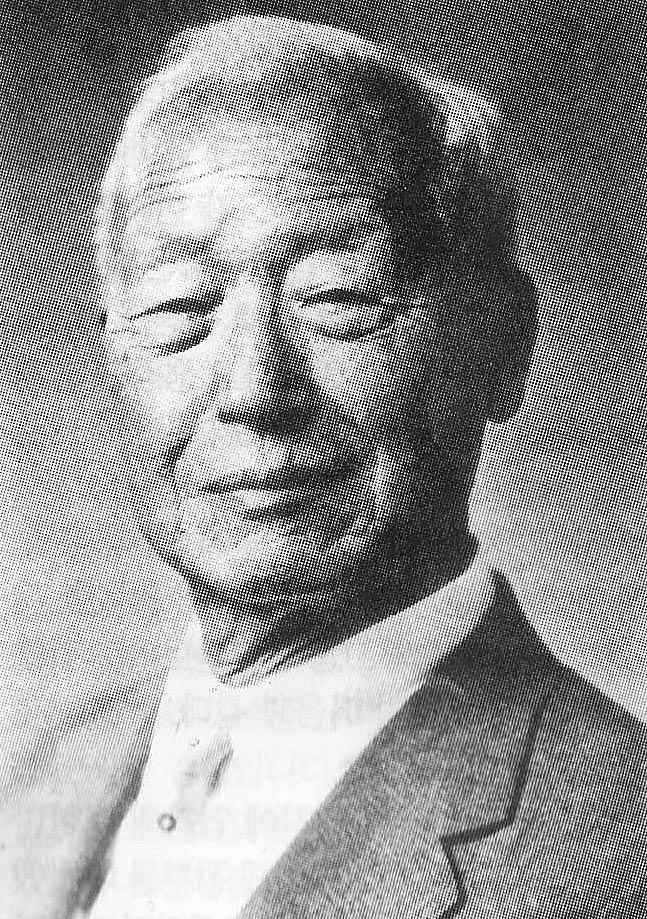
written (1995.12.2) webpaged (2013.3.7)Rhee Seung-man's mistakes in his late years are well known, and I do not intend to elaborate on them. However, I am free to comment on his mistake as a PhD scholar. If you are a PhD, you should be able to write down systematically what you have in mind. Rhee made many important decisions which still affect us. He should have written books explaining circumstances which led to his decisions. We may not agree with him on everything he said, but he could have at least made his views known to us.
Perhaps he was too old to write, but he had enough resources to let young people to write for him.
- While our young people take a negative view toward him, they say that he
was the only Korean president who could give "kihap" to Americans. Rhee
undoubtedly was proud of this aspect of his life and should have written
a book about how to deal with Americans. Since I have been playing games
with Americans in the United States, I have to be an expert on the person
known here as Syngman Rhee.
During the period 1945-53, Rhee gave kihaps to three American generals. They were John Hodge, Matthew Ridgway, and Dwight Eisenhower. Today, I will tell you the story based on Ridgway's book entitled "Korean War" in which he explains how he received kihap from a Korean who was Woodrow Wilson's student at Princeton. Here is the story.
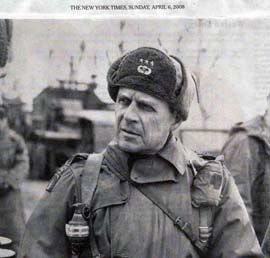
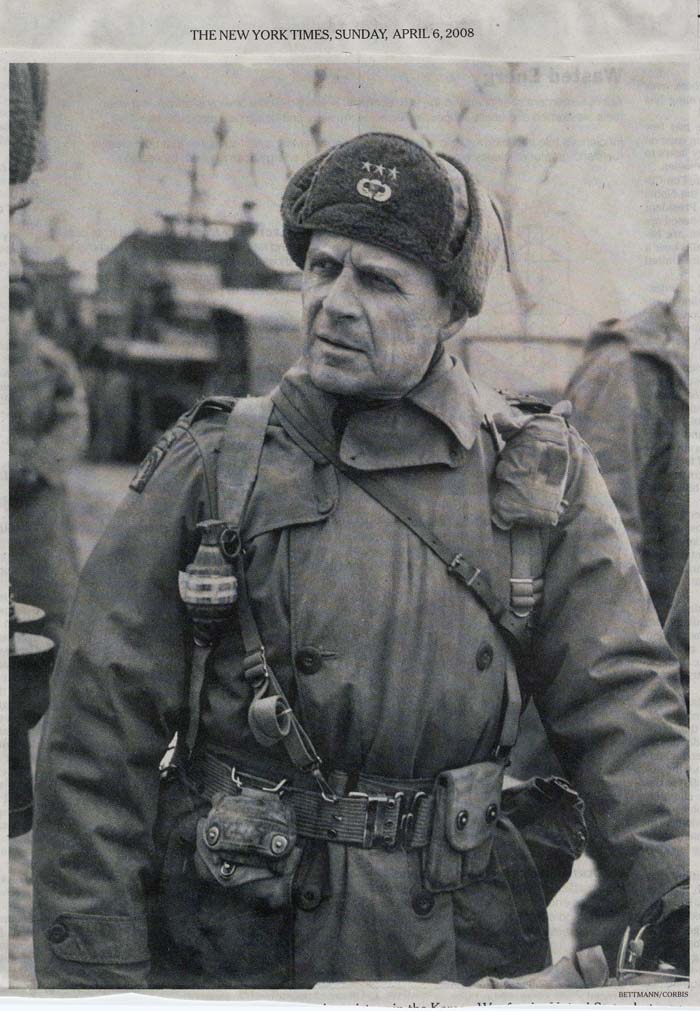
- In 1950, Lt. Gen. Ridgway was the Vice Chief of the Staff of the U.S.
Army. Lt. Gen. Walton Walker was the commander of the 8th Army fighting
in Korea. During the month of December, the 8th Army became completely
disorganized due to the unexpected Chinese offensive and Korea's cold
weather. To make things worse, Gen. Walker died on December 22 when
his jeep crashed into a truck [he was a reckless driver]. At that time,
Ridgway was having a X-mas party with his relatives in Washington.
Within an hour of Walker's death, Ridgway was ordered to interrupt his
party and fly to Korea. His first responsibility was to supervise the
tragic 1.4 retreat. His second responsibility was to reconstruct the
8th Army. He surprised every military expert by accomplishing this job
within one month, again by being harsh to West-point
graduates. He then
became promoted to a four-star general. Who do you think could give
kihap to him. If so, for what?

John C. Garand invented the M-1 rifle. He is presenting his invention to American generals (1935). - The semi-automatic M-1 rifle was invented by a French Canadian Engineer
named John C. Garand. It took him 20 years to develop the machine until
the U.S. Army adopted it as the infantry rifle in 1935. Ridgway was in
love with this engineering jewel. He often carried this full-sized rifle
(weighing 10.5 pounds) while making inspection tours. Reporters used to
enjoy taking photos of this unusual scene for a general.
On the other hand, Ridgway did not believe Koreans have enough discipline and mechanical sense to handle the M-1 rifle, and he did not supply U.S.-made arms to Korean troops. This of course caused frequent battle failures for the Korean units, and a large number of Korean casualties. Syngman Rhee developed the following strategy to deal with this crisis.
Rhee scheduled a news conference with American reporters, and advertised that he would speak personally in English. The reporters became very curious and brought the most advanced cameras. Rhee knew that he was talking directly to Americans. In English, he said
Give us arms!
Our boys will fight, and your boys can go home.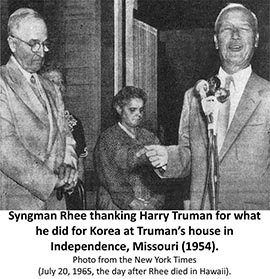

From shortwaves to internet. - Americans had been impatiently waiting for someone to say that their
boys could come home, and Rhee said this. This became a big public issue
in the U.S. Ridgway was called in and was scolded thoroughly by Harry
Truman who was the U.S. president at that time. This was how the United
States started supplying arms to Koreans as well as military training.
The training package included a West-Point style military academy. These
day, we are watching from Korea's TV dramas how the early graduates of
this military academy behaved during the period 1960-1980.
- If you wish to develop a new theory in science, the established
communication system may not cooperate with you in making your theory
known to your colleagues. The reason is very simple. The existing
system is controlled by the people with the
Herod complex.
How would you solve this problem? Build your own communication system. You have to come up with a device which your colleagues cannot think of. Syngman Rhee teaches us a lesson.
|

A Harvard Story
written (1995.11.30), coverted to webpage (2013.3.7)
- Harvard students and graduates are respected throughout the world. About
25 years ago, I read the following interesting story in the Metro section
of the Washington Post.
Two young boys got into a fist fight in front of a local store and broke the window. The shop manager called the police, and those two boys were brought to a "trial" by a local judge (presumably lowest-ranking judge). The judge did not think it was worth spending time on finding out who was at fault. Instead he asked them what they were. One of them was a Harvard student, and the other was an automechanic. The judge then gave the minimum sentence to the automechanic (let him go home), and the maximum sentence to the Harvard boy (let him spend one might at police detention room).
The judge's reasoning was that the Harvard man should get a heavier sentence because people follow the example set by the Harvard man and he should show a better example. The newspaper story said this was a great trial.
- Many of you have heard this story from me. When I ask what they think
the result of the trial was, most of them say the Harvard man should
have been freed while the other fellow should have stayed in jail. But,
when I tell the true result, they become impressed and agree with me
enthusiastically. This tells us two important stories. The first one is
that we have been brought up in a society where educated people can afford
to violate the laws while they are more strictly applicable to "lower-class"
people. The second story is that we are now ready to understand why the
educated people have a heavier responsibility to the society and work harder
than less-educated people. I am quite happy to tell you that we are ready
to accept this new spirit of law.

Ridgway (second from left) was a major general when he started organizing the American unit of paratroopers in 1942. - This "new spirit of law" is not new. Many army generals practiced this
spirit when commanding their troops. General Matthew Ridgway of the
U.S. Army was both brave and brilliant. He commanded the the U.N. troops
(U.S. and Korean troops) during the most difficult period of the Korean War
(December 1950 - April 1951). I will have an occasion to talk more about
him in connection with our problem of understanding Americans. During
World War II, Ridgway organized the U.S. paratroop forces and jumped into
a German-held territory before the Normandy landing.
You have seen German soldiers from the documentary films. Do you like to fight against them? As you know from the Korean Army, the paratroopers are the wildest men you can think of. The Korean paratroopers do not yet a combat experience, except crushing student demonstrations. What was then Ridgway's secret in organizing the U.S. paratroopers and leading to the combat? I already told you the answer. He was very kind to lowest-raking soldiers, while being extremely harsh to West-Point graduates.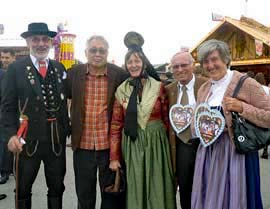
I met two elderly Germans who fought against Ridgway's troops in Normandy (1944). I met them at the Oktoberfest site in Munich (2012). - I am not known to be very kind to Korean physicists who claim to be
first-class or something like that, but I get enough support from them
to run this network system. Intellectually speaking, physicists are the
wildest human beings. At this point, I have to confess that I have been
imitating Matthew Ridgway in running this network system. There are many
who like to take over the system from me, and most of them play gamtu
games -- very stupid. Indeed, I am looking for younger people who will
run this network better than I can, but their minimum qualification is
the ability to practice the "new spirit of law" which I explained above.
|
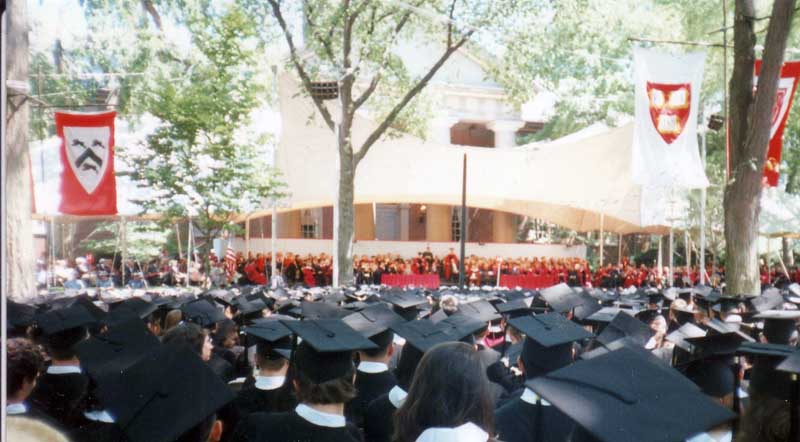
| Harvard graduation of 1994. |


I have many other stories to tell. I would love to talk about the following items. Please come again.
- Broadcast announcemen of the war at 1:11 PM on June 25.
- Explosion of the Hangang bridges on June 29.
- Busan Perimeter and bloody battles.
- The role of the 17th Regiment: from Ongjin, to Daejon, to Busan
and to Inchon.
-
Construction of the Korean Marine Corps.
- Inchon landing and liberation of Seoul.
- Who is responsible for starting the Panmunjom cease-fire talk?
- Many other questions. I feel I have to clarify these issues before I die, because I am the only one who could answer some of the above questions.
copyright@2013 by Y. S. Kim.
Unless otherwise specified, all photos are from the public domain, the Wikipedia fair-use domain, the North Korean propaganda literature, or from my personal collection.
Here is my home page.