Soldiers
When I was born in Korea, the country was under Japanese occupation, Japan was staging a war against China. Japan then attacked Pearl Harbor in 1941. Immediately after the nuclear bomb on Hiroshima, the Soviet Union declared war against Japan and rapidly moved into Manchu and northern provinces of Korea, resulting in the division of Korea along the 38th parallel. In June of 1950, the North Korean army launched a massive military attack on the South, starting the bloody Korean War which lasted until 1953. When I left Korea, the country was still in a war atmosphere.
|
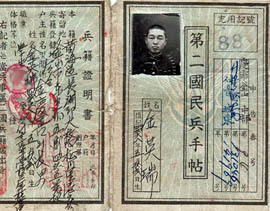
- I was not old enough to be drafted to the army during the Korean war, but
I had to carry my draft registration card during my junior and senior
high school years, until I left Korea in 1954. You may
click here for my draft registration card.
Indeed, I grew up in a dense military atmosphere. When I was a child, I used admire Japanese soldiers. They looked very glamourous to me, but I did not have a camera to have photos with them. I still remember many of Japanese military songs I used to sing. You may click her for those Japanese songs.

- General Maxwell Taylor was the commander of the U.S. Forces during the final phase of the Korean War (1950-53). While in Korea, he was quite interested in ordinary people in Korea. He visited my high school in December of 1953. I shook hands with him.
In 1955, Taylor became the Army Chief of Staff. In 1962, he became the Chairman of Joint Chiefs of Staff, and provided military advice to President Kennedy including the Cuban invasion plan of October 1962.
Taylor served as the ambassador to South Vietnam in 1964-65, and played the key role in building up the U.S. forces there. Here is the Wikipedia page about him.
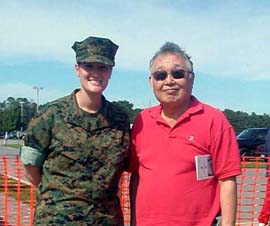
- USMC, the United States Marine Corps. There are many lady soldiers in the United States (2003). The U.S.marines are the toughest soldiers in the world, but they are also known to be warm-hearted individuals.
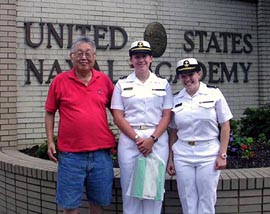
- Navy.The U.S. Naval Academy in Annapolis an college producing top-class scientists. These scientists serve in the U.S. Navy. Jimmy Carter (the president of the United States 1977-1981) studied here, and was a nuclear engineer. This is the campus of the Naval Academy.
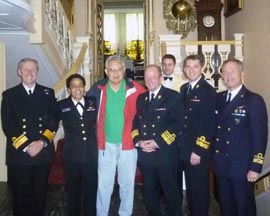
- NATO Admirals I met in Gdansk (Poland 2010). I met them at a seafood restaurant called Pod Lososiem. They were NATO admirals from Britain, Italy, Poland, France, and the United States. The lady on my right is an Annapolis graduate, and was a rear admiral of the U.S. Navy. She was from the United States, and was naturally the boss of this NATO group, even though she was the lowest-ranking admiral among this group. She became very happy when I mentioned Michelson, the first American Nobel laureate in physics. Michelson studied at the U.S. Naval Academy.
I became very happy when I read a story about her in the Washington Post. She became a four-star admiral on July 1, 2014. Her name is Michelle Howard, and here is a Wikipedia page about her.
- General Maxwell Taylor was the commander of the U.S. Forces during the final phase of the Korean War (1950-53). While in Korea, he was quite interested in ordinary people in Korea. He visited my high school in December of 1953. I shook hands with him.


Russian Soldiers
- I was in the North when Japanese left Korea in 1945, and witnessed Soviet
troops moving in. Naturally, I was interested in them, but those Soviet troops
had problems with Koreans. They were were Stalingrad combat veterans, and their
mission was to fight against never-surrendering Japanese soldiers. They were
not diplomats, and some of them did things which were not consistent with
Korean culture and ethics.
Furthermore, they came to Korea to impose Stalin's communism on Koreans using Kim Il-Sung as their puppet. Many Koreans moved to the South, and I was one of them. I came to Seoul on May 12, 1946. I then came to the United States in 1954 after my high school graduation.
with a Soviet soldier at the
Brandenberg Gate in Berlin (2010).Yet, those troops were interested in talking with Koreans, and Koreans started learning Russian words. They called Koreans, Japanese, and Chinese "Kareisky," "Yaponsky," and "Kitaisky" respectively. They called themselved Russky, but Koreans called them Roskei. Many Koreans, including myself, still use the word "Roskei" for Russians, especially Russian soldiers. I become very happy whenever I meet Roskei soldiers.
- They introduced their songs.
- Soviet National Anthem, with Korean wording.
- Comminist Internationale, with Korean wording.
- Katusha. Russian Song popular among Russian soldiers during World War II.
- Red Army March No. 5.
- While Kim Il-Sung's son and grandson are giving trouble to everybody
including Russians, the South became a prosperous country, and opened trade
and diplomatic relation with the Soviet Union during the period 1990-92.
During the Cold War era, going to Moscow was like going to the moon. In 1990, while the country was called the Soviet Union, I was able to go to Moscow twice in August and in October. While I was there in October, Mikhail Gorbachev got his Nobel peace prize. Not all Russians were happy about his prize, because they thought Gorbachev sold their country to the West. This was Russia's internal problem. I was curious about everything about the Soviet life.
Soviet soldiers in Moscow (1990). 
- Red Square (1990). Soviet Union's Address No.1.
- St. Basil's Basilica at the Red Square. This Cathedral was built on the order of Ivan IV (Ivan the Terrible) during the period 1555-1560. He was very happy to be able to expand the Russian territory to the Volga River by conquering the city of Kazan.
- Red Square guards after their
duty at the Lenin Mausoleum.
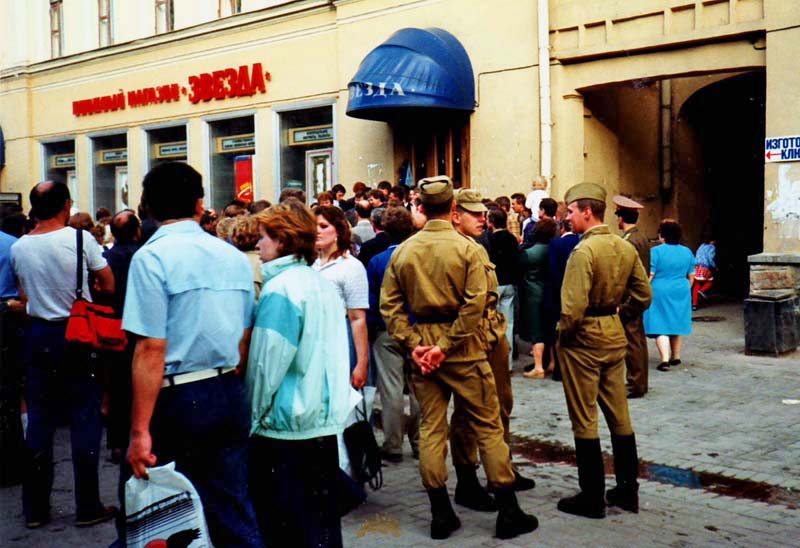
- Combat Uniforms. I noticed these Soviet soviet soldiers in their combat uniforms while walking on Moscow's Arbat street during my first visit in 1990. I was so happy to see them because their uniforms look exactly like those of the "Roskei" troops who came to Korea in 1945.
- Stalingrad Veteran remembering his comrades at the war memorial outside the Kremlin wall in Moscow. He drove one of those T-34 tanks in Stalingrad (now Volgagrad). These photos were taken in 1900.
- In 1994, I attended a conference held in Minsk, Belarus. The conference
was held at the military base which used to serve as a conference center for
the generals of the Warsaw pact nations during the cold war era. The place
was still maintained by Russian soldiers. I was very happy to meet them,
and I took many photos with them.
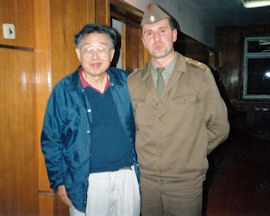
- Commander of the Base Unit. I met him at the base during the night while he was making an inspection tour. We had a friendly talks, and asked me whether I could go to his house and further talk. Then he contacted his wife, but she said it is too late. She was right. I think his rank was a major. A very nice person.
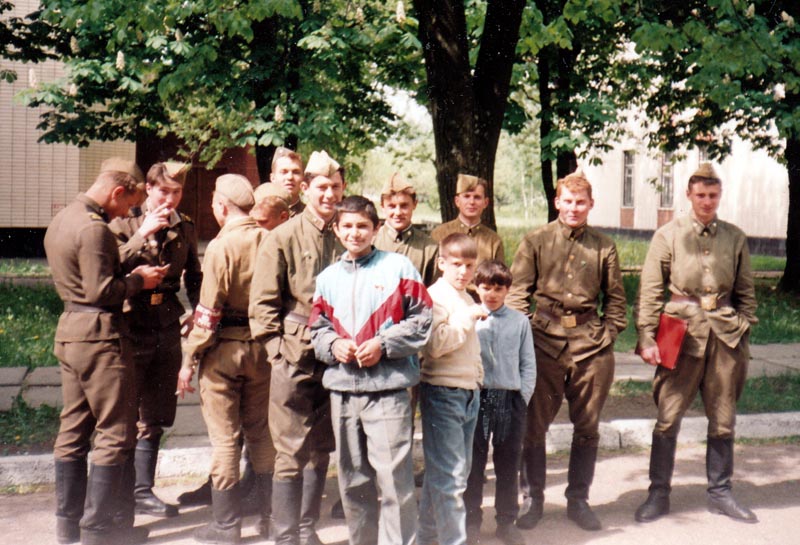
- Soldiers with children. Small boys admire soldiers. When I was a small boy, I used to like Japanese soldiers, their trucks, and their horses. When Soviet soldiers came to Korea, I was as tall as the boy in the middle in this photo. After Japanese left Korea in 1945, I admired those Soviet soldiers. They came to Korea with American-made GMC trucks. I do not have photos with them. At that time, not many Koreans had cameras.
- I was so happy to have photos with them. In 1945, it was unthinkable.
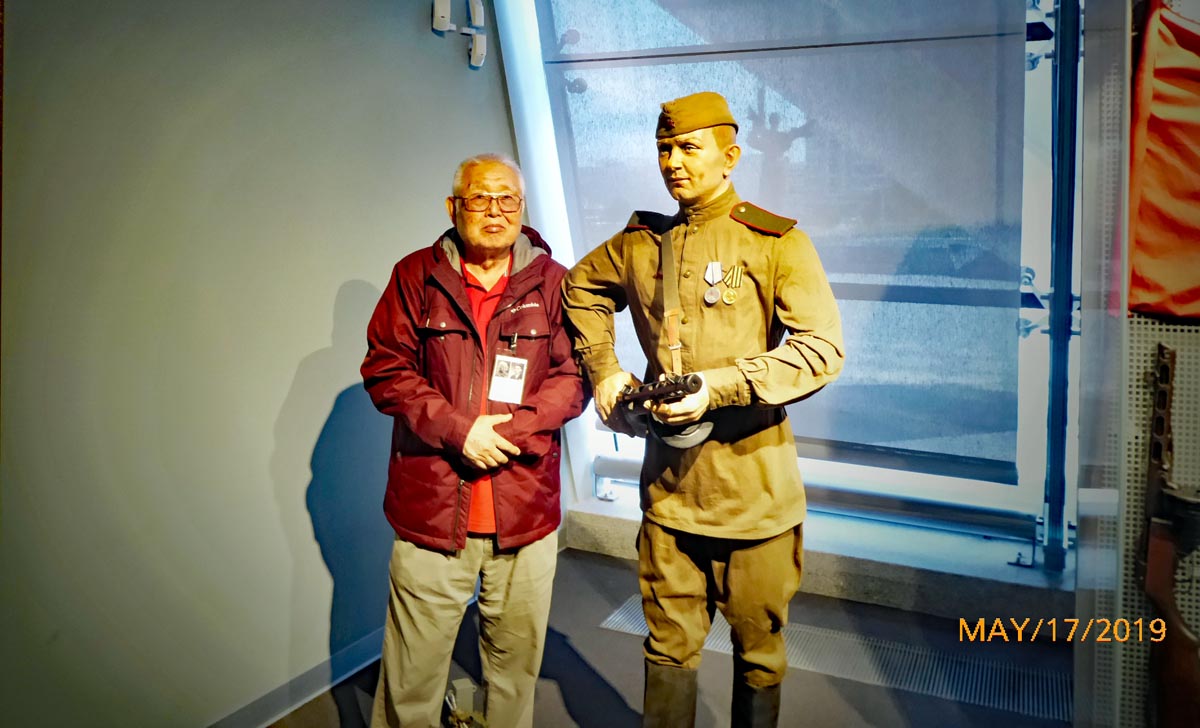
- In 2019, I was at the World War II Museum in Minsk (Belarus). I was very happy to see a model of the Soviet soldier during WWII. The soldiers looking like this came to the northern provinces of Korea in 1945.
- Click here for more Russian soldiers. I like them.



| |
|



- copyright@2016 by Y. S. Kim, unless otherwise specified.
- Click here for his home page.
- Einstein page.
- Princeton page.
- Travel page.
copyright@2014 by Y. S. Kim, unless otherwise specified. You may send your
comments to yskim@ysfine.com.
- Click here for his home page.

|
|
How is this man
entangled with Einstein? |