Russian Soldiers
- I was in the North when Japanese left Korea in 1945, and witnessed Soviet
troops moving in. Naturally, I was interested in them, but those Soviet troops
had problems with Koreans. They were were Stalingrad combat veterans, and their
mission was to fight against never-surrendering Japanese soldiers. They were
not diplomats, and some of them did things which were not consistent with
Korean culture and ethics.
Furthermore, they came to Korea to impose Stalin's communism on Koreans using Kim Il-Sung as their puppet. Many Koreans moved to the South, and I was one of them. I came to Seoul on May 12, 1946. I then came to the United States in 1954 after my high school graduation.
I had this photo at the Brandenburg Gate in Berlin (2010). I of course thought about the Soviet troops who came to Korea in 1945. I said words of greetings in Russian to him, but he could not speak Russian. He was just wearing a Soviet uniform. Yet, those troops were interested in talking with Koreans, and Koreans started learning Russian words. They called Koreans, Japanese, and Chinese "Kareisky," "Yaponsky," and "Kitaisky" respectively. They called themselved Russky, but Koreans called them Roskei. Many Koreans, including myself, still use the word "Roskei" for Russians, especially Russian soldiers. I become very happy whenever I meet Roskei soldiers.
- They introduced their songs.
- Soviet National Anthem, with Korean wording.
- Comminist Internationale, with Korean wording.
- Katusha. Russian Song popular among Russian soldiers during World War II.
- Red Army March No. 5.
- While Kim Il-Sung's son and grandson are giving trouble to everybody
including Russians, the South became a prosperous country, and opened trade
and diplomatic relation with the Soviet Union during the period 1990-92.
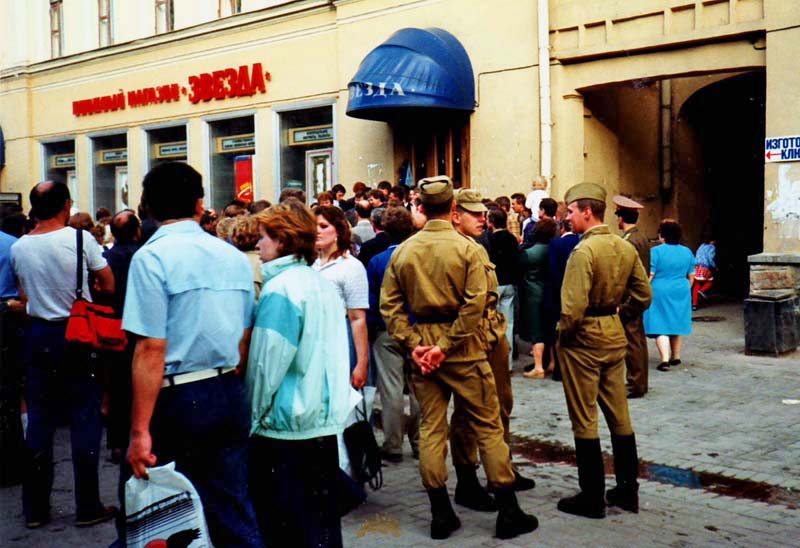
During the Cold War era, going to Moscow was like going to the moon. In 1990, while the country was called the Soviet Union, I was able to go to Moscow twice in August and in October. While I was there in October, Mikhail Gorbachev got his Nobel peace prize. Not all Russians were happy about his prize, because they thought Gorbachev sold their country to the West. This was Russia's internal problem. I was curious about everything about the Soviet life.
Soviet soldiers in Moscow (1990). 
- Red Square (1990). Soviet Union's Address No.1.
- St. Basil's Basilica at the Red Square. This Cathedral was built on the order of Ivan IV (Ivan the Terrible) during the period 1555-1560. He was very happy to be able to expand the Russian territory to the Volga River by conquering the city of Kazan.
- Red Square guards after their
duty at the Lenin Mausoleum.
- Combat Uniforms. I noticed these Soviet soviet soldiers in their combat uniforms while walking on Moscow's Arbat street during my first visit in 1990. I was so happy to see them because their uniforms look exactly like those of the "Roskei" troops who came to Korea in 1945.
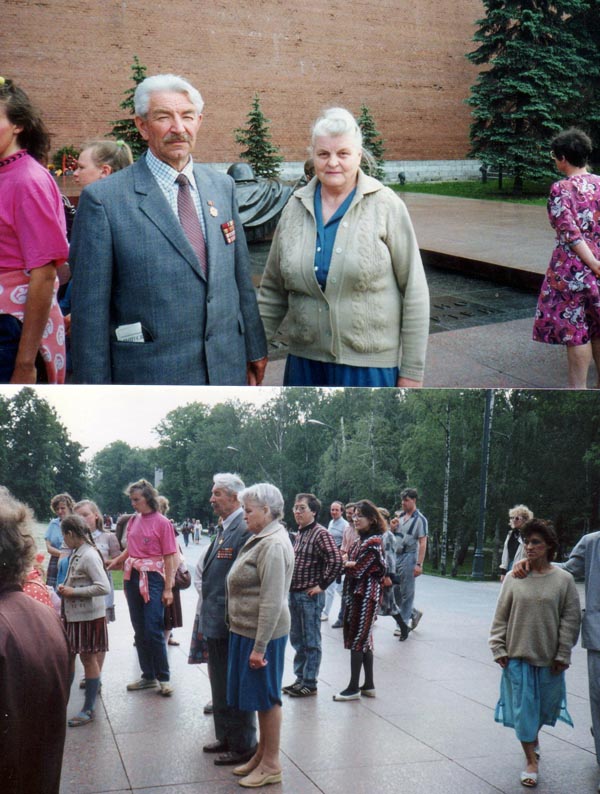
- Stalingrad Veteran remembering his comrades at the war memorial outside the Kremlin wall in Moscow. He drove one of those T-34 tanks in Stalingrad (now Volgagrad). These photos were taken in 1900.
- In 1994, I attended a conference held in Minsk, Belarus. The conference
was held at the military base which used to serve as a conference center for
the generals of the Warsaw pact nations during the cold war era. The place
was still maintained by Russian soldiers. I was very happy to meet them,
and I took many photos with them.
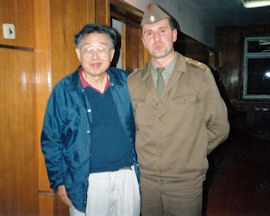
- Commander of the Base Unit. I met him at the base during the night while he was making an inspection tour. We had a friendly talks, and asked me whether I could go to his house and further talk. Then he contacted his wife, but she said it is too late. She was right. I think his rank was a major. A very nice person.
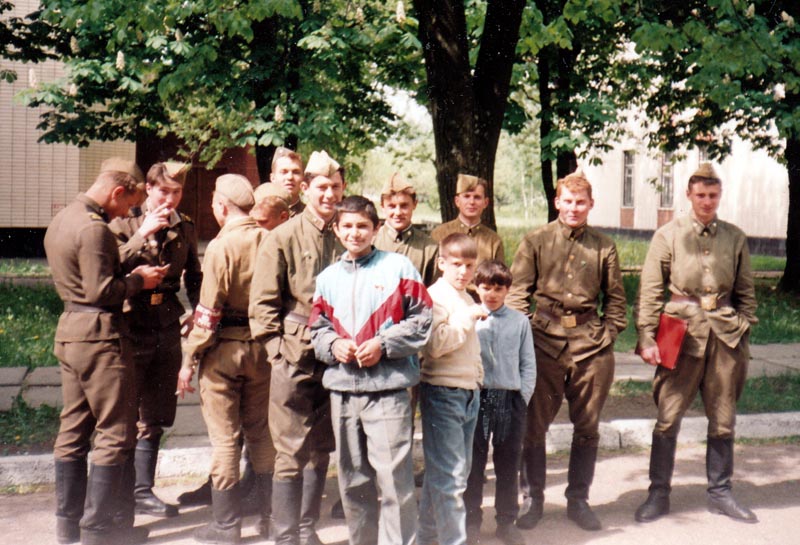
- Soldiers with children. Small boys admire soldiers. When I was a small boy, I used to like Japanese soldiers, their trucks, and their horses. When Soviet soldiers came to Korea, I was as tall as the boy in the middle in this photo. After Japanese left Korea in 1945, I admired those Soviet soldiers. They came to Korea with American-made GMC trucks. I do not have photos with them. At that time, not many Koreans had cameras.
- I was so happy to have photos with them. In 1945, it was unthinkable.
- In 2019, I went to Minsk again. I was at the World War II Museum in Minsk (Belarus). I was very happy to see a model of the Soviet soldier during WWII. The soldiers looking like this came to the northern provinces of Korea in 1945. I saw them.
- In 1999, I visited the Ukrainian city of Kharkov to attend a conference.
Kharkov used to be an important industrial-scientific base for the Soviet
Union. Lev Landau was the No. 1 Soviet physicist, Kharkov was his home
base. The FED camera (Soviet Leica) camera was developed and produced
in this city. Click here for
a story. The T-34 tank was also developed in this city.
Click here for a story of this tank.
On June 25, 1950, one hundred fifty of those Soviet-built tanks crossed the 38th parallel entered Seoul on June 29, after destroying the entire (south) Korean army. Earlier in 1943, those T-34 tanks destroyed the core of Hitler's German army in Stalingrad. The city of Kharkov is very proud of this tank, and one of them is at its central park.
- I look great with a tank, a lady,
and soldiers. I was going to have a photo in front of this tank with
two soldiers, but they invited into the picture one of the ladies passing
by. Their reasoning was that this is the way to treat their generals.
They are good soldiers.
- These Ukrainian sodiers look happier with one lady.
- Soldier with his Sister. They look OK, and I look OK too.
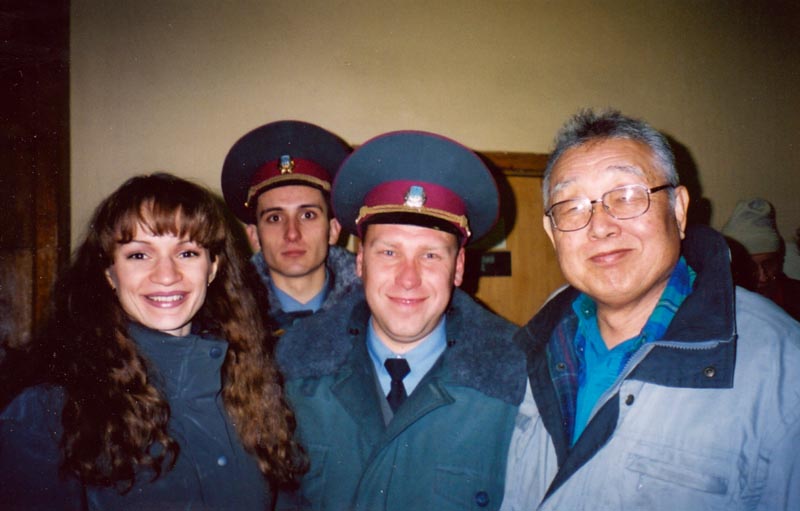
- In 2003, I was in St.
Petersburg, and had this photo with two lady security agents.

- In 2005, I went to the Russian city of Kaliningrad, a Baltic wedge between
Poland and Lithuania. This area used to be the German province of East
Prussia, and served as the craddle of modern physics. This area served
as Einstein's philosophical base,
as well as the
home base of Arnold Sommerfeld
whose doctoral students played the pivotal role in constructing quantum
mechanics.
However, after the end of World War II in 1945, this area became annexed to the Soviet province of Kaliningrad. Soviets used Kaliningrad as their naval base, and this area used to be a forbidden place until 2000. I went there to see the geographic origin of modern physics. I met many navy people on the streets.
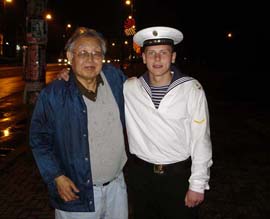
With one Russian sailor in Kaliningrad (2005).
Many of them in Istanbul (2008). They came from Kaliningrad.
- Navy City. Since
Kaliningrad was to serve as a Soviet naval base, it is not
difficult to find navy sailors and officers on the streets.
- Here is another photo.
- Russian Military Police, a strong man who does not need a pistol or carbin. They are all friendly people.
- Sailors look better with Girls. Russian soldiers are dressed like army foot soldiers during their land duties.
- In July of 2008,
I met these Russian sailors in Istanbul (Turkey). I asked them
whether they belong to their Black Sea Fleet, they said No. I
then asked whether they came from Kaliningrad.
They said Yes. I told them I was in Kaliningrad in 2005, and
promised to put their photos on this webpage. Next day, I met
more at the Topkapi Palace Museum, and I am happy to put three
more photos of those young sailors.
I hope these sailors will be happy to see their own photos from
my Kaliningrad page.
In November of 2010, I went to Kazan to attend a conference. I watch girls carefully, but I also watch very soldiers carefully. In Kazan's concert hall an elderly man wearing combat ribbons. I wondered whether he came to Korea in 1945, and asked him where he fought.

- This senior citizen fought in Kursk,
where
the bitterest tank
battle took place in 1943 during World War II. I asked him whether he
was on a T-34 tank. He said No. He was shooting his
Shpagin (short
hand-held) machine gun while running around between the tanks.
- Medal Certificates. He was so proud of his contribution to the "Great Patriotic War" (World War II against Hitler's Germany) He is so proud of the medals he earned that he is carrying their cirtificates, and he showed them to me. This Soviet-made Soviet-made gun is known as "Dabal Chong" among Koreans. You will be interested to hear that I know how to operate this machine.
- The Battle Scene like this he had gone through.
While I was coming back from Kazan in 2010, I spent three days in Moscow. There I spotted a number of young Russian soldiers in front of the Bolshoi theater. I proposed a photo with them.
- Military Secret.
Two of these young soldiers wanted to protect the military secret of their
country, and turned against the camera lens.
- Ivan the Terrible.
When I was in Moscow in 1999, I had a photo with these men dressed like the troops
during the reign of Ivan IV (Ivan the Terrible). This photo was produced at the
Kremlin ground, where Ivan IV built the Cathedral of Saint Basil.
There is a theory that this cathedral was
copied from the Kul-Sharif Mosque in Kazan which Ivan the Terrible destroyed
when he invaded Kazan.
Let us compare these two buildings.
- Too Young to be Soldiers. I met these boys at Moscow's Domodedovo Airport (2010). Apparently they were flying to a training center to have a taste of military life.
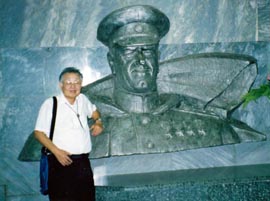
Marshall Zhukov in Kharkov (2000), and one of the T-34 tanks near Berlin's Brandenberg Gate (photo 2010). 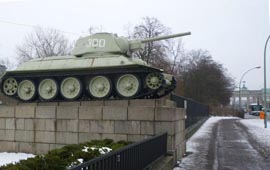
- Marshal Georgy Zhukov. I
had this photo with Zhukov's bust at one of the subway stations in Kharkov
(Ukraine 2000). Zhukov was the commander of the Soviet units sent to
Mongolia to expel the Japanese invasion in 1939. This battle against
Japanese troops is known as the
- Nomonhan incident. In this battle, the Soviet army destroyed Japanese troops with the numerical superioty in tanks. Zhukov later used this tactics to destroy Hitler's German army. He led the Soviet army to Berlin in 1945.
- T-34 tanks played the main role in World War II. They were originally developed in the Ukrainian city of Kharkov. When German troops occupied Ukraine, the Kharkov's tank factories were moved to the secluded Ural Mountain city of Chelyabinsk. There Soviet women worked day and night to mass-produce the tanks in the factory without roof. They did not have time to put the roof on their tank-producing plant.
- Marshall Zhukov consists of his brain, his dedication to his country, and the T-34 tanks developed in Kharkov. Thus, Kharkov has enough reason to be proud of Georgy Zhukov.
- After World War II, Zhukov served as the defense minister and carried out important tasks in mocernizing Soviet armed forces. He became so popular among the people that Soviet politicians became afraid of his. Nikita Khruschev, while he was the head of the Communist Party, forced him to retire.








copyright@2014 by Y. S. Kim, unless otherwise specified. You may send your comments to yskim@ysfine.com.