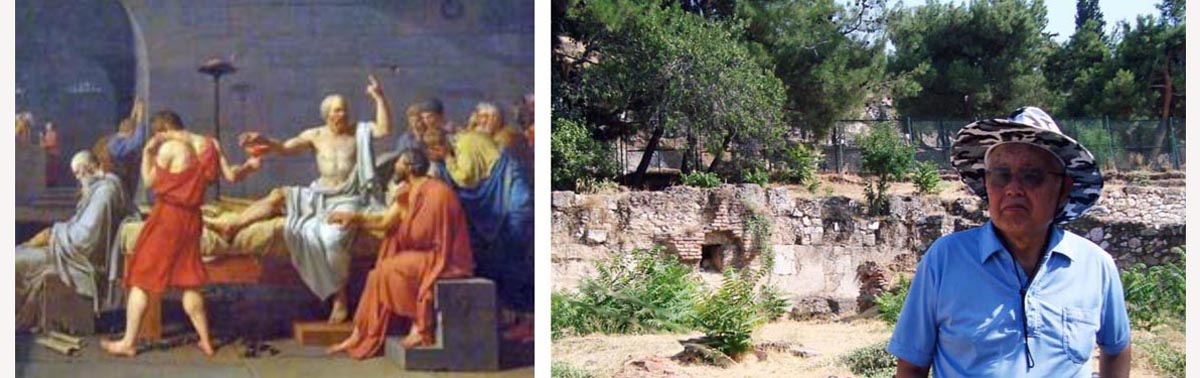
Socrates fought for and stood by what he believed in. I heard this story many times from the teachers during my high-school years in Korea (1948-54). At that time, I never expected his story had anything to do with my life.

  • In 2013, I visited the place where Socrates was forced to drink poison at the Agora (ancient market place) in Athens (Greece). The glamorous portrait of his death is from this page.

  • I went there because my academic life was in the direction similar to what Socrates went through.


I am mighty proud of
Twenty Years of Imprisonment.

  1. Was I confined in a prison room for 20 years? No.

    Twenty years of isolation resulting from
    20 years of delay in promotions in academic ranks.

    This isolation was worse than the prison confinement for a self-respecting man like myself.

  2. Do I blame anyone for this delay? Perhaps some people not worth mentioning, but the United States has been very nice to me.

In 1962, I came to the University of Maryland as an assistant professor and became a full professor in 1992, 30 years after 1962.

It normally takes 10 years for an academic person to reach the rank of full professor from the initial appointment as an assistant professor. Thus, my promotion was delayed by 20 years.

I have a very enviable student record. In 1958, I was one of the 15 students admitted to the graduate program in physics at Princeton University. What does this mean?


  • In 1962, I came to the University of Maryland as an assistant professor. This University is within the Greater Washington Area and about 18 km north of the White House. I was and still am very happy to live in this capital city of the world. Click here for photos of this area.

  • Click here for the campus photos of the University of Maryland.
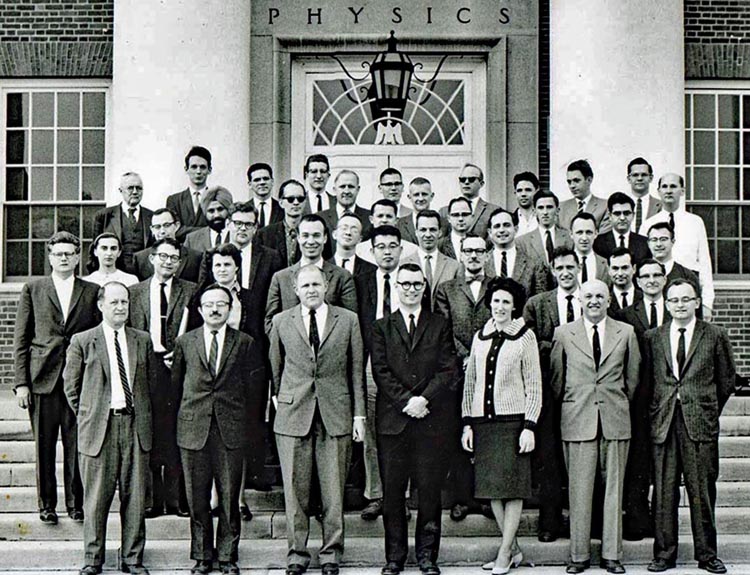
      Physics faculty photo of the University of Maryland (1963). I am the youngest person in this photo.

    However, my physics colleagues thought it was a hopeless demotion from Princeton, and they used to ignore me when they saw me at physics conferences. These days, we cannot find their names in the physics literature, or anywhere else. In other words, the United States has been very nice to me.

  • Yet, when I came to Maryland, I came to the real life in the real world.

    1. It was strange for me to get paid for my services provided to the University, while I was so used to scholarships and fellowships during my school years.

    2. I had to say YES to the Chairman of my department even though my true answer was No.

  • My departmental colleagues were highly competitive, and they were looking for my weaknesses. Why?

    1. In 1955, Einstein died in Princeton, and it was a giant story in American newspapers and magazines. Thus, everybody wanted to go to Princeton to meet Einstein even if he was in Heaven.

      I was one of the 15 students admitted to the graduate program there in 1958. However, there were thousands of excellent students who were turned down from Princeton during the period from 1955 to 1965.

    2. Thus, among the physics faculty of the University of Maryland, there were many who got rejected by Princeton. Some of them attempted to get even by voting against my promotions.

    3. I would be less than fully honest if I tell I did not feel any prejudice against my national origin. In the 1960s, Korea was regarded as a hopelessly underdeveloped country relying on American aids, and my American friends used to say directly to me "We should get out from Korea after giving the country back to Japan."

      "Give Korea back to Japan" is the worst insult Koreans can receive, but it was very routine for my American friends to tell me. They did not and still do not know the history of that part of the world before December of 1941 when Japanese planes, from their navy aircraft carriers, attacked Hawaii's Pearl Harbor. At that time, Americans could not understand how Japanese with their non-white skins could build airplanes and large ships with runways.


  • In 1965, while I was struggling as an assistant professor at the University of Maryland, Princeton found the genius of the century. His name was Roger Dashen. He received his PhD degree from Caltech in 1965, and his PhD thesis was on the calculation of the neutron-proton mass difference. While the neutrons and protons are basic ingredients of nuclei, the proton has the basic electric charge (same as that of one electron), while the neutron does not.

    The neutron is slightly heavier than the proton. Thus, it was and still is a great challenge to calculate the neutron-proton mass difference from the basic electric charge.

    Dashen's Caltech PhD thesis was on this subject, and he produced the exact value of the mass difference using "bootstrap theory," which was a number-producing tool popular among American physicists at that time.

    I became very unhappy to hear about Dashen. I was so pampered during my school years that I had and still have my Herod Complex. Anyone other than myself is genius? Not acceptable!

  • I looked at Dashen's paper claiming his result on the neutron-proton mass difference, and I found a mistake in that paper. I thus published my paper in the same journal saying that his calculation was wrong. After this, the University of Maryland was considering my promotion from the assistant to an associate professor with permanent tenure.

  • The reaction to my paper from my American colleagues was

    Dashen is a genius, but you are only a Korean.
    How can you be right? Go back to Korea!

    I was almost fired by my University. Under this environment, the only person who could save me was Sam Treiman, who was my thesis advisor when I was a graduate student at Princeton, and he was a good teacher.

    He was kind enough to ask me to come to Princeton, and I went there to explain why Dashen's paper was wrong. However, he did not have enough brain power to understand my explanations.

    He then became very angry, and told me "never come to Princeton again." I knew he had a prejudice against Asians. While I was a student there, he routinely called me "Oriental Fellow." This environment was far beyond my control.

    OK. This was the end of my connection with Treiman. On the other hand, was this the end of my Princeton connection?


From 1966 to 1986,

I had to develop a New Route to Princeton.

  • When I was a student there, I noticed Eugene Paul Wigner (Nobel 1963) was totally isolated from the rest of the physics department. My professors there routinely said "Wigner is gone."

    After being thoroughly rejected by Sam Treiman I was able to see why Wigner was so isolated from Princeton.

    Princeton people did not have enough brain power to understand Wigner's papers, because they did not have the brain power to resolve Dashen's case, known in history as Princeton's Dashen-Frautschi fiasco.

      My photo with Eugene Paul Wigner at the ground of the presidential mansion of the University of Maryland (1986).

  • I thus decided to build my new Princeton base, using the Wigner route. While nobody at Princeton was able to talk to Wigner, what special talent did I have to approach him?

    This was a big challenge to me. However, there was one method available to me. I could to tell him the story he wanted to hear. This idea came from this piece of my Korean wisdom.

  • Wigner was isolated from Princeton because nobody there could tell him the story he wanted to hear. Then, what story did he really want to hear?

    Wigner received his Nobel prize in 1963, but not for his 1939 paper on the Lorentz group which was dearest to his heart. Wigner was happy with his prize, but not 100% happy because the prize was not for his 1939 paper published in the Annals of Mathematics. Wigner regarded this paper as his greatest achievement in his scientific life.

  • Therefore, the best way to approach Wigner was to tell him that his 1939 paper alone deserved one full Nobel prize. Empty words were not enough. I had to present to him a concrete scientific reasoning. In 1986, 20 years after I was thorouhgly rejected by Treiman, I went to Princeton and presented to him this table:

    Contents of Einstein's E = mc2


    Massive/Slow between Massless/Fast
    Energy
    Momentum
    E = p2/2m Einstein's
    E=(m2 + p2)1/2
    E = cp
    Helicity
    Spin, Gauge
    S3
    S1 S2
    Wigner's
    Little Group
    Helicity
    Gauge Trans.

    This table was included in one of the papers I published with my younger colleagues in 1986, in the Journal of Mathematical Physics.

  • This table clearly defines Wigner's coordinate in Einstein's scientific genealogy. I showed this table to Wigner in 1986, twenty years after I was thoroughly rejected by Sam Treiman in 1966. Wigner became so happy that he invited me to publish joint papers on this subject.

  • During the years from 1987 to 1990, I published seven papers with Wigner extending his 1939 paper to the world of physics based on high-energy accelerators developed after 1960. Click here for the contents of those papers.

  • While I was collaborating with Wigner, I received some uncivilized reactions from those who were and still are highly respected physicists. Among many of them, I choose to mention two names.

  • Since I was once a student at Princeton, and since I published a number of papers with Eugene Wigner, I became known as Wigner's youngest student at Princeton. In this way, I established my identity in the world of physics.

    I was thus able to publish my paper in Physical Review Letters (regarded as the most prestigious journal in physics) containing this table:

    Further Contents of Einstein's E = mc2


    Massive/Slow between Massless/Fast
    Energy
    Momentum
    E = p2/2m Einstein's
    E=(m2 + p2)1/2
    E = cp
    Helicity
    Spin, Gauge
    S3
    S1 S2
    Wigner's
    Little Group
    Helicity
    Gauge Trans.
    Hadrons,
    Bound States
    Gell-Mann's
    Quark Model
    One
    Lorentz-Covariant
    Entity
    Feynman's
    Parton Picture

    The brown row on this table is an addition to the table given above, which defines Wigner's coordinate in Einstein's genealogy. The purpose of this brown row is to add my name to this genealogy.

    This brown row is based on my earlier papers on the question of whether Gell-Mann's quark model (proton at rest) and Feynman's parton picture (the same proton moving with a speed close that of light) are two different ways of looking at the same object. Click here for the explanation.

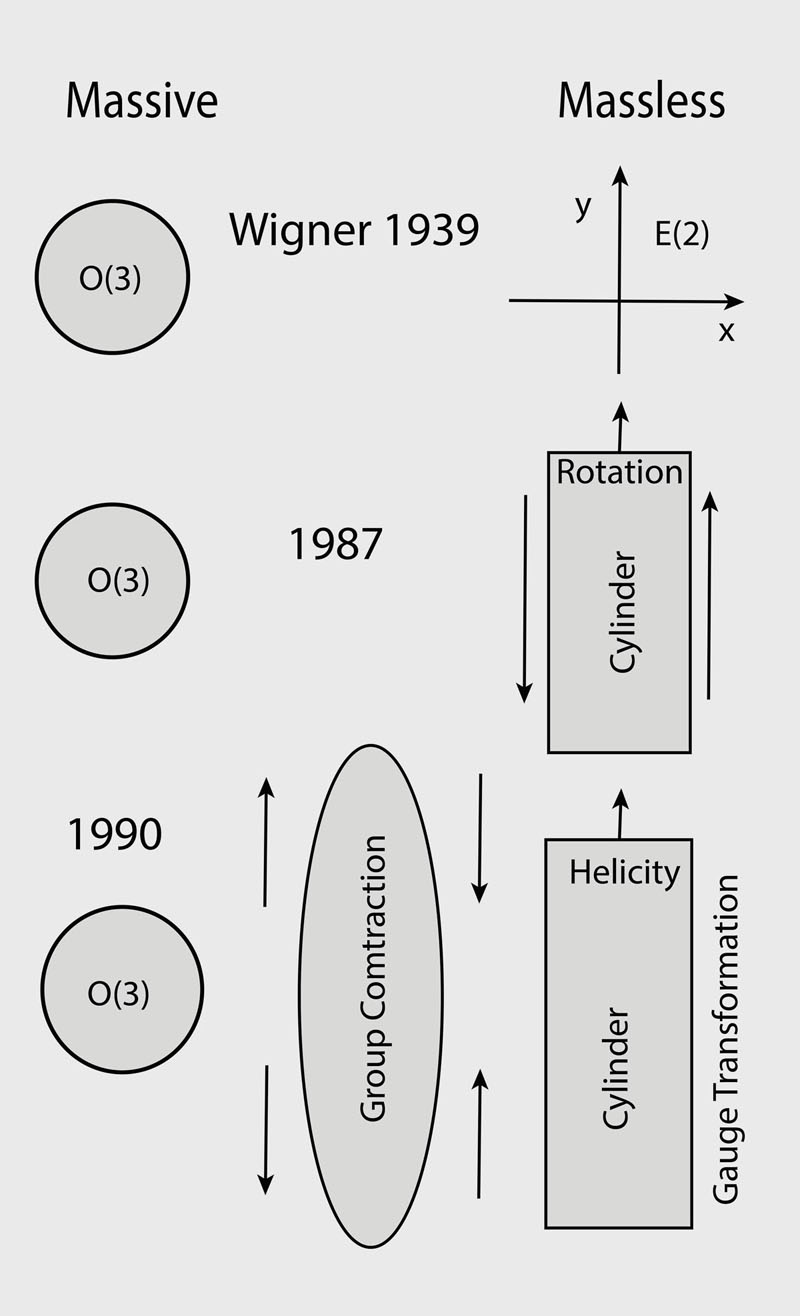
    Thus, this brown row places my name on Einstein's scientific genealogy. The table becomes translated into this figure:

  • My collaboration with Wigner made some people very unhappy.

    1. I do not think Sam Treiman was happy, because I approached Wigner without his permission. If he was unhappy, it was not my fault. He could have treated me as a civilized person when I needed his help in 1966.

    2. Arthur Wightman and Louis Michel were distinguished physicists, receiving respects from physicists around the world. Their names were mentioned in one of Wigner's books.

      They knew me well. This is the reason why they thougt I needed their clearances before approaching Wigner.

    3. Click here to see

      how uncivilized

      they became when I started publishing papers Wigner.

  • You came to this webpage to see how unhappy I became due to the prolonged delay in my promotions in the academic ranks. Sorry. This page did not meet your expectation.

    The 20-year promotion delay was the price I had to pay to be on this Great Genealogy. It was a reasonable price. Who agrees with me? Click here for the radio interviews on this issue.


  • copyright@2023 by Y. S. Kim, unless otherwise specified.

      Einstein-Hauls in Bern, Switzerland. I was there in 2014.

    1. His home page

    2. His interviews

    3. List of publications

    4. Princeton page

    5. Korean background

    6. World travel

    7. Style page

    8. Einstein Magazine

    9. Bohr and Einstein

    10. They run away from me when I brag. Click here before you away from me.