Korean War (1950-53)
- In 1950, my father was a high-ranking Korean navy officer at the ministry of defense. He was not
a military man, but was an economist. He was in charge of foods and daily needs for soldiers on the
front line. On Sunday June 4, 1950 (three weeks before the 6.25 day), he was one of the
inspection team from the Ministry of Defense to look at the situation at Dongduchun just south
of the 38th parallel.
I was 15 years old. My father invited me to go with him. The head of the inspection team was
Col. Chang Do-Yong, who became the
army chief of staff in 1961. He headed the army take-over of the government, but was soon
ousted by Park Chung Hee who ruled
the country until he was assassinated in 1979. This story is well known.
- Col. Jang was asking questions to the front-line officers, including the following
key questions.
- What is the most serious problem for them?
The front line officer said they did not have enough ammunition for their rifles. They
were equipped with American M-1 infantry
rifles. Earlier in January of 1950, the American Congress did not pass the resolution
to give military aid to Korea. At that time, Americans were thoroughly confused by the
fall of China into the communist world in 1949.
- What was going on the north side of the 38 line?
The front-line officer said they (in the north)
are building a road toward us. Col. Jang asked why? What was the purpose of the road?
The front-line officer said "I do not know sir."
The purpose of the road was for their tanks, but the tanks were far beyond the imagination
of military people in the South at that time.
At 4:00 Am, on June 25, 1950, North Korean Army started crossing 38th Parallel. The major city of
Kaesong fell within an hour. The North Korean army used their T-35 tanks on the Dongduchun front
(directly north of Seoul) and came to Uijungbu (a town between Seoul and the 38th Parallel) on the
same day.
On Monday, June 26, we thought those northern trouble makers would be pushed away, and we had a normal
school day.
- In the morning of June 27, there was an important radio announcement from the Minister of Defense
(whose name was Shin Sung-Mo), saying that the North Korean army came close to Seoul, and the
government is moving to Suwon, small city south of Seoul.
Upon hearing the news, my family moved to the house of our friend south of the Han River
(flowing from east to west. dividing the city of Seoul into north and south).
We thought the Han River would be the major defense line if the North Korean army came to Seoul.
We spent the night of June 27 at our friend's house just south of the River. Around 4:00 AM on
June 28, we heard a big noise of explosion. We thought it was a nuclear bomb, but found out
the explosion was from the destruction of the Han River bridge to prevent North Korean tanks from
coming to the South. The major portion of Seoul became under the control of the communist regime
of North Korea.
In the morning of June 28, Soviet-made T-35 tanks of North Korean army were roaming around the
city of Seoul. The Soviet T-35 tank had a brilliant history of destroying Hitler's army during
World War II. Stalin initially gave 200 of those tanks to North Korea to chase out the
American influence from Korea. Here is a photo of one of those Soviet-built tanks in Seoul:
 Click here for more tank photos.
In the morning of June 28, my family was fortunate enough to be on the south side of the Han River.
We decided to walk toward Suwon and it took us all day to walk.
- As soon as we reached Suwon, a light plane of the Korean Air Force was dropping leaflets to
the crowd of refugees on the ground of the Suwon railway station. The leaflet said that the
United States would send American ground troops to help us. We were all relieved to hear the
news, but when are they going to come? In the meantime, the name of the game was to move southward.
In the morning of June 29, we were waiting on one of the roofless cargo cars on a south-bound train
at the Suwon railroad station.
Suddenly a four-engined American airplane was flying over the railway station toward the Suwon
airport to land. We did not know who was on the plane, but we all cheered.
Alas, we heard machine gun noise, and the F-80 American jet fighters were scrambling around,
and things then became calmed down. We did not know what went on.
Later, I found out that
General Douglas MacArthur was on that four-engined American plane, and
the North Korean electronic system intercepted American communication. They knew MacArthur was
coming and sent their Soviet-built
YAK-9 fighters to shoot down Mac's plane. Mac's plane was escorted by F-80 jet fighters
of the U.S. Air Force. Perhaps, I am the only one who saw those planes from the ground and
tell this story in detail. I assembled the following photos of Mac and the planes involved.

- My family moved to the city of Daejon (south of Suwon) and waited for the army of the South
with active American help to recapture Seoul. However, things did not become in the way we
hoped. My family then moved to the naval base in Chinhae (west of Busan). Since my father was a
high-ranking officer of the Korean Navy, Chinhae's naval base provided a comfortable living
place for my family until 1951, when my father was transferred to the navy headquarters in Busan
in 1951.
We lived relatively comfortably in Busan from 1951 to 1953. My father was able to speak English,
and he had his friends among American navy officers. Sometimes, he was able to go to American
PX (department store for soldiers) with his American friends. We thus enjoyed American
stuff not readily available to Koreans.

|
My shortwave radio was Model S-38 manufactured by the
Hallicrafters Company
was very dear to me in Korea, but I could not bring it with me when I came to America
in 1954. In 1963, in USA, I bought the same model to listen to the world.
With this radio, I learned the importance of communication. While listening to the world,
I developed my strong desire to talk to the world. The internet system was created for me.
I am talking to the world by constructing webpages.
|
- My father got a short-wave radio from the American shop. I was able to tune to radio stations
in far-away places. I liked Japanese radio programs since I could understand their language.
I also picked up radio signals from Australia. Their English style was different from
the American style, perhaps closer to the British style, easier for me to understand.
I was a constant listener of the Pyongyang radio. They had very powerful shortwave transmitters
with 2.7, 4.4, 6.75 mc. I knew their communist stories were nonsense, but they used to
report exactly the corrupt practices in the (south) Korean government. I still do not know how
they got the information.
- Koreans believe very strongly in the education of their children. My high school was
one of the elite schools in Seoul. It continued its educational programs in Busan, and we
studied diligently there until we moved back to Seoul in September of 1953. You are invited
to my high school diary, given on this page.
Let us go back to the war story.

|
- Americans sent their 24th Infantry Division from Japan to Korea in July of 1950, and we expected
North Korean soldiers would run away after seeing American uniforms. Things did not work out in that
way. This Division was completely destroyed during the first engagement, and the Division commander
named William F. Dean became missing
in action. He was captured alive by North Korean soldiers and became a prisoner-of-war until the
cease-fire was signed in 1953.
Americans then realized the seriousness of the problem, and decided to send in some of their elite
units including the First Division of the U.S. Marine Corps and the First Cavalry Division
(tanks, not horses).
- General Douglas MacArthur was in Tokyo at that time as the commander of American forces in Japan
(Japan lost in the Pacific War). MacArthur naturally became the commander of the American troops
in Korea. The (south) Korean army was completely destroyed during the first month of the war, but
some amry units were reconstructed while Americans slowed down the North Korean army.
The joint American-Korean army was able to hold a small territory in the south-eastern corner
of the Korean Peninsular, which includes the port city of Busan. This small area became
known in history as the
Pusan perimeter.

|
MacArthur in Incheon (September 1950)
|
- While North Korean military planners sent all of their combat-capable units to the Pusan
Perimeter, MacArthur, on September 15 of 1950, landed the joint American-Korean troops at the
port of Incheon, near Seoul.
This event is known in history as the
Battle of Incheon. In this way, Mac liberated the city of Seoul and trapped the army
of North Korea who came to the South. North Korean army was completely destroyed.
MacArthur became so conceited that, using the public broadcasting system, he asked
Kim Il-Sung of North Korea to surrender. I heard this demand from my own radio receiver.
MacArthur then became ready to march into the territory north of the 38th Parallel controlled
by the communist regime headed by Kim Il-Sung. However, the question was whether China and
the Soviet Union would let that happen.
- Indeed, the policy makers in Washington were worrying about this problem. The normal
process would be to order MacArthur to come to Washington in order to question the wisdom
of crossing the 38th Parallel. However, MacArthur was so big that Harry Truman, the president
of the United States, had to fly to a small Pacific island between the Philippines and Hawaii
to have a meeting with Mac. The name of the island is
Wake Island.

|
Truman and MacArthur at the Wake Island meeting (October 1950).
|
- At the Wake Island meeting, MacArthur was conceited and did not treat his president properly
as the commander-in-chief of all armed forces as defined in the Constitution. Truman was
angry, but he was a seasoned politician, and he decided to listen to Mac carefully.
- When Truman humbly asked MaCarthur about the possibility of Chinese intervention if
American troops approach the border between China and the Korean Peninsula, Mac flatly
said "Chinese will never dare to face us in Korea. If they come in, we can easily take
care of them." Mac was so persuasive that Truman had to say OK.
However, MacArthur was wrong. Chinese troops secretly moved into the North Korean
territory and were hiding in the mountains. When American and Korean troops marched into
the North, the weather became cold and hostile (October, November, December), and Chinese
troops emerged from the mountains to fragment (divide into small isolated groups) the
American and Korean troops. It became a military disaster, and the capital city of Seoul
was occupied again by the communists.
During the 6th Century BC, in China, there was a military philosopher named
Sun Tzu.
He said "you are bound to fail if you under-estimate the strength of your enemy."
- MacArthur failed because he under-estimated the strength of Chinese army in Korea.
- He got fired because he under-estimated the power of his superior, the president
of the United States.
|
As a consequence, MacArthur was fired by Truman in April of 1951. The United States then
attempted to end the costly war by negotiation. The communists knew that they could not
push out Americans from Korea. They agreed to negotiate.
- The first cease-fire talk was held in the city of Kaesong in July of 1951,
but the city was under the communist control, and it was not safe for the American
team to go the negotiation place. The government of (south) Korea refused to
participate in this negotiation.
Thus, the negotiation place was moved to a small village on the military borderline.
The village's name was Panmunjom.
The negotiation was very difficult, and it lasted for two years. During this period of two
years, the military battle line was not significantly altered, but many bitter battles took
place. Many Korean soldiers lost their lives during this period. Why not Americans? The
communist side knew that (south) Korean army units were poorly equipped and poorly trained.
The Cease-fire negotiations started in July of 1951 and was not concluded until July of 1953.
Why did it take two years to reach the agreement? There were three difficult issues.
- Exchange of prisoners of war.
The American side demanded that each POW (prisoner-of-war) should be given
his freedom to return to his homeland or to stay at the land of freedom (South Korea).
However, the communists (Chinese and North Koreans) demanded that all POWs should be
returned according the Geneva Convention.
- The Cease Fire Line. The communists demanded that the line
should be the 38th Parallel, the boundary before the war. The Americans side insisted that
the line should be the combat line where the troops were at that time.
- The Americans demanded that no new airports should be
built on either side for military purposes. The communists said No.
|
|
|
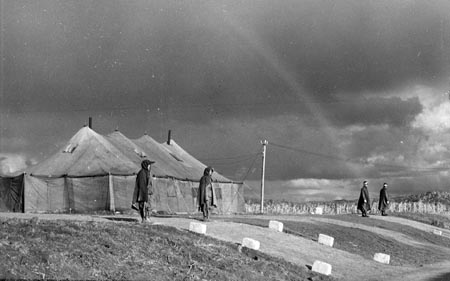
The cease-fire negotiations took place in this tent (1951-3). They had to build a
new building for the signing ceremony in 1953.
|

|
They argued on these issue for two years. Finally, the communists accepted the first
two conditions, namely on the cease-fire boundary and the issue of the POW's choice.
The American side made the concession on the airport issue.
The negotiators then decided to build a new building for the signing ceremony, and the
signing took place on July 27, 1953. This building is still there as a tourist site.
The government of (south) Korea did not participate in the negotiation.
- On July 27, 1953,
the cease-fire agreement was signed by Americans, Chinese, and North Koreans. This was a very
unfortunate event in the history of Korea. It divided the country into two separate parts.
The (south) Korean government did not sign the agreement. According to the Constitution of
(south) Korea, Korea (both south and north) is a single unified country.
- In July of 1953, it was a vacation time for me and my high-school classmates. While
those cease-fire negotiations were going on, I was chosen as one of the "elite students"
to go through the basic military training. On July 27, we heard the news that the cease-fire
agreement was signed, but we had to complete the training program. In other words, I learned
how to become a soldier capable of handling the M-1 infantry rifle and throwing hand grenades.
I am still very proud of this skill.
The POW exchanges took place in December of 1953. Most of the (north) Korean POWs chose to stay
in the South, and mor than half of (communist) Chinese POWs chose to go to Taiwan.
Indeed, on these POW issues, the communists were big losers.
Earlier, Major Gen. William Dean was returned in a civilian dress with necktie. He was
the commander of the 24th Division of the U.S. Army thoroughly defeated at the initial
engagement of American troops in Korea (July 1950).
- In the South, Koreans worked hard since then. They constructed a strong economy and
then a respectable democracy. Koreans can send their ex-presidents to jail for violating
the laws, while Americans cannot. It is generally agreed that (south) Korea is one of
the ten strongest countries in the world.
In the North, hard-working Koreans established a monarchy according to their old
culture. They are bragging about having developed nuclear bombs.
Some (south) Koreans are proud of the ability of North Koreans (the same kind of) to make nuclear
weapons, while the nuclear matter is still regarded as an American monopoly by Americans and
by many other people in the world. While I was a graduate student at Princeton (1958-61), my
American friends flatly told me that the people with non-white skins do not have enough brains
to make nuclear bombs.
- Sooner or later, hopefully sooner, Koreans in the North will get rid of their out-dated
system of monarchy and join their brothers and sisters in the democratic South.
Koreans there are also smart. How do I know? I regard myself as
a smart boy, and many people agree with me. I was born and spent my childhood years at a
village now in North Korea. I regard myself as a North Korean.
Do you like to know how smart I am? Click here.
Finally, let us examine why the communists chose to attack Korean army units, instead of American units,
during the two-year period of cease-fire negotiations. Why were the Korean army units so weak,
compared with the American units? It was the question General Van Fleet asked.

|
General James Van Fleet. He was embarrassingly friendly to Koreans.
|
- James Van Fleet was the
commander of the 8th Army of the United States and the commander of the United Nation Ground
Forces consisting of units of sixteen countries including the Korean and American units, plus
British, Turkish, Philippine, French units, and those from other countries.
Van Fleet concluded that the Korean army officers lacked the military professionalism. At that
time, most of the Korean front-line commanderS (ranks of lieutenants and captains) were former
sergeants of the old Japanese army, and those who went through two years of special training program.
Those Korean officers lacked the military professionalism. Thus, Van Fleet in 1952 proposed the
Korea Military Academy modeled after the West-Point of the United States.
Then, with American supports, the Korean government started a four-year collage program for
the Korean army. This was how the Korea Military Academy (called KMA) was set up in 1952.
However, in order to have a successful college program, you need qualified high school
graduates. You cannot collect jobless boys from the streets.
Korea was indeed fortunate to have excellent high-school system at that time. This was
recognized by General Maxwell Taylor who succeeded Van Fleet after his retirement in 1953.
Taylor noted it possible to transform those high school students into capable army officers.
He was interested in visiting the best high school in Korea, and he came to my high school
in 1954. It was one month before my graduation, I am shaking hands with General Taylor in
this photo:
- Why am I making a big deal out of high schools? To brag about myself? Yes, but there
is a more significant historical issue.
In the 1960s, Americans were interested in building a strong army in South Vietnam, using
the Korean experiences. However, they failed. It was because Vietnam, under the French
rule, did not develop the secondary educational system for boys. The French rulers however
developed the schools for Vietnamese girls. The reason was that French soldiers wanted to
play with Vietnamese girls, not with boys.
I heard this unbelievable story from one of Vietnamese friends. I do not know whether he
was telling me the true story of not. In either way, I am very happy to hear that many
Vietnamese students are coming to Korea to study these days, and that Vietnam is Korea's
fourth largest trade partner (after China, Japan, and USA).
|
|


