Wigner's Berlin and Wigner's Nobel Prize

| |
|
- If Germany was and still is a country of engineers, there must be at least
one engineering college. Indeed, the
Technical University of Berlin
has been and still is a distinctive engineering school. Where is it? The campus of this university occupies a large portion of Berlin's real estate. Look at this map.

The Street of June 17 starts from the Brandenburg Gate (east) and ends at the Charlottenburg Gate (west). The campus of TU-Berlin is on the land west of this Gate.
von Braun with John F. Kennedy (1963). They were talking about sending a man to the moon. -
Wernher von Braun was among the outstanding outstanding alumni of
this university. As we all know, he was responsible for developing the
engineering basis for sending a man to the moon.
- There was another outstanding scientist from this university. His name
was Eugene Paul Wigner. Wigner was born in Hungary, and finished his
high school years in 1920.
Click here to see Wigner's high school in Budapest. He was interested in physics, but his father forced him to go to a money-making profession. After high-school graduation, he entered a college in Budapest, but was not happy there. He came to the Technical University of Berlin in 1921 to study chemical engineering. He continued studying chemical engineering there, and he did his research at Max Volmer Laboratory for Physical Chemistry.
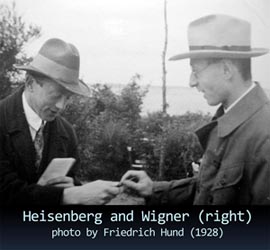
However, Wigner's heart was always in physics. He diligently attended physics seminars held at various places in Berlin. He also met many active physics researchers to discuss physics.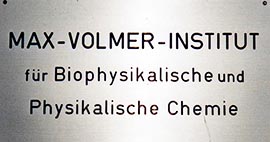
Institute of Physics,
44 Bunsen Strasse in Göttingen.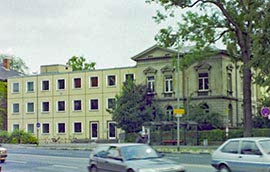

After finishing his degree at this university, Wigner moved to the Kaiser Wilhelm Institute for Physical Chemistry, which is now called the Fritz Haber Institute of the Max Planck Society. This institute is now located at the campus of the Free University of Berlin.
During his post-doctoral years, Wigner moved toward physics rapidly by making frequent contacts with the established physicists in Berlin. He then moved to Göttingen. As you know, the University of Göttingen was the headquarters of modern physics from 1925 to until Hitler came to power in 1933. Here is a photo of the Institute of Physics.
- Front view of the Institute
- Entrance to the Institute with a plate telling you are at the right place.
- This institute is on Bunsen Strasse
- I was there in 1991 to take these photos. I took this photo at the railway station.
While in Göttingen, Wigner was associated with David Hilbert, and became deeply interested in mathematics. He became interested in group theoretical approach to crystals, and then atomic physics. There, he completed his book entitled "Gruppentheorie und ihre Anwendung auf die Quanten mechanik der Atomspektren (in German)," which was translated into English by James J. Griffin in 1959. The title of this English edition is "Group Theory and its Application to the Quantum Mechanics of Atomic Spectra." Here, Griffin into the right-handed from the left hand coordinate system which Wigner used in his original book..

Wigner's portrait at the Physics Department of Princeton University. Mr. and Mrs. Wigner at their home in Princeton (1991).

- In 1931, Wigner moved to Princeton, but Princeton was not completely happy with
what he was doing and did not renew his contract in 1936. Thus, he had to move
to the University of Wisconsin at Madison. In Wisconsin, he finished his
paper on the Lorentz group in 1937, which was published in the Annals
of Mathematics in 1939, after rejections by the Physical Review and by the
Transactions of the American Mathematical Society. After the publication of
this paper, Wigner was invited by Princeton University as a permanent faculty
member.
While in Princeton, he published many papers, produced many students. John Bardeen and Frederick Seitz were among Wigner's thesis students. He also participated in many national projects including nuclear energy issues.
Wigner left us in 1995, and was buried at the Princeton Cemetery not far from the University campus. When I approached him in 1985, he was eager to write new papers. He maintained his passion for physics until he became very weak in 1990. I maintain a webpage dedicated to Wigner.

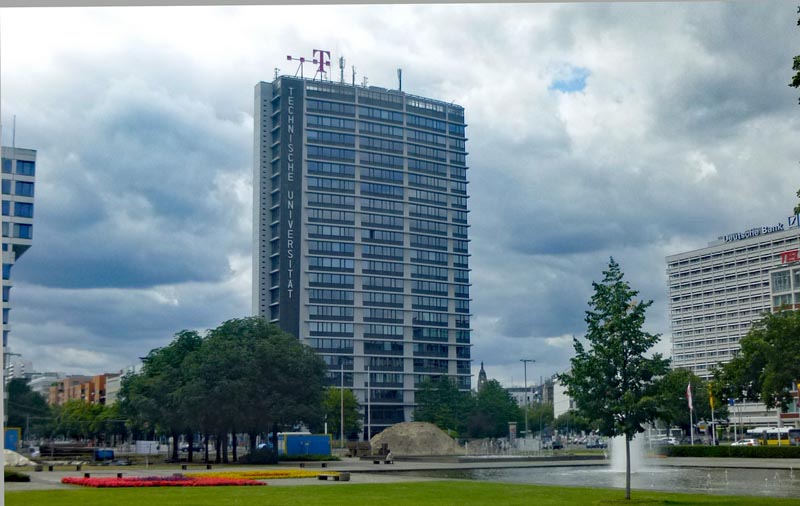
The Eugene Wigner Building is one of the three biggest buildings on campus of TU-Berlin. Click on the map for a larger image. 


- Let us go back to the Technical University of Berlin. The University now has
a new building named after Eugene Paul Wigner. It is one of the three
biggest buildings on the campus. Click here
to see where this building is located. Two other large buildings are
- Main building, and
its entrance.
- Technology Innovation building. The tall building seen from the Charlottenbug Gate.
- Main building, and
its entrance.
-
The Wigner Building must be new. I was not able
see this building when I was at the TU campus in 1998.
- At the entrance to the building, there is a brass plate saying
Eugene Paul Wigner Building. I was so happy to
see this plate that I had a
photo of myself standing on the side the plate.
- I met a group of graduate students
near the building. I asked them whether they know who Wigner was, and they
knew. I then told them I published seven papers with him. They became surprised
and asked me how old I am. I said two hundred years. We all laughed. When I
told them I was a graduate student at Princeton, they started becoming serious.
- I also talked to a group of
undergraduate students studying for their exams at the lobby of the building.
I asked them who Wigner was. They said they do not know. It is OK. This is how
the history is made.
- The main lobby was designed for study,
relaxation,
as well as social or academic gathering. A product of modern architecture.
Here is another photo.
- The directory in the lobby says this building houses biological physics, chemical physics, -- all kinds of physics.
Yes, these Berliners were extremely nice to Eugene Wigner for providing this shiny building for young generations of physicists.
- At the entrance to the building, there is a brass plate saying
Eugene Paul Wigner Building. I was so happy to
see this plate that I had a
photo of myself standing on the side the plate.
- Germans were not the only ones to be nice to Wigner. Since Wigner received his
Nobel prize in 1963, many people invented many different programs carrying Wigner's
name, in order to elevate themselves.
Many distinguished physicists, including Louis Michel and Arthur Wightman, accused me of taking advantage of Wigner's name. They were right. My plan to approach Wigner was to study his papers and find further applications to physics. At one of the campus meetings 1982, I told about this plan to John S. Toll who was the chancellor of the University of Maryland at that time. Toll was very happy to hear about my plan, and told me Wigner would like my method best. Toll was right.
Photo with Toll and Wigner (1986).
Faculty photo of 1963. I am
the youngest man in this photo.
Toll was kind enough to invite me and Wigner at the Chancellor's residence when Wigner came to Maryland in 1986, and we had this photo.
John S. Toll was John A. Wheeler's student at Princeton, and came to the University of Maryland in 1953 to build the physics department. He hired me as an assistant professor in 1962 one year after I got my degree in 1961. He always gave me correct advices whenever I needed them. When he invited Paul A. M. Dirac to Maryland in September of 1962 for a week, Toll assigned me as Dirac's servant. Click here for an interesting story.
- Wigner published many papers. What is the best way to reach his heart and mind?
He was awarded the Nobel Prize in Physics in 1963 for
his contributions to the theory of the atomic nucleus and the elementary particles, particularly through the discovery and application of fundamental symmetry principles.
Wigner was of course happy to get the prize. Here is a photo of Wigner at the Nobel dinner in December of 1963. He went there with his former high-school class mate. Wigner had one daughter and his friend had three daughters. Thus, there are four young ladies in this photo. You will be interested to hear that I have photos with three of those four young ladies.

Wigner was very happy to get the prize. However, he was not 100% happy, because the prize citation did not mention the contribution he made in his 1939 paper on the Lorentz group. The prize committee did not know the physical content of this paper. Should we blame them? Yes and No.
We can rephrase the question in the following way. Did Wigner deserve the prize for this paper alone? Some people say Yes, and some others say No. Both seemed to be right in 1963. How about Wigner? Wigner thought Yes, but he was eager to provide a stronger YES.
In his 1939 paper, Wigner provided the Lorentz covariant interpretation of the spin of a massive particle, by considering the subgroups of the Lorentz group whose transformations leave the momentum of a given particle invariant. He called them "little groups."
- If a particle is at rest, there is a Lorentz frame in which it is at rest.
In this frame, the momentum is invariant under three-dimensional rotations.
Thus, the little group is O(3), leading to the concept of the spin. If
the particle moves, the little group is a Lorentz-boosted O(3) still with
three generators.

Wigner did not get the prize for his 1939 paper because his did not provide the physics of this matrix. - For a massless particle, there are no Lorentz frames where it is at
rest. This particle can be rotated around the momentum, leading to
the concept of helicity. In addition, Wigner found two additional
transformations which leave this light-like momentum invariant.
However, he could not provide the physics of those transformations.
Click here for an illustration.
For this reason, Wigner did not get the prize. It is safe to say.
- Wigner however was clever enough to give a group theoretical interpretation
to these matrices. The Lorentz group has six generators consisting of
three rotation and three boost generators. If we use the notations
Ji and Ki for those generators respectively, the rotation generators
satisfy a closed set of commutation relations. Thus the rotation group is
a subgroup of the Lorentz group as we noted before for the massive particle.
In addition, Wigner constructed the three generators
-
J3 ,
N1 = K1 - J2 ,
N2 = K2 + J1 .These generators satisfy the closed set of commutation relations
[ N1 , N2 ] = 0 ,
[ J3 , N1 ] = i N2 ,
[ J3 , N2 ] = - i N1 .Wigner, in his 1939 paper , noted that this set of commutation relations is identical to that for the E(2) group or the two-dimensional Euclidian group with with one rotational and two-translational degrees of freedom.
- In 1987, I and Wigner published
a paper showing that there is the
cylindrical group isomorphic to the E(2) group and thus to the
little group for massless particles. It is a cylindrical group
with one rotational and one translational degrees of freedom. This
group can explain the helicity and the gauge degrees of freedom, as
illustrated in this figure.
Click here detailed calculations.
This 1987 paper gives the physical interpretation of the E(2)-like little group introduced by Wigner in 1937, and published 1939. It took the physics world fifty years to complete the job of introducing the little group as the fundamental group governing the internal space-time symmetries of massive and massless particles.

Newton initially formulated his gravity law between the sun and earth assuming that they are point particles. It took him 20 years to work out the same law for extended objects. 
- Is this the end of Wignerism? No. It is only a beginning of a new
phase of physics. Isaac Newton formulated his gravity law between
the sun and earth assuming that they are point particles. It took
him 20 years to complete the law for extended objects. He had to
develop a new mathematics, known today as integral calculus.
Likewise, Bohr and Einstein met occasionally to talk about physics. Bohr was worrying about the electron orbit in the hydrogen atom. Einstein was worrying about how things look to moving observers. Did they talk about how the electron orbit looks to a moving observer? If they did, we do not know about it. Wigner's little groups, defined for the Lorentz-covariant world, force us to back to this Bohr-Einstein issue. Click here for a story. The hydrogen orbit is an issue of the internal space-time symmetry.
Indeed, Wigner's 1939 paper leads us to examine whether Einstein's Lorentz covariance holds inside relativistic extended particles. On this issue, I also published a paper with Wigner in 1990. By that time, Wigner became very weak physically. I thus had to do most of the work for that paper. Click here for the paper. If the paper is boring to read, you can go to this webpage with colorful illustrations.
- If a particle is at rest, there is a Lorentz frame in which it is at rest.
In this frame, the momentum is invariant under three-dimensional rotations.
Thus, the little group is O(3), leading to the concept of the spin. If
the particle moves, the little group is a Lorentz-boosted O(3) still with
three generators.
- You may wonder whether all these can be found in a single book. Yes, you can go to the Amazon.Com to order the book. This book covers also applications of the Lorentz group to current issues on optics and entanglements. If you do not want to purchase the book, you can borrow a copy from me. Send your request to yskim@umd.edu.




Click here for more Berlin photos
copyright@2016 by Y. S. Kim, unless otherwise specified.
Click here
for his home page.