China after 1800
China is changing to China!
- China has a long history, and it is too complicated to understand.
On the other hand, the dynamics of Chinese history is very simple.
- Civilized Chinese set up an empire in the mainland.
- Its ruling class becomes corrupt, and farmers revolt. The empire becomes weak.
- Barbarians invade from the North and run the country. Those uncultured barbarians pick up Chinese culture, and they become main-line Chinese.
- This process repeats itself. Go to
this webpage for an illustration of this point.
- After 1800, new forms of invasion started taking place. Westerns
started coming to China. Unlike the northern barbarians, they came
up with a different civilization. It is of great interest to
see how China has been and dealing with this problem.
The point is to see the above-mentioned dynamics is applicable to this new chapter of Chinese history.
-
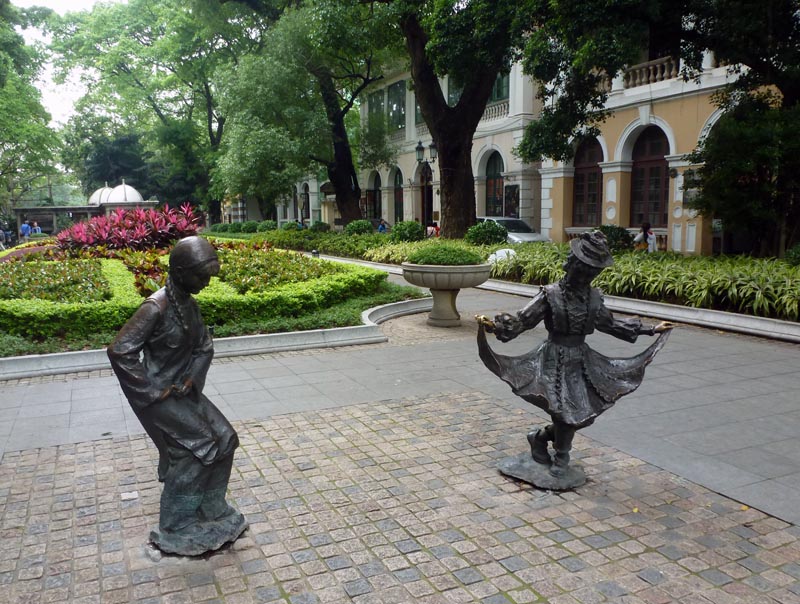
Shamian Island. English and French merchants came with
guns to established their colonies in this isolated area within
the city of Guangjhou.
Those Western-style streets and buildings are still there and are well preserved. This Island now serves as a park where boys can meet girls.
- This is a statue of one Chinese businessman talking with his English counterpart . The Chinese man is holding his lap-top computer, and the English man is holding a bottle of opium.

-
Shamian Island. English and French merchants came with
guns to established their colonies in this isolated area within
the city of Guangjhou.
- Let us start with a simple example. If you look at photos of
China taken during the period 1900-1990, the concept of luxury
never existed in China. Everybody was dressed like Chairman Mao.
This was not the case. Chinese have been enjoying "luxury" from the
beginning of their country. Where did silk come from?
What is happening these days?
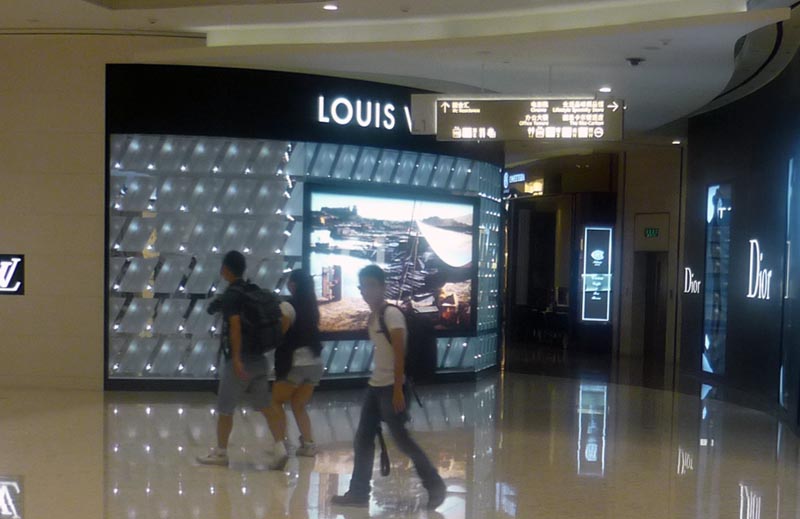
- Louis Vuitton stores are everywhere in China. There are
many in Shanghai. This is one
of those stores at Shanghai's International Financial Center.
This is one of the LV stories in
Dalian. Do you know where this city is?
Click here.

-
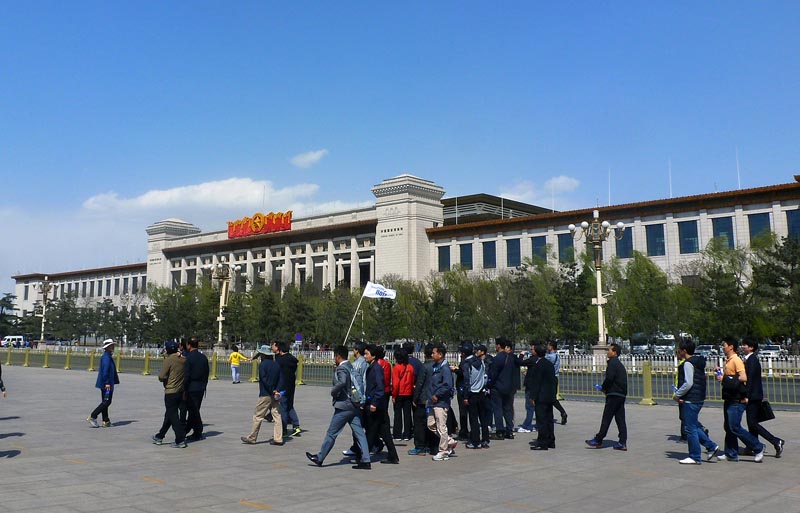
The National Museum of China
is a very important place in China.
It is located on the east side of Beijing's
Tienanmin Square. Its purpose is, in part, to show how
China developed the concept of luxury by displaying the luxury
items produced during various periods of Chinese history.
It has an impressive collection of porcelain plates produced
during 17th and 18th centuries. Look at
this item, and
this item. Porcelain
dinner plates are called China in the Western world.
Alas, this museum also contains a Louis Vuitton room filled with Louis Vuitton products. Thus, from their point of view, the Louis Vuitton already belongs to the main line of Chinese luxury.

Sun Yatsen with Louis Vuitton in the background (top).
Louis Vuitton headquarters in Paris.
- Sun Yatsen is regarded as the father of modern China, and
every city in China has streets or parks named after him
(he is known as Zhongshan in China). The city of Nanjing
is built around the south-north and west-east Zhongshan
streets. There is his statue where these two perpendicular
streets cross. It is the very center of the city.
I took a photo of him without worrying about the background.
Alas, this photo shows the Louis Vuitton prominently in the
background.
- What happened to the Louis Vuitton headquarters in Paris.
Go there. You have to speak Chinese to communicate with
the sales people. They are all Chinese, and they cannot
speak English or French well.
- Western luxury in the form of Louis Vuitton invaded China, and it became Chinese, as barbarians became Chinese after invading China throughout the Chinese history before 1800 . The dynamics of Chinese history seems to be working in the case of Louis Vuitton.
- Louis Vuitton stores are everywhere in China. There are
many in Shanghai. This is one
of those stores at Shanghai's International Financial Center.
This is one of the LV stories in
Dalian. Do you know where this city is?
Click here.
- Two strange Western ideologies invaded China, namely capitalism
and communism. The concept of money plays the central role in
both of them. China was able to absorb these two quickly, and
China is now a money country.
Chinese had a long tradition of worshiping money, namely money = god. It is not difficult to see this aspect of Chinese civilization from decorations in China.
- One of the gold stores
in Shanghai. It looks like a temple. Inside, there are
gold bars = money gods!
- Like all human races, Chinese have the tradition of worshipping
idols. Among the many idols, their god of money is still thriving.
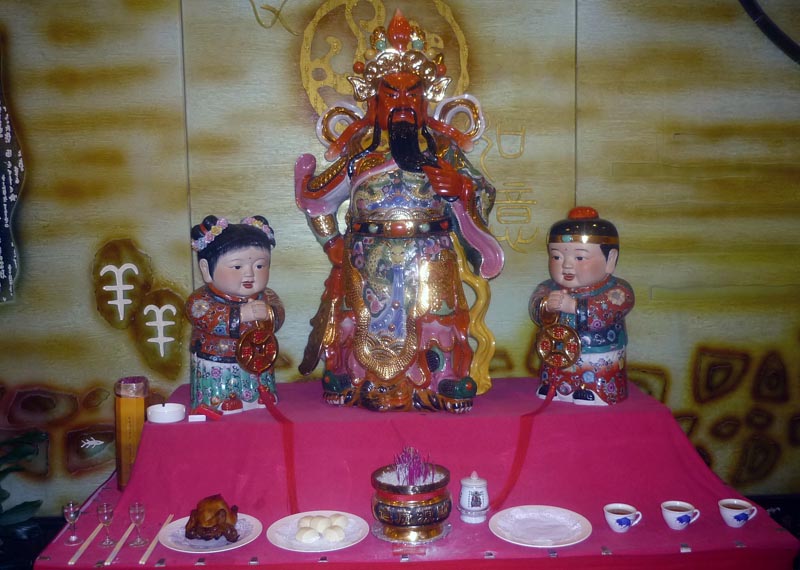
Go to a respectable Chinese restaurant. You will see a
small alter for the god of
money and wealth. The alter decoration includes
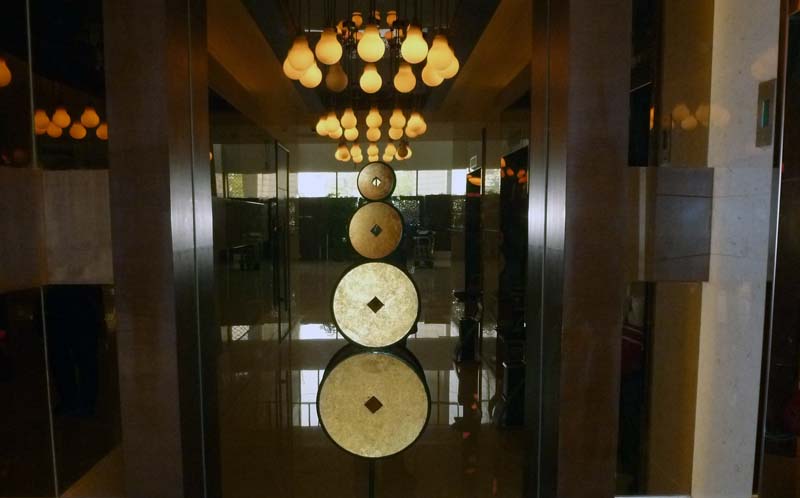
models of circular Chinese coins
with square holes in the middle.
-
This kind of decoration is quite
common in Chinese hotels. Also this.
- Chinese like circles in their decorations,
like this,
like this, and
like this. They all mean that
Chinese love money. circle = coin = money.
- One of the bridges in Suzhou. This bridge produces an image of their money god.
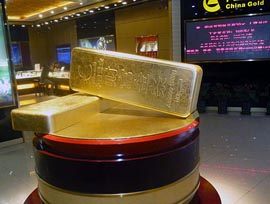
Gold bars = money gods in Shanghai (top).
Bridge in Suzhou producing a circular image (image of money god).

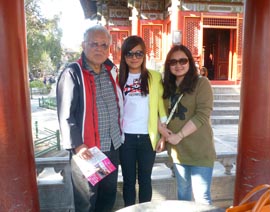
These Chinese students are studying Spanish. They are interested in going
to South America to manage real estates there (top).
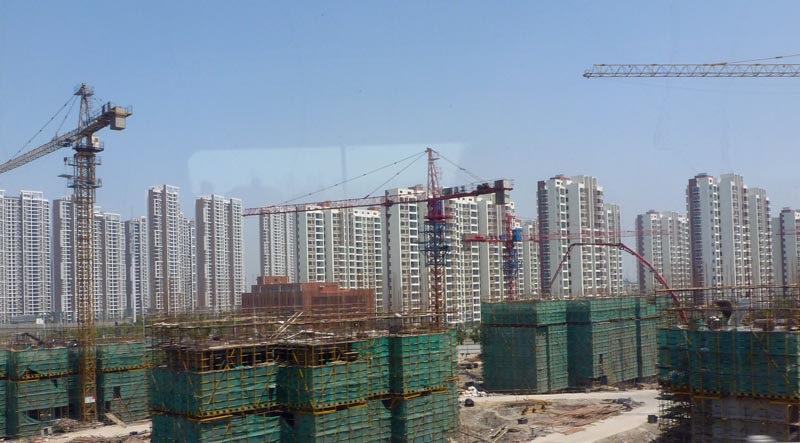
High-rise residential buildings somewhere between Suzhou and Nanjing
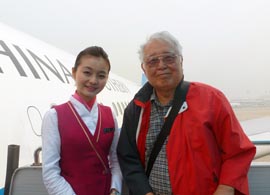
After a China Southern flight from Guangjhou to Beijing, April 2013. - One of the gold stores
in Shanghai. It looks like a temple. Inside, there are
gold bars = money gods!
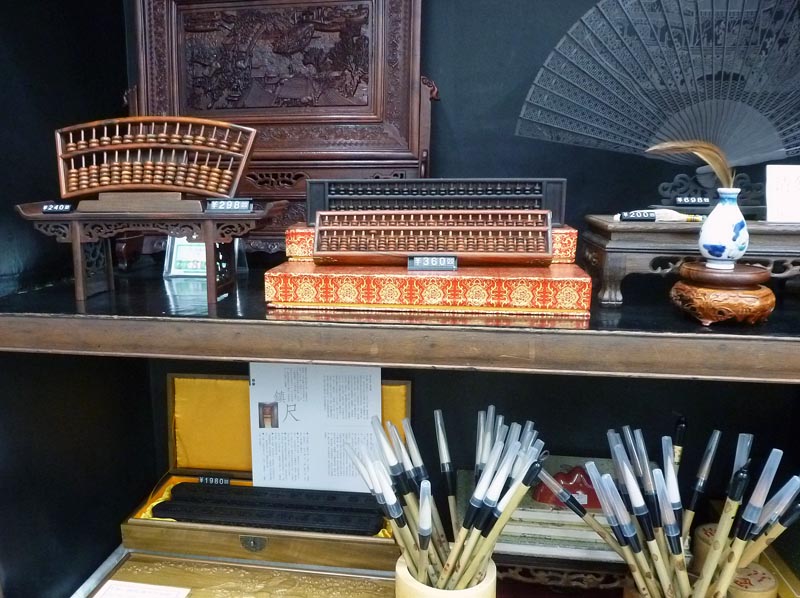
- In addition, they invented a
machine to count money.
However, Chinese were not able to produce a story like the "Merchant of Venice." They did not have to. Click here to see why. They developed the culture of putting their money into mattresses. These days, their money-holding mattresses take the following forms.
- Like rich men of all other countries, Chinese used to buy
farmlands when they had money. These days, they are buying
real estates all over the world. In the United States,
new houses are owned by Chinese financial groups until their
mortgages are paid up.
In Beijing, I met these two Chinese students. They are studying Spanish. I asked them why. They said they are interested in going to South America to manage real estates there.
- High-rise buildings are mushrooming up everywhere in China.
These most of those buildings were built after 2000, and
more are coming. Indeed, they are money-holding mattresses.
Is construction a new concept to Chinese? Look at the Great Wall.
- Their transportation system used to be very close to the
worst in the world when I made my first trip to China in 1995.
I took a train from Beijing to Taiyuan in Shanxi Province
(west of Beijing), and was on a Soviet-built YAK passenger
plane when I came back to Beijing. I know how things were
hopeless at that time.
Things are quite different these days. I was on trains, subways, taxis, buses, as well as domestic airlines during my recent trips (2011 and 2013). I would venture to say that China now has the best transportation system in the world. It is a real pleasure to be on domestic airlines. This photo shows how much I enjoyed on the China Southern Airlines flight from Guangjhou to Beijing in April of 2013.

This map is from Wikipedia. - Is the transportation a new concept to Chinese.
No! The Chinese civilization was developed along
the banks of their two great rivers, namely
the Yellow River in the north and the Yangtze in the
south. Their civilizationn is a products of these
two lifelines.
How about the land roads? The city of Xian (north-west) was developed as the main outpost to the western world. However, the silk fabrics were produced in the Shanghai area (south-east). Was it possible to move those silk products without the concept of transportation?
During the Sui dynasty (581-618), the emperor constructed a canal connecting the two great rivers in China, namely the Yellow and Yangtze Rivers. This canal starts from Beijing and ends at Hangzhou. Some sections of this canal are still operational.
China is a big country. Chinese were able to maintain their land as one country because they knew how to manage their transportation systems. By adding Western technologies to their own system, they are making those technologies their own.
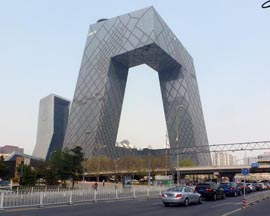
CCTV headquarters in Beijing (top).
In Korea, I was using the Hallicrafters Model 38 shortwave radio like this.

- China is a country with many ethnic diversities.
In order to develop a uniform culture, China has been diverging
an extensive broadcasting system. These day, it takes
the form of CCTV (Chinese Central TV). This system also
attempts to cover 70 million overseas Chinese. This networks
offers cable TV programs all over the world in many different
languages. These programs are not restricted to Chinese.
This TV network gives very comprehensive news programs.
When I was a high-school student in Korea, I used to pick up BBC signals from Australia with my shortwave radio, and I am still a BBC fan and watch its news programs. I have to confess that I am spending more time these days to watch CCTV programs.
It is mighty expensive to produce quality TV programs. In addition to the electronic facilities, the TV has to hire many talented producers. Indeed, the CCTV network is one of the big money-holding mattresses for Chinese.
Indeed, their transportation and communications systems constitute another big money-holding mattress for Chinese.
- Like rich men of all other countries, Chinese used to buy
farmlands when they had money. These days, they are buying
real estates all over the world. In the United States,
new houses are owned by Chinese financial groups until their
mortgages are paid up.
- Colonial powers came to China and established their own
zones and imposed the own laws. Hong Kong was under
British domination until 1997. In Shanghai, there used
to be British, French, and Japanese zones (called concessions).
The city of Dalian was under Japanese occupation since the
Russo-Japanese war of 1905. After those colonial powers
left China at the end of World War II (1945), they left
behind many buildings, and other facilities. What happened
to them?
- Hong Kong became a British colony after the Opium War. Britain
was and still is a civilized country. However, it is generally
agreed that the Opium War was not an act of civilized people.
British colonialist attempted to make Hongkong an English-speaking
city, and they did well.
When the British rulers left, they left behind millions of English-speaking Chinese, who can play active roles throughout the world. In addition, those Chinese in Hong Kong are now highly skilled workers and professionals. They know how to build tall buildings and how to run banks. Let us go back to to the dynamic of Chinese history. It still works.
Click here for more about Hong Kong and the Opium War.

Former British consulate and
Hongkong and Shanghai Bank buildings in Shanghai . - These buildings in Shanghai
used to be the British consulate and the Hongkong Shanghai
Bank. These two buildings represent the darkest days in
China's history: defeat in the opium wars. Yet, Chinese are
using these two structures for a very useful purpose. On
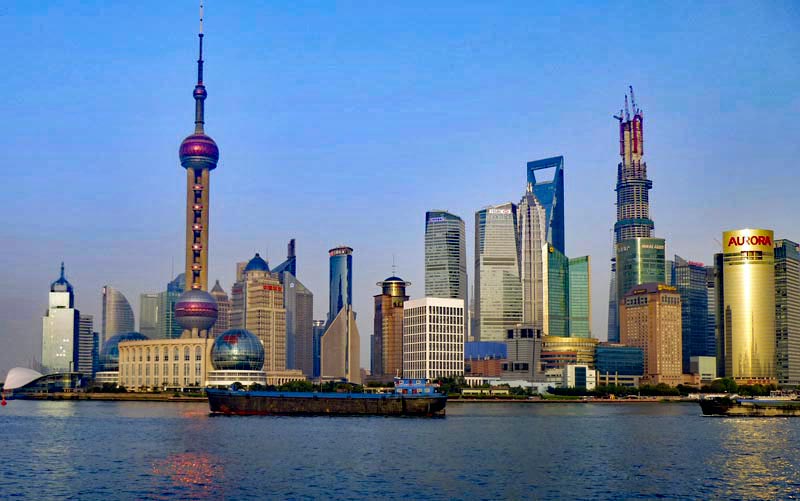
the opposite side of the Huangpu River, they built a new
international financial center.
The amazing fact is that the top of the consulate building is a tower copied after London's Big Ben. Chinese, without sacrificing the utility of the building, could have removed this tower to eradicate the symbol of their past humiliation, but they did not.
I asked one of my Chinese friends why they are not removing the Big Ben. His answer was that the clock is still useful.
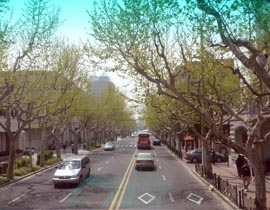

- The former French concession still keeps its French flavor.
Streets
are like those in French provincial cities. People
are relaxing in Paris style.
There are many foreigners roaming around in this zone.
Under the French rule, there was some political freedom.
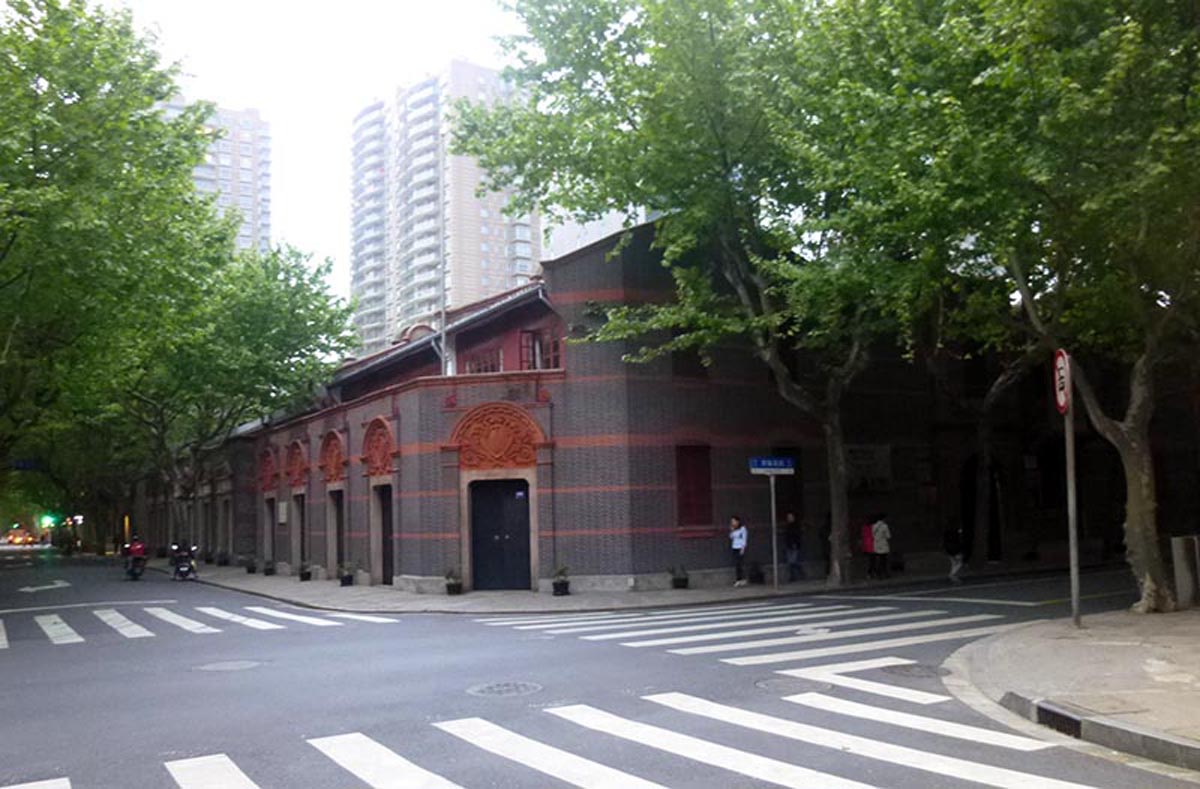
- The grey building
the place where the first meeting of the Chinese Communist Party
was held.
- This wall plate says so.
- This building now serves as the Shanghai Museum of the History of Revolution.
- The provisional government of
Korea was in the French concession. Since I was born and raised
in Korea while under Japanese colonial rule, this place was quite
meaningful to me. This place seems to be quite meaningful to Chinese.
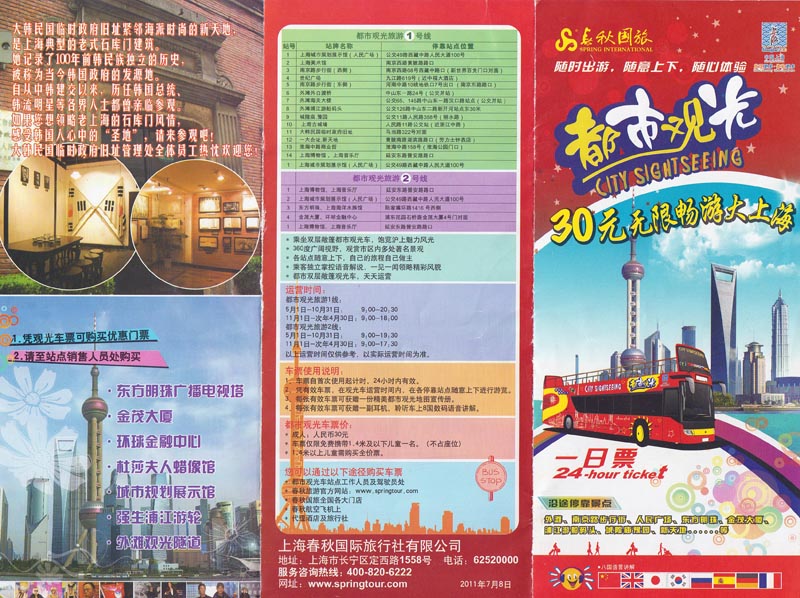
It is introduced as one of the important places in one of the
sight-seeing brochures in Shanghai.
Click here for the brochure
The Korean provisional government serves as a symbol of anti-imperialism
against Japanese invasion during the first half of the 20th Century.

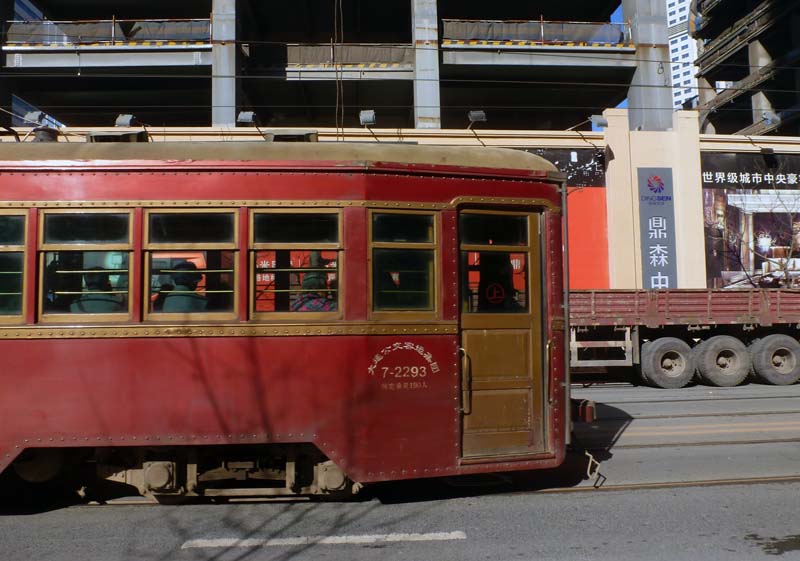
The city of Dalian was a Japanese colony. Dalians still use the street cars left behind when Japanese left in 1945. 
- There were many Japanese living in Shanghai. They also
established their own concession in the northeastern part of
Shanghai. They used this ares to prepare their invasion
of China which started in 1937.
In 1905, after the Russo-Japanese war, the city of Dalian became a Japanese colony. Japanese used this area as a logistical base for their military venture toward Beijing.
They also built a railroad system toward the mineral-rich land of Manchuria.
Alas! Chinese were still using trolley cars left behind when Japanese left in 1945. How do I know they are Japanese-made cars? Japanese also brought the same kind of cars to Korea, and I used to ride on them. Koreans got rid of them in 1965. Chinese are different from Koreans. Made in Japan? They belong to Chinese, of course.
Click here for interesting photos from Dalian. This photo collection shows how Chinese transformed Japanese installations to their own.
- The grey building
the place where the first meeting of the Chinese Communist Party
was held.
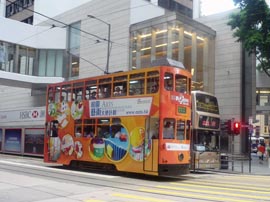
Hihgh-rise trolley car in Hong Kong. - Hong Kong became a British colony after the Opium War. Britain
was and still is a civilized country. However, it is generally
agreed that the Opium War was not an act of civilized people.
British colonialist attempted to make Hongkong an English-speaking
city, and they did well.
-
The Chinese Military
Parade is a scene familiar these days. The question is where
the Chinese armed forces started from.
- Toward the end of the 19th century, the central government in Beijing
became weak and ineffective. There started appearing many revolts.
In the North, a warlord named Zhang Joulin set up his own government
for the Manchurian area.
By 1900, there were many other established warlords, and China was in complete chaos.
Guangdong Province is in the southern end of China. The island of Hong Kong used to belong to this province. There also appeared a series of revolts starting from 1895.
-
Sun Yatsen (1866-1925) came from a farmland near Guangzhou,
and received his educations in the United States and Japan. His
uncle was very rich. Unlike those warlords, Sun was an idea man.
- His idea was simple to understand. For many years, Chinese were
led to believe their Emperor came from the heaven. If the
emperor passes through a gate or building, its roof became gold-colored.
Sun Yatsen's idea was to change the color to blue, indicating that
the people are under the blue sky.
- On January 1 (1912), Sun set up his
his provisional government in Nanjing and opened business for
the Republic of China.
In order to set up the government, he realized he needed a
political party. Thus he initiated the Kuomintang (KMT or
Nationalist Party). His government is commonly called the KMT
in the literature.
- He also realized he needed modern army to deal clean up
the many warlords.
- First of all, he knew he needed money to built a party and an
army.
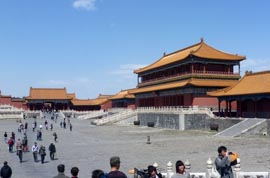
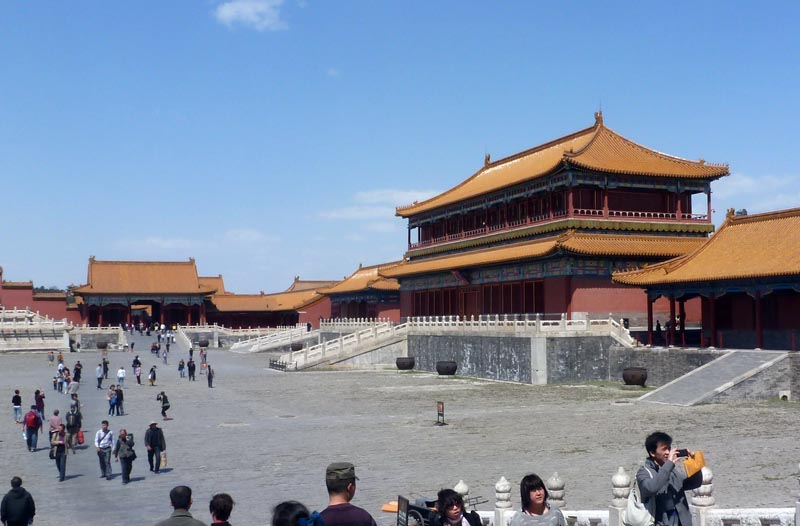
Emperor's buildings with gold-colored roofs in Beijing's Forbidden City (top), meaning the emperor is under the heaven.
Entrance to Sun Yatsen's grave. It has a blue-colored roof, telling the people are under the blue sky.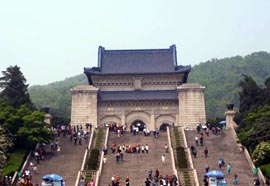
- His idea was simple to understand. For many years, Chinese were
led to believe their Emperor came from the heaven. If the
emperor passes through a gate or building, its roof became gold-colored.
Sun Yatsen's idea was to change the color to blue, indicating that
the people are under the blue sky.
- Charlie Soong
(1863-1918) studied in the United States. He became very rich
by running international trades in silk, perfume, and spices.
He had three talented daughters who played big roles in shaping
the KMT government.
-
Soong Chinglin was his second daughter and married
Sun Yatsen. She is well respected in China as the
mother of China (communist China).
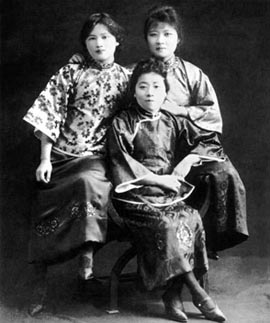
-
Mailing
was the youngest daughter, and became
Chiang Kaishek's wife. Chiang was Sun Yatsen's
general who took over the presidency of the KMT
government after Sun died in 1926. She was a very
popular figure among Americans, and she spent her
final years. She died in 2003 when she was 103 years
old.
- Ailing was the eldest daughter, and her husband was Kung Hsiang-hsi (1881-1975). Kung was the richest man in China and served as the finance minister for the KMT government.
There were two additional families with money and influence. Thus, the KMT government was an oligarchy run by four families.
This oligarchy propelled the government to grow fast and to build a large-scale army. On the other hand, the oligarchy was the cause of corruption and eventual separation of the government from the people, providing a room for the Chinese Communist Party to grow.

-
Soong Chinglin was his second daughter and married
Sun Yatsen. She is well respected in China as the
mother of China (communist China).
- The Whampoa Military Academy
was established by Sun Yatsen near Guangjhou in 1924.
At the opening ceremony Sun Yatsen is sitting in the middle. The first superintendent was Chiang Kaishek (wearing uniform) is standing next to Sun. Chiang was the first superintendent of this school. Chiang received his military education in Japan, and this school produced early military elites for Sun's KMT army.
- However, Sun Yatsen died in 1925, and Chiang Kaishek became in
charge of the revolutionary movement initiated by Sun.
In 1926, Chiang was able to assemble 100,000 soldiers at the in Guangzhou, and started his march toward the north. His purpose was to put down all those warlords and unify China. As he was showing his battle successes, his KMT army grew in number. He was eventually able to put his portrait on the Tienanmen Gate in Beijing.
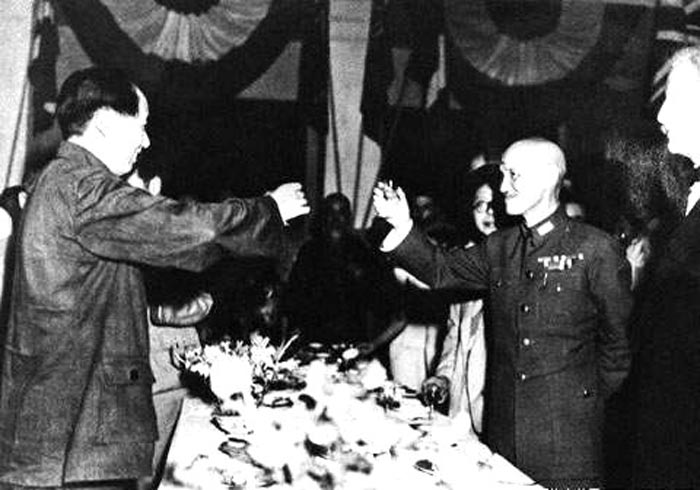
Chiang (then) and Mao (now). 
- However, on August 1, 1927, a group of communists in
Chiang's army staged a large-scale revolt in the city of
Nanchang, southwest of Shanghai.
This is the beginning of Mao's People's Liberation Army. Its
banner carries two chinese letters meaning the first day of August.
- Chiang Kaishek was in a stronger position and attempted
wipe out those communists. The communists had to run away,
and they walked to a northwestern place called Yenan (west
of Beijing). This
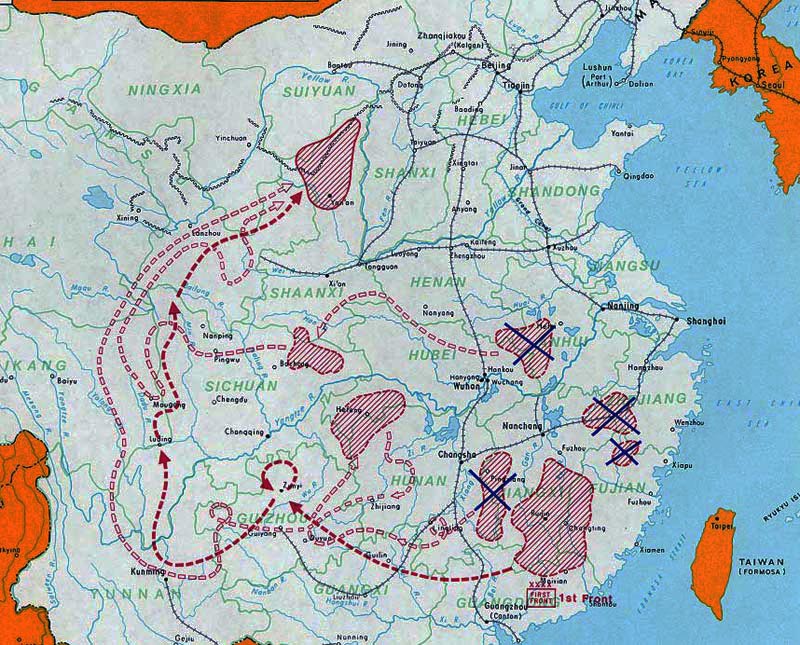
event is known as Mao Zedong's Long March. Mao started this
march in 1934 with 100,000 troops but ended up with only 20,000.
The rest of them died or defected. It took them 568 days, and
the march covered the distance of nearly 10,000 kilometers.
This map shows the routes of their march.

One of the gun positions of Chiang's army in Nanjing (top). - When Japanese troops invaded Shanghai in 1937, Chiang had
to put his best troops to the battle. While Japanese thought
they could occupy Shanghai within a week, the battle lasted three
months. The Shanghai battle was costly to both sides.
- Due to heavy casualties, Chiang's army lost most of its
combat-capable units. It had to retreat to Nanjing, and
then to Chongqing, where Chiang started reconstructing his
army with aids supplied throuth
the Burma Road.
- Out of
frustration of not winning the battle within a week, the Japanese
army committed the atrocity known as the
Nanjing massacre. This left a permanent injury to the
reputation of the Japanese army.
The Japanese war planners thought their difficulty in the Shanghai battle was due their rifles. Japanese soldiers were using their Arisaka-38 (called Sampatz Siki) rifles with the caliber of 6.5 mm, while the Chinese were using their Chiang Kaishek Mausers with the 7.9 mm cal.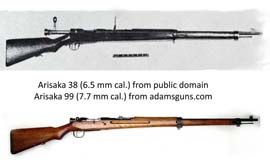
The same Japanese rifles with two different calibers, causing problems
of supplying ammunition.Consequently, in 1939, the Japanese army had to increase their caliber to 7.7 mm. This rifle is known as Arisaka-99 (called Gyu-Gyu siki in Japan). However, this change-over caused a great logistical confusion. Here the Japanese planners could not think of the problem of supplying ammunition for two different sets of rifles. Many Japanese army units were with rifles but without ammunition during the continuing war until 1945.
Chiang had to make an uneasy coalition with Mao's communist army to fight against Japanese. Chiang could not put up too much fight against Japanese. With American military assistance, he had to reconstruct his army in preparation for the forthcoming civil war against Mao's troops.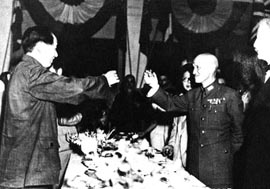
Chiang and Mao agreeing to unite
their forces against Japanese
invaders.By staging guerrilla wars against Japanese troops, Mao's army was gaining combat experiences, as well as popular supports the people. Mao's commonest army, called the People's Liberation Army, was becoming stronger both in size and in combat capability.
- Due to heavy casualties, Chiang's army lost most of its
combat-capable units. It had to retreat to Nanjing, and
then to Chongqing, where Chiang started reconstructing his
army with aids supplied throuth
the Burma Road.
- Click here for the civil
war after 1945, ending with Mao's victory and Chiang's defeat.

Douglas MacArthur summarized this book well. 
- The question is whether it was first time for Chinese to build armed
forces?
The answer is clearly No. China has a long history, and its history
books consist mostly of war stories. Even before Emperor Chin unified
the country 250 BC, there was a Chinese scholar named Sun Tzu. He
wrote a psychology book entitled "Art of War" In his book, he exploited
the human instinct to fight and win.
-
Some years later, Sigmund Freud constructed a psychology staring
from human desire to talk to opposite gender.
These days, Chinese armed forces are built on Western technologies. From their point of view, they are simply new additions to their own concept of war.
- Personal note: My maternal grandfather was quite fond of Sun Tzu's
book on the art of war, and he told me many war stories until I left
Korea after my high school graduation. Without knowing that I am armed
with this psychological weapon, many of my colleagues attempted to play
shady games against me. To them, I am very sorry.

I am standing oustside Zhang Joulin's headquarters in Shenyang (2011). 
I am shaking hands with General Maxwell Taylor who visited my high school in Korea. I was wearing a school uniform (1953). Gen. Taylor was the commander of the U.S. Forcces in Korea then. He served as the Chairman of the Joint Chiefs during the Kennedy administration (1961-63). - Toward the end of the 19th century, the central government in Beijing
became weak and ineffective. There started appearing many revolts.
In the North, a warlord named Zhang Joulin set up his own government
for the Manchurian area.
- The point of this webpage is to tell you many strange people
and cultures come to China, but China has been and still is able
absorb them and integrating them into their own national entity.
How did I come to this logic? There are two reasons.
First, I learned this aspect of Chinese history in a history class during my high-school years (1951-54).
Second, I have been publishing papers since 1961. From 1966, I have been presenting my own ideas, and the referee started becoming hostile. Yes, I pick up new ideas from those hostile reports and integrate them into my own scientific pool. This is how I am able to publish new papers, more than 50 years after my first publication.
In other words, I constructed this China page in order to talk about myself.
-
Why am I so interested in China? I am not the first physicist to become interested in Chinese affairs. It is well known that Hideki Yukawa studied rigorously the original writings of Taoim, as Einstein studied Immanuel Kant. Paul A. M. Dirac also was quite fond of oriental philosophies. This is the reason why Dirac was able to talk and listen to Yukawa. As you know, Dirac did not talk to too many people.
Dirac and Yukawa in Japan (1955). You are invited again to this webpage for interesting stories about Dirac.
- As for my part, I have been in the Washington area for more
than 50 years, I can say something about how Americans run their
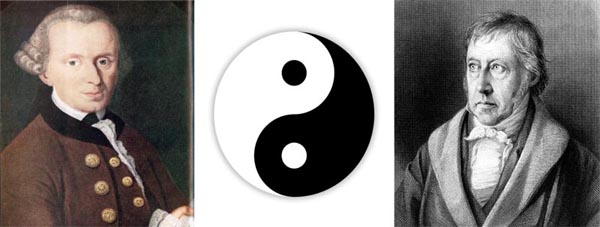
democracy. I can use the following images to illustrate what I
want to say.

Assemble many different opinions in order to find one (Kant), divide those into two groups (Tao), and produce one national policy from the two opposite views (Hegel). As for physics, I have been saying the following aspect of Einstein. Click on the image to see further illustration of where Einstein stands as a philosopher.

- I gave a talk on this
subject at the 32nd Congress of the Italian
Society of Historians of Physics and Astronomy (Rome, Italy, September 2012).
This report will be published in the proceedings.
- Click here for an expanded verion of this
article.
- Click here for my Einstein page.
Y.S.Kim (May 2013)
- Click here for an expanded verion of this
article.

|
|
Dynamics of Chinese History |










copyright@2014 by Y. S. Kim. Some of old photos are from the public domain.
|

- Click here for his home page.
- His photo-biography.
- His Einstein page.
- His Princeton page.
- His Style page.

I received my PhD degree from Princeton in 1961, seven years after high school graduation in 1954. This means that I did much of the ground work for the degree during my high school years.