| Click here for Medici's Florence |
Galileo's Florence
Physicists around the world designated this year (2005) as the world year of physics. Yes, we are celebrating one hundred years of physics since Einstein's formulation of special relativity in 1905. This does not necessarily mean that we should talk only about Einstein.
-
It is indeed fun to talk about personal backgrounds of those
history-making physicists. Galileo Galilei (1564-1642) is a case.
We all know he had a very colorful life, especially in connection
with church authorities. His life story inspires many physicists
even these days who are under money pressure and tenure pressure.
I also needed Galileo when had my
my own problem.

|
Millions of people visit Florence (Italy) every year. They go there to visit art museums. How many are going there to study Galileo's life? Perhaps one in one thousand if not one in one million. I was one of those ones. I went there during the Thanksgiving vacation in 2004.
As we all know, Galileo was born in Pisa. Like you, I have seen photos of Pisa's leaning tower many times. Yet, it is a pleasure to take this photo with my own camera and show it to others. It takes about two hours of train ride to go to Pisa from Florence. Both Florence and Pisa have been and still are two major cities of the Tuscan region in Italy. The land is beautiful and people are smart. After all, Tuscany is the land of Renaissance!
Galileo Galilei started as a medical student at the University of Pisa. After six months, he changed his mind and went to Venice to study astronomy.

|
Galileo was interested in developing telescopes to see stars and planets. He was able to use the glass technology available from the Murano to develop a telescope ten times more powerful than the existing ones at that time. Then Venice's military people became interested in Galileo's telescope for their spying purposes. Galileo was handsomely rewarded by them for his life-time income.
While watching the sky, Galileo was able to see the satellites circling around the Jupiter, and eventually became convinced that the helio-centric theory of Copernicus is not only a hypothesis but also correctly describes the real world. He became convinced that the earth was moving.
|
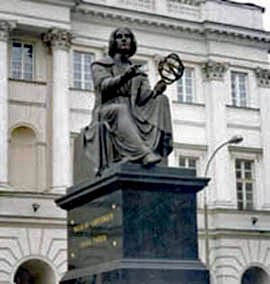
These days, there is a university named after him in Torun with a strong physics and math departments. I made my first visit to Poland in 1994, and I took this photo of his statue located near the main campus of Warsaw university. There is also the Church of Holy Cross. There is Frederick Chopin's heart entombed on the wall of this church. You may click on this photo to see expanded scenes.

|
When I was taking this photo in Florence, I was not critical about which Cosimo this statue represents. I later found out from a TV program that this is the first Cosimo's statue.
It is well known that the Medici family was quite generous to Renaissance artists. It is not known that Cosimo, the grand duke, was also quite fond of science and industry. He invited Galileo to come to Florence and continue his research at the university in Florence. Galileo came and became confident about his influence in Italian science. He went to Rome to talk with Cardinal Bellarmino who was Vatican's chief astronomer.
Bellarmino was also a very conservative theologian who earlier ordered a scientist named Bruno to be burnt to death for advocating a helio-centric view. Galileo had a confrontation with Bellarmino, but was not able to change his mind. What Galileo needed was to publish his book presenting evidences that the earth, not the sun, is moving. Galileo was allowed to publish his book as long as he admits his is wrong.
When Galileo became 70 years old, his Tuscan friend became the pope. He was Pope Urban VIII. Quite confident that he would not be punished, Galileo published his book containing his original claim. The church was so rigid in its view that the Pope could not intervene in Galileo's case.
Thanks to Medici's influence, Galileo served his life-imprisonment sentence in his own house in Florence. He continued his scientific research there. When he was 74 years old, Galileo wrote a book about the time dependence of motion which led to the concept of constant acceleration.
|
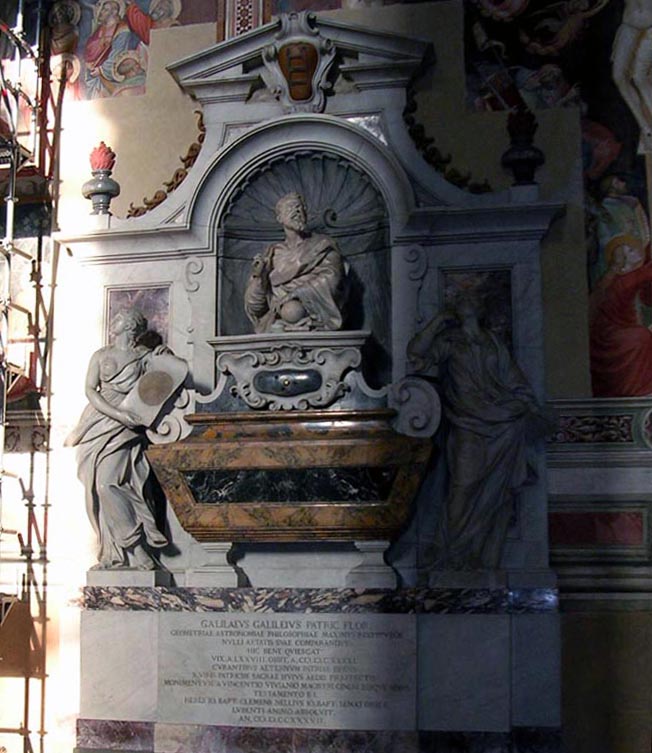
Have you seen this photo before? I do not know when this tomb was constructed, but definitely not immediately after his death. Galileo was a convict. It is interesting but soluble problem to find out when the church allocated this space for him. I should have asked this question to the church officials when I was there, but I forgot. It is agreed that Galileo was not properly treated by the church during his time. I regret to say that the city of Florence is not treating him properly these days. Florence collects tons of dollars and euros from museum visitors. The city does not seem to make any effort to tell them Florence is also Galileo's Florence.

|
|
The name of this museum was changed in 2010 to Museo Galileo. |
We cannot blame the museum alone. It is not easy to find about Galileo from Florence. The city tourist offices cannot provide much information about this great Italian. I found the Galileo's tomb quite accidentally. The city of Florence and especially the University of Florence should do more to direct attention of their tourists to the Galileo items.
Y. S. Kim (2005.1.3)
PS. We are very happy to receive the following communication from the
Galileo Galilei Institute in Florence.
Date: Mon, 10 Jan 2005 14:01:50 +0100
From: Galileo Institute (ggi@fi.infn.it)
To: yskim@wam.umd.edu
Subject: New Institute for Theoretical Physics "Galileo Galilei" in
Arcetri, Florence
Dear Prof. Kim, as you can see we are trying to do something about
Galielo and Florence.
Best regards, Roberto Casalbuoni
Please find enclosed the
announcement of the establishment by INFN of
The Galileo Galilei Institute for
Theoretical Physics in
Arcetri, Florence. We would be grateful if you could help us make
our community aware of this initiative. Here is the
GGI webpage.
Roberto Casalbuoni, Local Representative of GGI,
roberto.casalbuoni@fi.infn.it,
Giuseppe Marchesini, Chairman of the INFN TH-Committee,
giuseppe.marchesini@mib.infn.it,
Gabriele Veneziano, Chairman of the Launching Committee,
Galileo Galilei Institute
L.go E. Fermi
50125 Firenze, Italia