My Bridge to Einstein

|
Same photographer.
How is it possible to place me next to Einstein?
Click here.
|
- Young Suh Kim
Professor Emeritus
Department of Physics
University of Maryland
College Park, MD 20742, U.S.A.
- On March 12, 1958, while I was a senior at the Carnegie Institute of Technology
in Pittsburgh, I received
a letter from Princeton University telling me I ranked very high among the 15 students
selected for their graduate program in physics.
Going to Princeton meant working with Albert Einstein even though he went to Heaven
three years earlier in 1955.
My Carnegie Tech professors congratulated me. They knew Einstein was no longer at
Princeton, and they advised me to work with
Eugene Wigner there.
It was my first time to hear his name. Wigner's name was known to them but not to me.
- When I went to Princeton in July of 1958, Wigner's office was in the mathematics
building, and he was totally isolated from the younger physics professors there.
I chose a young associate professor named Sam Treiman as my thesis advisor. He was
a good teacher, and he taught me how to write articles coherently and stylishly.
I am forever grateful to him, even though I had to be completely separated after I left
Princeton.
Click here for his Wikipedia
page. I am on the list of the students he advised. The most famous person
on the list is
Steven Weinberg (Nobel 1979). Since Weinberg was so famous that there
is every reason for me to brag about sharing the same thesis advior with Weinherg at
Princeton. However, I had to work hard to be known as Wigner's youngest student.
Why?
In order to build my bridge to Einstein, Treiman was not enough.
I had to become Wigner's student:
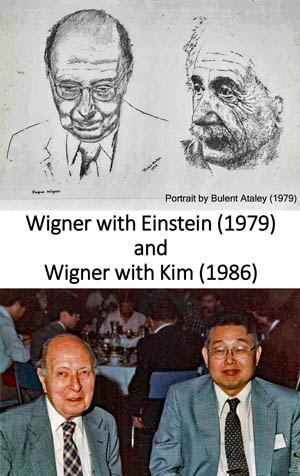
Einstein-to-Wigner, and
then Wigner-to-Kim.
|
Counterclockwise: Princeton's Einstein genealogy.
|
While I was a student at Princeton, I became interested in Wigner and his articles,
since my professors at Carnegie Tech talked about him. Among his articles, one of
them caught my attention. This paper was published in a mathematical journal, and
was written in mathematical language. When I mentioned this paper to my physics
professors at Princeton, they said the paper is about mathematics and has nothing
to do with physics. They told me not to waste time on that useless paper.
However, I maintained my interest on that paper, and I choose to call it
Wigner39 throughout this webpage.
After finishing my PhD degree in 1961, I was invited to stay there for one additional
year as a pot-doc. Princeton University was very nice to me.
In 1962, I became an assistant professor at the University of Maryland.
- Going from Princeton to Maryland was a hopeless demotion from Princeton's
point of view. My friends there gave me a farewell party, but it was a funeral
party. They thought I would disappear from the physics world.
Yet, coming to Maryland was the best decision I made in my life. Its College
Park campus was created by Abraham Lincoln as an agricultural college, with huge area of
farmland. This campus is in the Greater Washington area, 20 kilometers north of the
White House.
|
In the Washington area, there are many Korean residents, and they say Washington is the capital
city of (south) Korea.
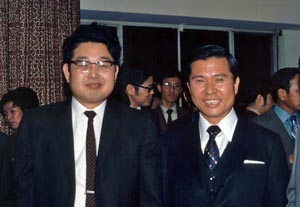
Kim Dae-Jung was the president of
(south) Korea from 1998 to 2003. In 1969, he visited Washington, DC to introduce himself
to the American political establishment. He received a Nobel peace prize in 2000. I had
a photo with him at a meeting of Koreans welcoming him in 1969.
Koreans in Washington say that you need a permission from the United States before running
for the president of (south) Korea.
We hope very much North Korea's ruling family will make efforts to get supports from the
United States. They do not seem to like their big brothers: China and Russia.
|
- We hope very much this city will soon become the capital city of North Korea.
Koreans there, including their ruling family, do not seem to like their big brothers:
Chinese and Russians.
- How about DPRK (north Korea) as a separate country as colony of the United
States, competing against the South? Quite possible, but much better than now.
- Two competing Koreas are easier for Americans to control the entire peninsula
of Korea, according to the traditional British wisdom (divide and conquer).
Korea is important for Americans because it keeps China and Japan separate.
I am not a politician. Let me go back to my profession. The best aspect of
my life at this new place was to develop my own research program,
separate from those big shots at Princeton.
On the other hand, was this the end of my connection with Einstein's Princeton?
I had to develop a new route to Princeton.
How?
- After this catastrophic separation from Treiman, I came to realize why
Eugene Paul Wigner (mentioned above) was so isolated from the rest of Princeton.
The people there did not have enough brain power to resolve the Dashen case,
widely known as the Dashen-Frautchi fiasco.
Thus, with this limited brain power, they could not understand Wigner's papers.
This was the reason why Wigner was so isolated.
You may not agree with me on my view on "Princeton's brain problems." However,
according to the recent ranking of graduate programs in physics, Princeton's ranking
was 7th or 9th in the United States. Thanks to Einstein's name, its reputation
was No. 1 when I went there in 1958.
Without their brain problems,
how could they bring down their
reputation that much?
However, was this blaming enough?
- In 1966, after my separation from Treiman, I restarted studying the above-mentioned
paper by Wigner and spent 20 years for publishing my research results based on the
Wigner39 until 1986. The purpose was to connect
the mathematical formulas (given before 1939) contained in his paper with what we
observe in the real world with particle accelerators after 1960.
- After publishing enough papers on the subject matters coming from the
Wigner39 with my younger colleagues, I became
ready to tell Wigner the stories he wanted to hear. In 1986, 20 years after 1966,
I started going to Princeton regularly to tell him the stories.
Essentially, I was telling Wigner that he deserved one full Nobel prize for his
Wigner39 alone, while his 1963 Nobel citation
did not mention this paper.
At that time, Wigner was so isolated that he was known to be the most undo-approachable
person in the world. How could I break this barrier? I had to tell him the
stories he wanted to hear. Click here for a
piece of wisdom I inherited from my Korean root.
- Wigner was so happy to hear my stories that he invited me to publish papers
with him. Since I published six papers with him from 1987 to 1990, I became known
as Wigner's youngest student in the world of physics.
- So, what was the Wigner39 about? What
did I add to the paper?
|
|

|
On a train from Naples to Rome (2013). Wondering how Italian girls
would appear when the train moves with a relativistic speed. Italian
girls are stylish and open-hearted. I enjoy looking at them and
talking with them.
Let us change the scale. How would the hydrogen atom appear to me?
Nickels Bohr was interested in what happens inside the hydrogen atom.
Einstein was interested in how things appear to moving observers.
Then how would the hydrogen atom appears to moving observers?
|

|
- When Einstein formulated his theory of relativity in 1905, all the particles were
point particles. Later, those particles were found to have their own internal
space-time structures. For example, the hydrogen atom is small enough to be regarded
as a point particle. However, it has a nonzero radius with a very rich internal
structure, namely bound state in quantum mechanics.
During Einstein's time, there were no observable particles on earth moving fast enough
to show relativistic effects. Thus, he had to go the universe. Then his theory became
"general relativity."
- After 1950, particle accelerators started producing tons of protons moving with
speeds very close to that of light.
Here then comes a new subject. Nickels Bohr was interested in what is going on inside the
hydrogen atom, while Einstein was worrying about how things appear to moving observers.
Bohr and Einstein were good friends. They met occasionally to talk about things
including physics.
They could have asked how the hydrogen atom appears to moving observers. However,
there are no written records to indicate they ever discussed the issue of moving
hydrogen atoms or moving bound sates in quantum mechanics.
- I was interested in how to extend Einstein's relativity to the inside of the
hydrogen atom or the quantum bound state in Einstein's world.
Let us hear one of the radio interviews I had on this issue.
Click here.
In order to attack this problem, we need the mathematical framework constructed
by Eugene Paul Wigner in his Wigner39
published in the Annals of Mathematics.
I found out this paper while I was a graduate student at Princeton (1958-61),
and it appeared to be impressive to me even though I could not understand its
contents at that time.
While I was a student at Princeton, Wigner was totally isolated from the rest
of the physics faculty. His office was in the mathematics building, and younger
professors routinely said "Wigner is gone." They told me not to waste my time on
that useless paper.
|
|
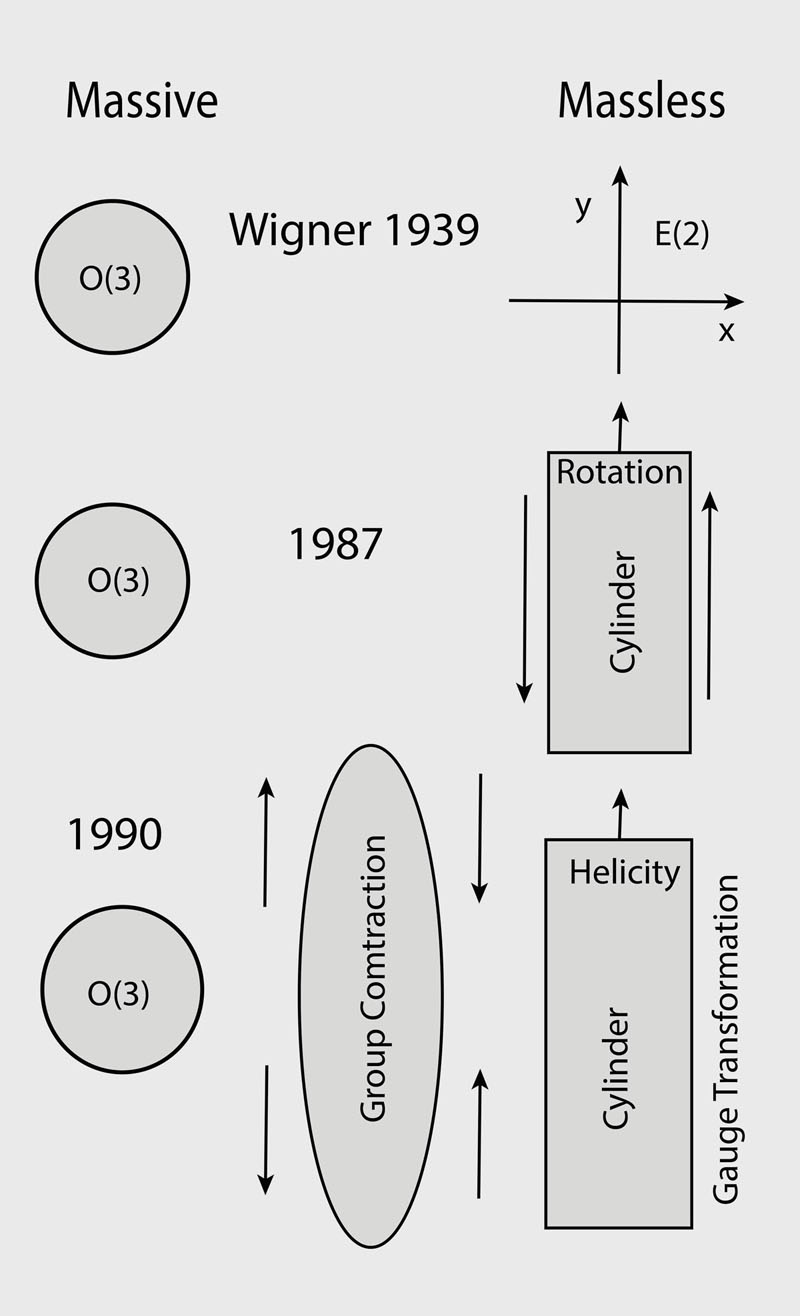
- In his Wigner39, Wigner starts with a particle
with Einstein's energy-momentum relation.
When the particle moves, it carries its momentum p . Then, according to Einstein, the
energy-momentum relation becomes
E2 = (mc2)2 + (cp)2,
leading to E = mc2 when the particle is at rest with p = 0,
and E = cp when the particle is massless with m = 0.
- Wigner then discussed additional dynamical variables.
- When the particle is at rest with p = 0, it can spin and can have
its angular momentum. It is like a rotating top.
- When the particle is massless with m = 0, Wigner noted that the
symmetry was like that of the rotation and translations on the two-dimensional
plane.
His observations created two fundamental problems on massless particles.
- The rotational symmetry on the two-dimensional problem can easily be associated
with the helically of the massless particle. What about those two translational
degrees of freedom on the two-dimensional plane?
- The energy-momentum relations for massive and massless variables can be connected
as two different limiting cases of
one formula given above, namely
E2 = (mc2)2 + (cp)2.
Is it possible to derive those two different internal symmetries as two limiting cases
of one symmetry formula?
- As for the first question, it took many painful years for the physics world to realize
that those two translational degrees of freedom collapse into one unobservable gauge
degree of freedom for massless particles. We can list some of the authors and their
papers who contributed to this important task:
- S. Weinberg,
Phys. Rev. 133, B1318 (1964).
- S. Weinberg,
Phys. Rev. 134, B882 (1964).
- S. Weinberg,
Phys. Rev. 135, B1049 (1964).
- A. Janner and T. Jenssen,
Physica 53, page 1 (1971), and
Physica 60, page 292 (1972).
- J. Kupersztych, Nuovo Cimento B 31, page 1 (1976).
Indeed, these authors noted that the two translational degrees of freedom lead to
the gauge degrees of freedom.
|
|
- Yet, the problem is that there are no observable hydrogen atoms moving with relativistic
speed. On the other hand, there are protons moving with speed very close to that of
light. Protons are not hydrogen atoms.
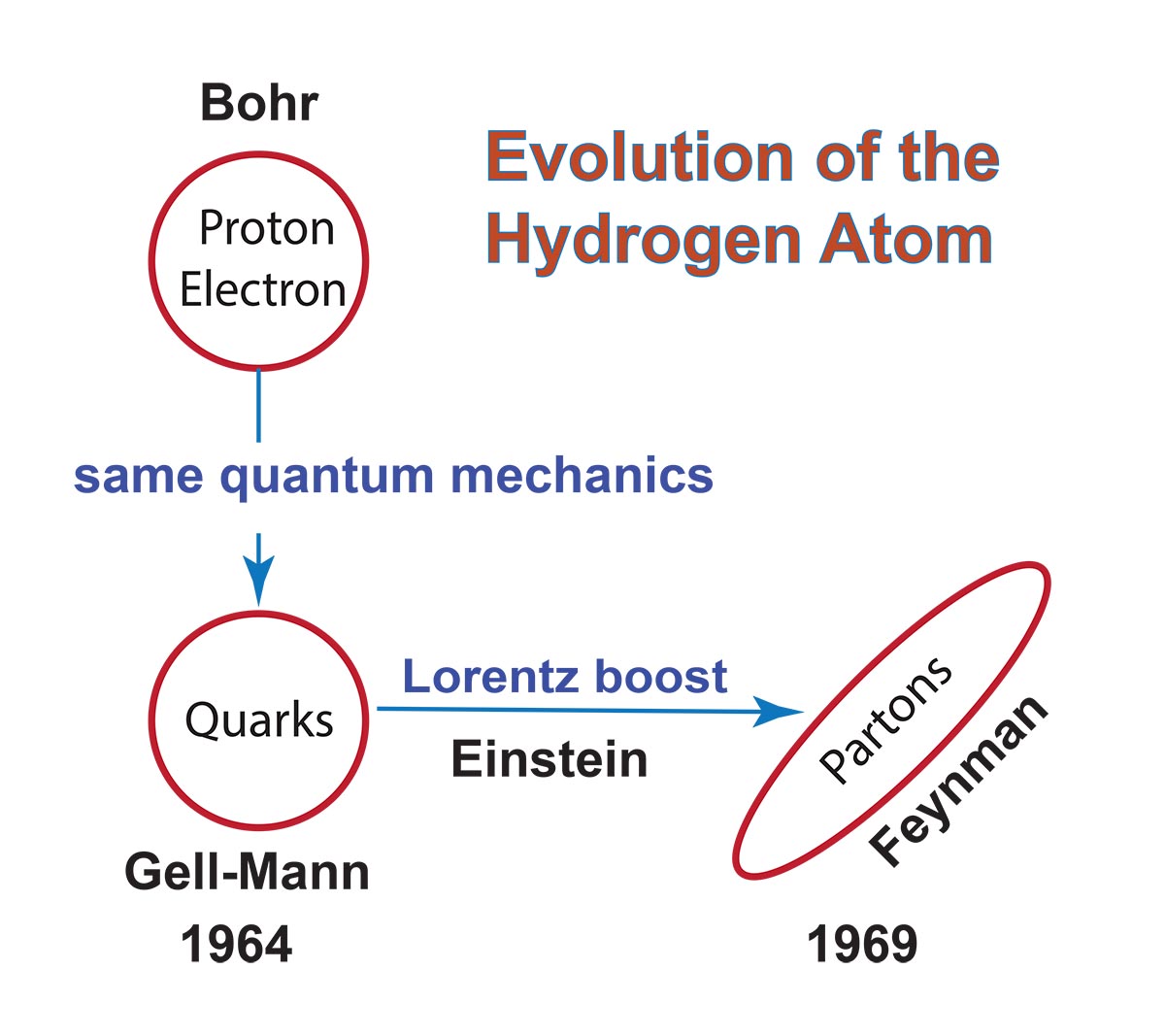
According to Gell-Mann's quark model, the proton shares the same bound-state quantum
mechanics as the hydrogen atom as illustrated in this figure:
Fast-moving protons can be observed in laboratories. In 1969, Feynman gave
the exact description of those fast-moving protons. It is known as
Feynman's parton picture:
The question is whether the quark model for the proton at rest is consistent
with its parton picture when it moves fast. I worked on this problem for
many years, and the result was tabulated in the following table.
Further Contents of Einstein's
E = mc2
|
Massive/Slow |
between |
Massless/Fast |
|
Energy
Momentum |
E = p2/2m |
Einstein's
E2 = (mc2)2 + (cp)2 |
E = cp |
|
| |
| |
This table was published in my paper:
Phys. Rev. Lett. [63], 348 - 351 (1989).
pdf.
|
The green row is added to the table given before. While we cannot detect the
hydrogen atom moving fast enough to show the effect of relativity, with particle
accelerators, it is possible to produce many protons moving with speeds very
close to the light speed.
- The point is that the proton is also a bound state sharing the same quantum
mechanics as the hydrogen atom.
|
|
The above table leads to
Princeton's Einstein Genealogy shown here:

|
I use one of Wigner's papers as my bridge to Einstein.
Not Wigner, only
one of his papers. Wigner is too big to be
a bridge to anyone.
In 1963, Wigner received his Nobel prize in physics. The prize however was not
for this paper. Wigner was happy with his prize, but not 100% happy because the prize
was not for this paper.
How do I know this? Wigner told me.
|
|
|
|
- When Einstein formulated his theory of relativity in 1905, all the particles were point
particles. Later, it was found that those particles have very rich internal structures,
with internal variables. Eugene Wigner noted that there are internal variables in
his 1939 paper. I studied Wigner's paper for many years to construct Princeton's
genealogy described above.
- Am I saying my brain is superior to those of the Princeton people during the
period (1965-66)? Perhaps Yes or No. In either way,
I can brag about my persistence to continue my research efforts for 20 years while
being isolated and humiliated by my colleagues and friends.
I am not Jesus, I do not have kind words for those who were unkind to me in the
past. On the other hand, I do not have to mention them, since you cannot recognize
their names these days. Perhaps, I can mention two names still recognizable in
the physics world. Click here.
- While I keep saying the United States has been very nice to me,
one prominent American broadcaster says the United States is
very grateful to me. Like to hear what he says?
Click here for my interview with Doug Llewelyn. In his interview, he asks me
- Why is my high school class in Korea was the No.1 class in world.
- Where was the blank spot in Einstein's theory of relativity? How did I fill in?
- What was the cause of my 20 years of delay in promotions in academic ranks.
Did I have enough perseverance to sustain this delay?
- I am scheduled to have a TV interview on September 9 of this year. My hair is not
long enough yet, but I am considering a haircut before that date.
|
|
copyright@2023 by Y. S. Kim.
|
|
|
|