Korea's Recent History
- Young Suh Kim
Professor of Physics, Emeritus
University of Maryland, College Park, Maryland 20742, U.S.A.
Home page.
- Toward the end of the 19th Century, the government of Korea was totally
paralyzed and was incapable of dealing with foreign influences from China,
Japan, Russia and the United States. The government headed by King Kojong
was insensitive to the discontents of the people. There were revolts and
reform movements.
- One Prisoner. One of the leaders of
the reform movements was a young man named Syngman Rhee (Yi Seung-Mann).
Rhee was imprisoned in 1896 and stayed in prison until 1903. This is a photo
of Rhee while in prison. He was 28 years old then. He looks very confident,
and was determined to become the president of his country. He indeed became
the president in 1948 . This photo is
from a Korean daily newspaper called Hankook Ilbo.
While in prison, Rhee studied the Bible thoroughly and wanted become like
Jesus. As Jesus rose from the death, he was thinking of getting out of the
prison and leading the nation toward a ideal country where everybody is happy.
He was in contact with the Christian missionaries from the United States.
One year after he was released from the prison, he went to the United States
for study. He received his PhD degree from
Princeton University in 1910. Rhee's thesis advisor was Wilson's
son-in-law, but he was known as Woodrow Wilson's best student. Wilson was
the president of Princeton University at that time.
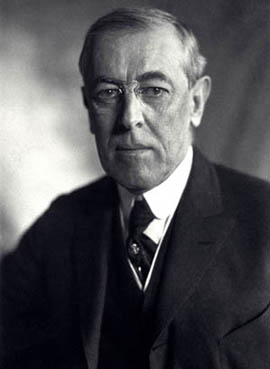
- Woodrow Wilson
was an inspirational president of the United States (1913-921). He
sent American troops to Europe to fight against Germany during the
European War, known as
World War One (1914-18).
After the War, he wrote the Fourteen Rules for World Peace, and created
the idea of the world organization called "League of Nations" (like the
United Nations these days). However, the U.S. Congress was strongly
against joining this international organization. Americans, until that
time, were strong isolationists. George Washington, during his time, was
interested in constructing his country totally isolated from Europe.
While Wilson's idea was totally ineffective in his own country, Koreans
became excited about Wilson's Fourteen Rules. They call for self-determination
of all nations. Korea at that time was under Japanese colonial rule since
Japan occupied the Korean Peninsula in 1910.
On the first
day of March in 1919, inspired by Wilson's Rule of Self-determination,
Koreans declared the independence of their own country and revolted
against the Japanese rule. However, Wilson's idea was as infective as in
his own country, and Japanese authorities brutally put down the Korean
revolts and imposed harsher rules to Koreans.
- In this photo of 1941, Korean school children are bowing
toward the Emperor of Japan.
|
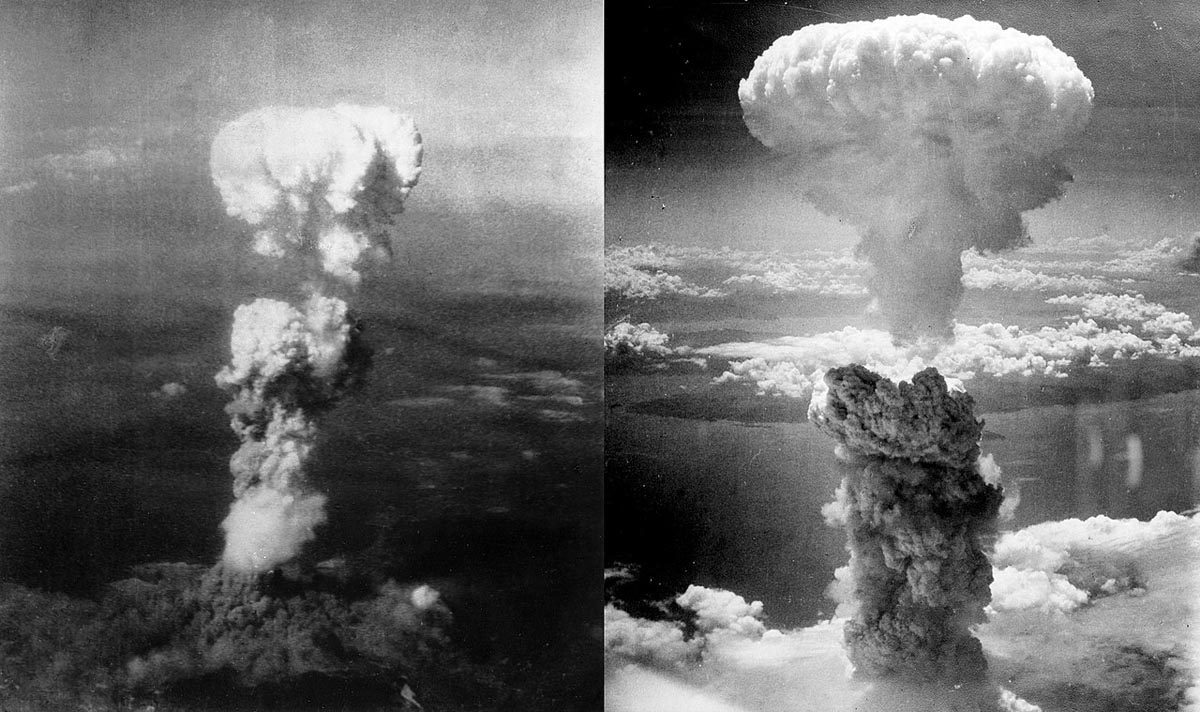
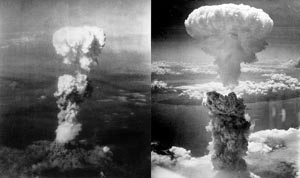
Nuclear bombs on two Japanese cities, called Hiroshima and Nagasaki, on August 6 and 8,
1945. One week later, Japan had to offer the unconditional surrender to the
Allied Forces.
|
On December 7 (1941), the Japanese navy attacked the U.S. naval base in
Hawaii and started the war against the United States. The result was a
disaster to Japan.
- In 1945, Korea was liberated from
the 35 years of Japanese occupation after Japan was defeated in the
Pacific War.
- Yalta. In February of 1945, Franklin
Roosevelt, Winston Churchill, and Joseph Stalin met at the Livadia
Palace in Yalta overlooking the Black Sea. They talked about how
to divide up this world after the war (WWII). This historic meeting
is known as the Yalta Conference.

|
|

|
At the same conference, Roosevelt asked Stalin to attack Japanese troops in Manchuria.
Roosevelt did not know all combat-capable Japanese troops there had been moved
to the Pacific front to fight against Americans.
|
- Roosevelt and Stalin. During the
Yalta Conference, they met without Churchill. Roosevelt asked Stalin to
join the war against Japan, and open the eastern front against Japanese
troops in Manchuria.
At that time, Americans were planning a landing operation in the
main land of Japan, and they thought those Japanese troops would come
back to their mainland to fight again Americans. Roosevelt thought the
Soviet intervention would weaken the Japanese opposition to Americans.
He did not know that those combat-capable Japanese troops in Manchuria
had been moved to the Pacific and South-East Asian fronts, and were
destroyed the American and British forces.
I have a Russian friend whose father was a Soviet intelligence officer
during World War II. He told me even Russians did not know
Manchuria was that empty. Soviet troops had a free pass on their GMC
trucks given by Americans. They moved quickly to the Korean Peninsula.
This was the beginning of the present monarchy in North Korea.
- Potsdam. In July of
1945, Stalin, Truman, and Churchill got together at the
Cecilenhof Palace in Potsdam near Berlin. By that time,
the United States had successfully tested a nuclear bomb, but
Joseph Stalin had an upper hand because the conference was held
at a place under his control. In addition, he had been well informed
of the U.S. nuclear project from his spies. Stalin got a large
chunk of the world real estate and was thinking of eating up the
Korean peninsula.

| |
|
I saw the Soviet trucks looking like this in the Soviet occupied area
in Korea in 1945. My family moved to Seoul in May of 1946 to avoid the communist regime
being set up there. I then saw the same kind of trucks driven by the American troops.
It took me some years to understand why the armies of two different countries had the
same kind of trucks.
|
- During the World War II, Americans sent many trucks to Europe
to fight against German troops. After Germany's surrender in May of
1945, 8000 GMC trucks, looking
like this, were given to the Soviet Union to encourage
Russians to attack Japanese troops in Manchuria.
- Berlin now.
There still is a giant stature of a Soviet solder with a Mosin-Nagant
rifle (with a foldable bayonet) hanging on his right shoulder. At the
bottom of the statue, there are two T-34 tanks, and one of them is
seen in this photo. One of the two Soviet 155-mm guns is also seen.
This stature is near the Brandenburg Gate.
-
1945 and 1990. In 1990, during my first
trip to the Soviet Union, I spotted three Soviet soldiers on Moscow's
Arbat Street. I immediately pulled out my camera and took this photo.
I was excited to see them because I saw the soldiers like them 55
years earlier in Korea (on the northern side).

|
A man with an old Soviet flag in Berlin (2005).
He was not a Russian soldier but wearing the Soviet uniform. He was standing there
to show that East Berlin was occupied by Soviet troops until 1989..
|

|
In 1900, while Russia was still the Soviet Union, I noticed these
Soviet soldiers in Moscow. Their uniform was the same as the on I saw on
the northern side of Korea.
|
In 1945, American and Soviet troops came to Korea to disarm the Japanese
army. They came to the south and the north of the 38th parallel
respectively. I was on the northern side then, but my family to the South
in May of 1946 to avoid the communist regime being installed there by the
joseph Stalin of the Soviet Union. The Soviet soldiers I saw in the North
were wearing the uniforms
looking exactly like these I saw in Moscow in 1990.
- Russian Soldiers again.
I met these Russian soldiers again while
I was in Minsk in 1994. It was indeed a pleasure to meet them and
exchange friendly greetings with them. I still wonder why we were
thinking of having wars with them for so many years.
- American Soldiers came to
the South, on jeeps of the same model as this car which I spotted
in Sweden in June of 2002.
- Click here for a more detailed explanation
of how Korea was divided in 1945.
- Wilson Park in Geneva.
In the South, a pro-American government was set up in 1948 headed by
Dr. Syngman Rhee. Rhee was Woodrow Wilson's PhD student at Princeton
University, and he served as the first president of the Korean
provisional government in Shanghai (China) while Korea was under Japanese
occupation (1910-45). Rhee went to the 1933 meeting of the League of
Nations in order to appeal Korea's independence to the world. Nobody
paid any attention to him except an Austrian lady named Francesca Donner
who shared a table with him in a crowded restaurant. She became
Mrs. Rhee in 1934 and typed thousands of letters for Dr. Rhee's cause.
The 1933 meeting of the League of Nations took place in the
red-yellow-red building seen in this photo. With me in the photo is
an Austrian student who wanted to be kind to a Korean-born professor
working in the United States. She appears to be from a conservative
family. This photo was taken in July of 1999.
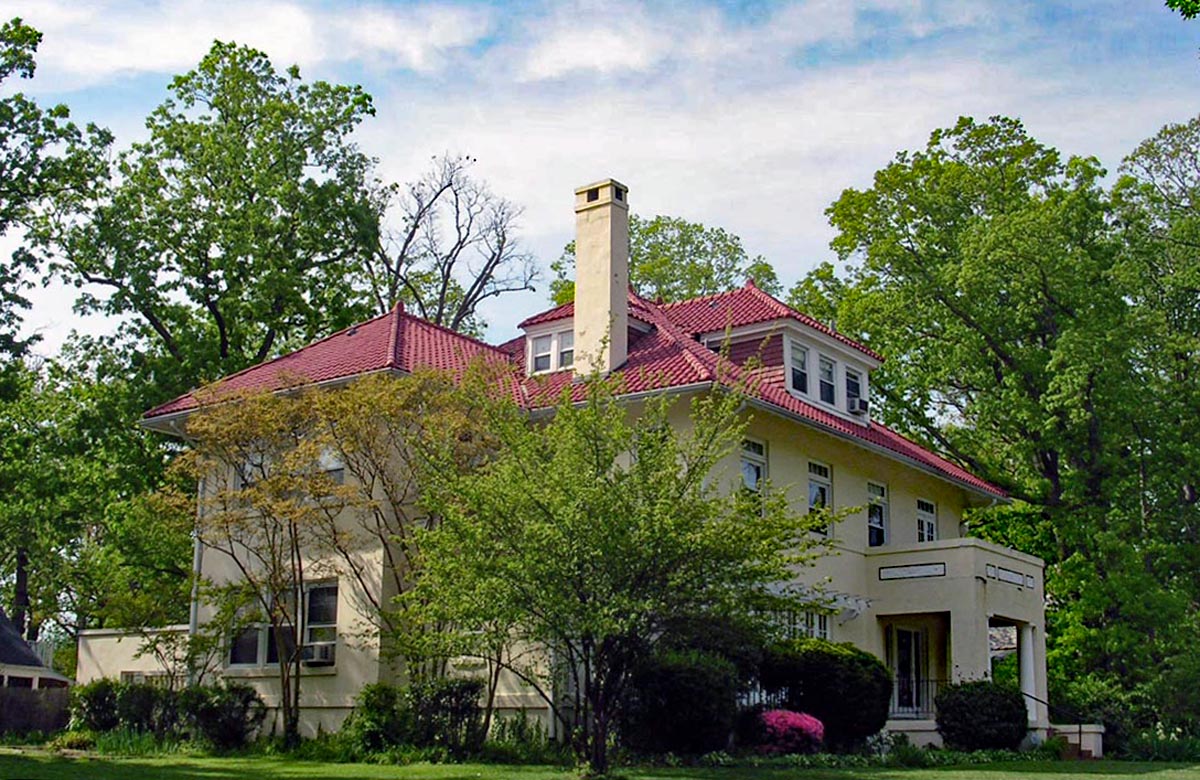
- Rhee's House in Washington.
Rhee continued calling himself the President of the Republic of Korea
while living in exile in the United States until 1945. He was skilful
enough to collect "taxes" from less than one thousand Korean residents
living in the United States, and bought a luxury house on the 16th Street
in Washington, DC (about 5 km north of the White House). From this
house, Rhee staged a effective campaign for Korea's independence, and
built his political base in the U.S. before returning to Korea in 1945.
This photo was taken in 1992, and the house is still in good shape.
- Republic of Korea in the South.
According to the United Nations resolution of 1947, Korea's first general
election was held in May 10 (1948) in the South, and the Korean government
was inaugurated on August 15 (1948). Syngman Rhee became the first
president of the Republic of Korea.
- Syngman Rhee with Harry Truman
in Independence (Missouri) during his visit to Truman's house
(1954). On July 20, 1965, the
day after Rhee died in Hawaii, the New York Times gave a full-page
coverage of Rhee's life, including this photo which presumably was
the best Rhee photo the Times had at that time. When this photo was
taken (1954), Dr. Rhee was 79 years old. He did not know he was
becoming old until April of 1960, when Korean students brought him
down. He spent the rest of his life in Hawaii.
While in the White House (1944-1953), Harry Truman made three of the
most difficult decisions for the U.S. in the 20th Century.
- The first one was to drop nuclear bombs on two Japanese cities in 1945.
- The second one was to send American troops to Korea in 1950.
- The third and the most difficult decision was to fire Douglas MacArthur in 1951.
All three played crucial roles in shaping up the modern history of
Korea. I respect Harry Truman as a very honest president, and visited
his house in Independence (Missouri) in 1968, even though I was not
invited in. I have a photo of the Truman House which I took then
somewhere in my house. I will add the photo to this web page as soon
as I find it.
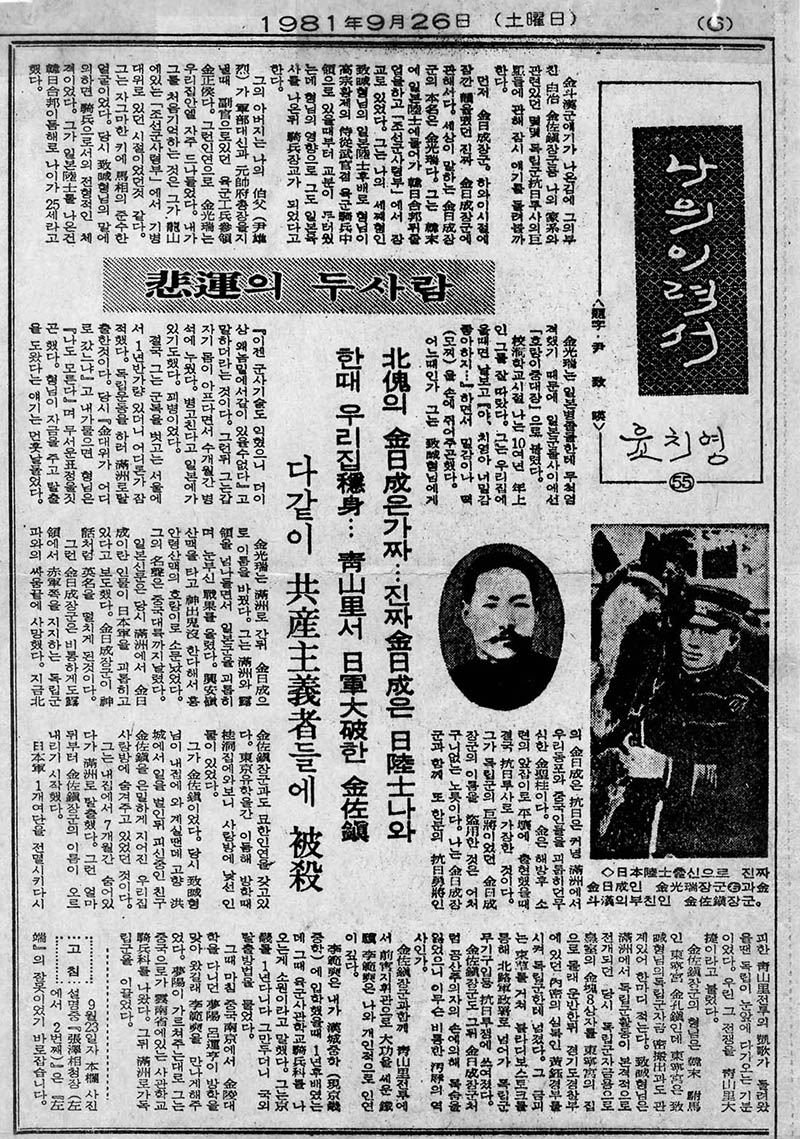
- Kim Il-Sung in Japanese army
uniform. In the North, a Soviet-style communist government
was set up in 1948, headed by Kim Il-Sung whose real name was Kim
Sung-Ju. He was a captain of the Soviet Army when he came to Korea
in August of 1945. Kim went to the Siberian city of Khavarosk from
Manchuria in 1940 or 41, but nobody knows what he did before he
crossed the Manchu-Soviet border. This photo presumably was taken
while he was in Manchuria. He was a young man at that time. Why
was he wearing a Japanese army uniform?
- Triumph Speech. Kim Il-Sung came to
Pyongyang as a captain of the Soviet Army. His real name was Kim Sung-Ju.
He changed his name to Kim Il-Sung, which was the legendary name of a
brave Korean general who could perform miracles while fighting against
the Japanese army. Korean were thoroughly disappointed because he
looked quite different from what they had expected.
One of the patriotic Koreans threw a hand grenade to him, and a number
of the Soviet body guards were injured. But Kim was untouched and
finished his "Triumph Speech" on October 14, 1945, and ruled North
Korea until his death in 1994.
- Gazza (false) Kim Il-Sung. An article
from Hankook Ilbo (one of major daily newspapers in Korea). To all Koreans,
the name "Kim Il-Sung" meant a legendary figure with magical power who fought
against Japanese during the Japanese occupation of Korea (1910-45). This young
man stole his name. His real name was KIm Sung-Ju.
- Kim Il-Sung set up in the North
his country called the "Democratic Peoples Republic of Korea" in
September 1948, 25 days after the government of the Republic of
Korea was inaugurated in the South on August 15, 1948.
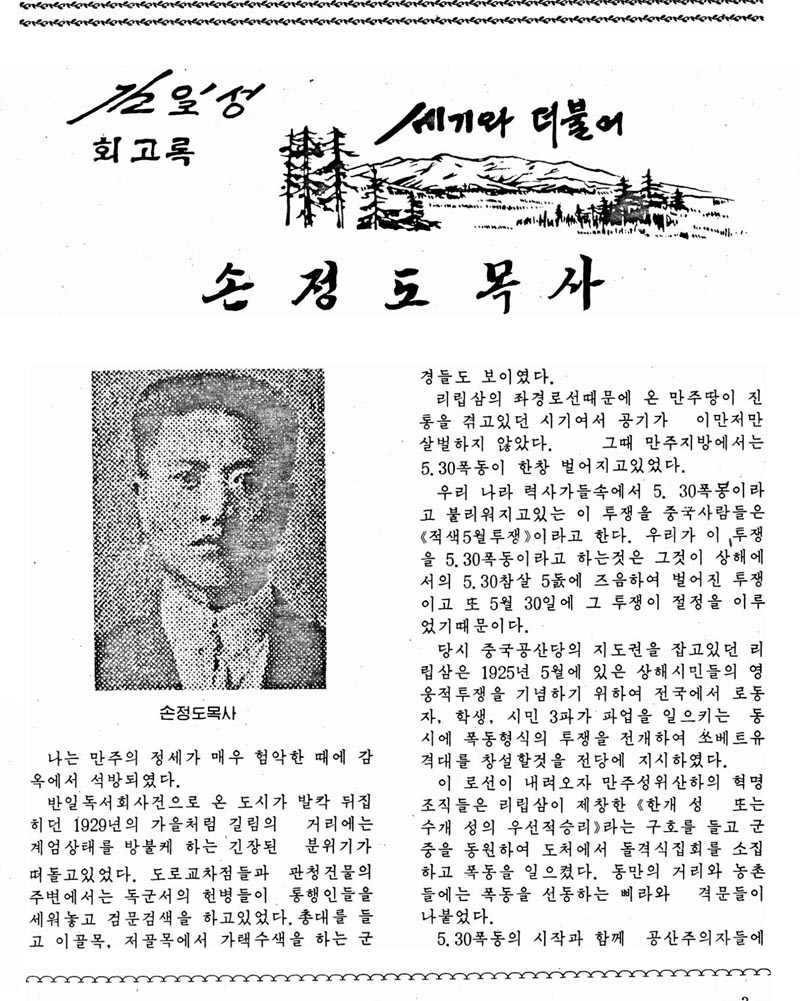
- Kim Il-Sung's Christian Background.
In spite of his anti-American slogans, Kim Il-Sung in his later years
tried to align himself with Korean nationalists, such as Ahn Chang-Ho,
respected by all Koreans. Here is an article he wrote about
Rev. Sohn Jung-Do who was the paster of Seoul's Chung-Dong Methodist
Church before he fled to Manchu. There was the leader of a Korean
Christian community, and one of those devoted Korean Christians was
a lady named Kang Ban-Suk, who had a son who later became Kim Il-Sung
of North Korea. In this article, Kim Il-Sung tells his real name was
Kim Sung-Ju.
Kim Il-Sung with his Mother.
This is a propaganda drawing (not photo). The caption says Kim is
learning patriotism from his mother, but it is more likely that the
mother was telling Bible stories to him. Very common practice in
Korean Christian families at that time.
While in Seoul, before moving to Manchu, Rev. Sohn had a Christian friend
named Syngman Rhee, who later became the first president of Korea in the
South and Kim Il-Sung's sworn enemy. Rev. Sohn was so close to Rhee
that Rhee appointed his son, Sohn Won-Il, as the first chief of staff of
his Korean navy. Admiral Sohn later became the defense minister and
arranged a mutual defense treaty with the United States in 1953. Rev.
Sohn's widow used to come to my house often (presumably whenever turned
off by her domineering daughter-in-law) to talk with my mother. His
two grandsons were on my wedding party in 1963.
Admiral Sohn Won-Il (far left) at the
signing ceremony of the mutual defense treaty in 1953. With him are Prime
Minister Paek Doo-Jin and President Syngman Rhee. The treaty was signed
by Foreign Minister Pyun Yung-Tae and Secretary of State John Foster
Dulles of the United States.
- Ahn Chang-Ho. Kim Il-Sung talks about
Ahn Chang-Ho and other Koreans whose names are familiar to us.
-
Gifts from the Soviet Army in North Korea (1945-48).
|
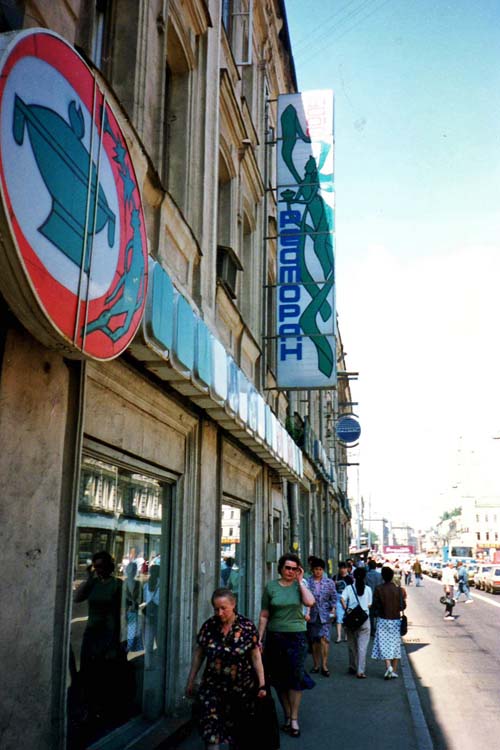
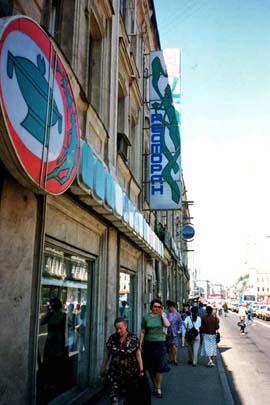
Pyongyang Restaurant in Moscow
|
- from the North.
I met these Koreans from the North in Moscow in 1990.
They were very friendly and polite to me. They also told me where
the Pyongyang Restaurant was.
- Pyongyang Restaurant,
near the Sukharepska metro station in Moscow. I went there several
times. The manager of this restaurant, known as Mr. Lee, is one
of the kindest persons I have ever met. The waiters are also very
kind.
- 50 Years after Separation.
Many Korean families were separated in 1950 during the first year of
the Korean War. In this photo, the husband from the South and his
wife in the North met in Pyongyang thanks to the South-North dialogue
(2000). After 50 years of separation, they are not able to talk to
each other. Their daughter is working hard to bring her parents to
get closer. Photo from Hankook Ilbo.
- Korean War (1950-53).
Click here for the War pages.
copyright@2022 by Y. S. Kim, unless otherwise specified.
|
|