Lifestyle of Affluent Americans
P-rades: Parades of Princeton Alumni
Thanks to Einstein, Princeton is an excellent physics place. Otherwise, Princeton is known as an exclusive gathering place for affluent Americans.
- Princeton University has its own unique culture called "P-rade." Every
year, the day before the graduation ceremony, there is a parade of
Princeton alumni in colorful costumes. It takes about three hours to
complete.
- Prospect Avenue ready for the P-rade (1986). The historic Prospect Avenue used to be the P-Rade route. The P-rade goes through a different routes these days. I do not know why they changed.
- P-rade turned on.
- Prospect Avenu without P-rades lined with Princeton's Social Clubs (called Eating Clubs).

- I took this photo of Adlai Stevenson
in 1962. He came to the 50th reunion of his 1912 class. Stevenson ran
against Dwight Eisenhower for presidency in 1952 and again in 1956. He
had his own liberal ideology and was widely respected even by those who
did not agree with him. He served the nation well as the ambassador to the
United Nations for the Kennedy administration, and did a superb job
in defending the U.S. position during the Cuban missile crisis. Here is
Steveson's bust at the main lobby of the
Woodrow Wilson School for Public Affairs.
-
Brief history of Princeton's alumni reunions.
I am very happy to see the above photo of Stevenson on this alumni page. I took this photo in 1962 with my Canon camera.
In 1962, Japanese cameras were unknown in the United States. Even worse, not many graduate students could afford personal cameras. How did I get this machine? Click here for the story.
The P-rade has a long history. As early as my Princeton days (1958-62), I was able to see that the P-rades are quite consistent with the present-day digital culture. How was this possible? The world-wide internet system was far beyond human imagination at that time. The following three pages will explain how I got this crazy idea.
- The passion for communcation defines
Thomas Edison's creativity.

- Short-wave radios. I was fortunate
enough to own a short wave radio and listen to the world during my
high-school days in Korea. While listening, I developed my appetite to
talk to the world.
- Sergei Eisenstein was a
a creative Soviet film director. When you make movies, you write the
story first and take photos. Eisenstein was different. Take photos
first, and then construct a story by arranging those photos. This is
how I make my webapages. I use my old photos.
I learned about Eisenstein while I was a graduate student at Princeton. I was there from 1958 to 1961 as a graduate student, and as a postdoc from 1961 to 1962 before joining the faculty of the University of Maryland.


- The passion for communcation defines
Thomas Edison's creativity.
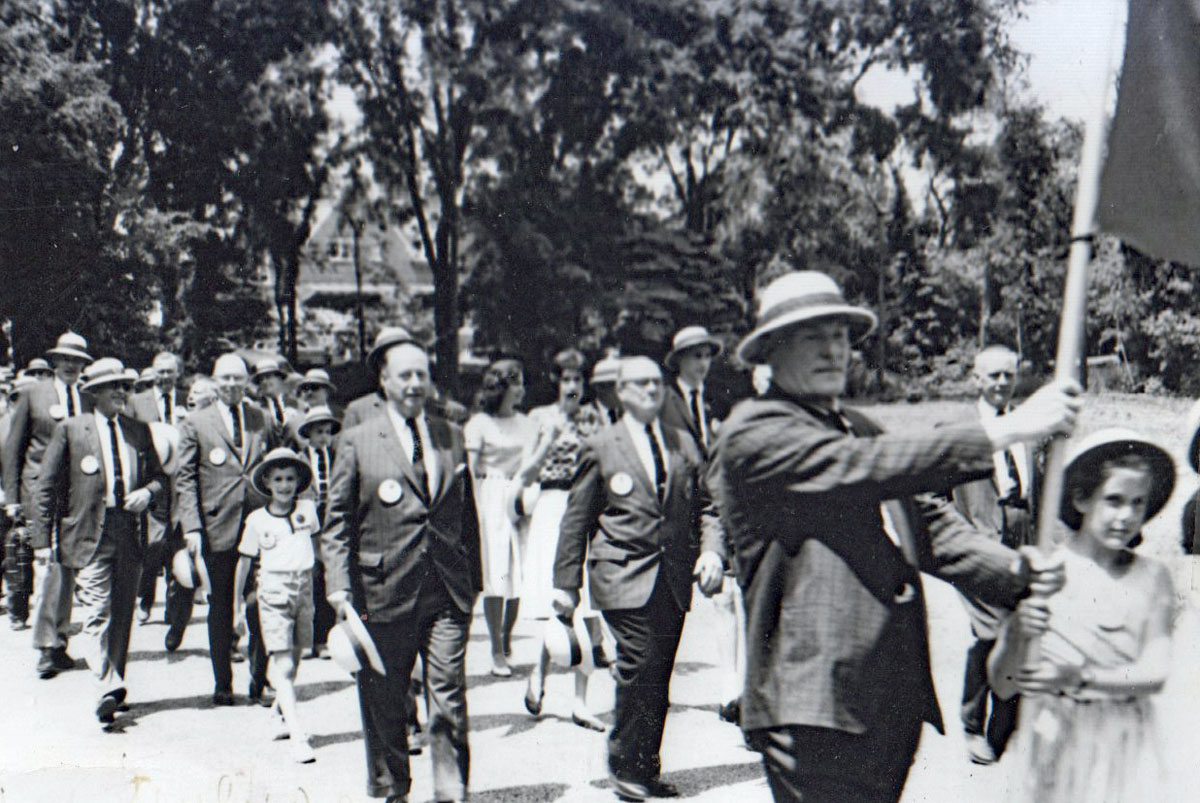
- Here is a photo of Robert Goheen
(without necktie) leading the 1962 P-rade. Goheen was the president
of the University at that time. He was an internationalist and used
to say that Americans should wake up from their traditional isolationism
and get ready to face problems of the world. He later served as an
ambassador to India. Here is
the Goheen page in the Princeton website.
- In June of 1987, William Bowen,
as the president, was leading the P-rade.
- In June of 1988, Harold Shapiro
was the president. He had to lead the 1988 P-rade.
In June of 2000, Harold Shapiro was still the president. He was reviewing the P-rade of 2000. He used to say that Americans should take care of their internal problems first to lead the world.
In December of 2000, I had an occasion to meet President Harold Shapiro and Mrs. Shapiro.
- In 2004, I had an occasion to have a
photo with President Shirley Tilghman. She became the president in 2001,
and she is doing very well, and I hope I can say more about her in the future.
In June of 2007, Shirley Tilghman is leading the P-rade of 2007. - In 2013, there was a re-union of graduate alumni. Christopher Eisgruber
was and still is the president of the University. I had a
photo with him in 2013.


- In June of 1987, William Bowen,
as the president, was leading the P-rade.
- Dwight D. Eisenhower
visited Princeton in 1961 after
his retirement from the White House. The occasion was the
dedication of the John Foster Dulles room in the Firestone
Library. Dulles was a Princeton graduate, so was his younger
brother Allan. John Foster was Eisenthower's secretary of
state, and Allan was the first director of a branch of the
U.S. government known as the CIA (Central Intelligence Agency).
Indeed, the Dulles brothers played the central role during
the period in which the United States emerged as the dominant
world power from an isolationist country. They deserve a
separate webpage.
Please click here for
Dulles-related photos and stories.
- Princeton University produced many conservative politicians.
Donald Rumsfeld served as the secretary of defense for George Bush.
James Baker was also a Princeton graduate. He was the secretary of the
treasury forRonald Reagan (1981-89) and was the secretary of state during
the first Bush administration (1989-93). George Schultz was
Ronald Reagan's secretary of state. It is not difficult to
find future secretaries of state on campus. I was able to find
a future secretary of state
studying very hard at the Woodrow Wilson School for Public Affairs
during the winter semester break of 2002. She seems to have
her own political view, and she is entitled to.

Rhee and Truman (1958),
Syngman Rhee Lecture Hall at the Woodrow Wilson School
- Among the Princeton PhDs, Syngman Rhee was a very conservative
politician. He was Woodrow Wilson's student and received his degree
in 1910. Rhee was the founding president of South Korea, and weathered
the tragic Korean war (1950-53). He visited the United States in 1954
in order to thank Americans for helping his country during the Korean
War (1950-53). The New York Times printed
his photo with Harry Truman the day after he died in
Hawaii in 1965. The main lecture hall at the Woodrow Wilson School
is named after him. This world needs more leaders like him, especially
in the countries with developing democracy.
- I can write a world history book while writing stories about
the P-rades, but let me resist this temptation. Indeed,
I have many photos of Princeton graduates who came back to
"Nassau Hall" in New Jersey, and I hope to be able to put their
images on my webpages when I have time.

- Princeton University produced many conservative politicians.
Donald Rumsfeld served as the secretary of defense for George Bush.
James Baker was also a Princeton graduate. He was the secretary of the
treasury forRonald Reagan (1981-89) and was the secretary of state during
the first Bush administration (1989-93). George Schultz was
Ronald Reagan's secretary of state. It is not difficult to
find future secretaries of state on campus. I was able to find
a future secretary of state
studying very hard at the Woodrow Wilson School for Public Affairs
during the winter semester break of 2002. She seems to have
her own political view, and she is entitled to.
- Since I live near Washington, DC (about 200 km from Princeton),
Princeton is a very convenient break-away place for me. I usually
add new photos to the Princeton campus page after making the trips.
Let us look at the campus photos. I
went there to take P-rade photos. Let us look at some of those photos.
- The university band has a cartoon-like banner.
- Monocles and tiger dresses.
- Future Princetonians.
- Crazy costumes.
- Crazy steps.
- Elephant and Elephant.
- Salute to the P-rade commander on the reviewing stand.
- Tall Man for the right job.
- Live tiger, and another tiger.
- Tiger Look. Everbody wants to look like
a tiger.
- Scottish Bagpipes. Bagpipes bands
appear frequently in P-rades. Why? Princeton University has a very strong
Scottish influence. The most influential president during the 18th Century
was John
Witherspoon. He was a Presbyterian pastor from Scotland.
The greatest president during the 19th Century was
James McCosh. He was also a Presbyterian pastor from Scotland.
- Kiltie Band of Carnegie Tech (1957). My Scottish connection does not start from Princeton. I spent four undergraduate years in Pittsburgh founded by Andrew Carnegie and Andrew Mellon. Carnegie came from Scotland, and Mellon's parents came from Scotland. Carnegie-Mellon University is named after them.
- Scottish costume. I become very happy whenever I spot Scottish people in their own costume. I met them in 2004 at the Amsterdam airport. They came from Edinburgh near Andrew Carnegie's hometown. Click here for photos from Edinburgh.
- My Presbyterian connection can be traced to my grandfather, who was one of Horace Underwood's most trusted Korean friends. This is my photo with youngest grandson (Urbana, Illinois 2004). Underwood was the first Presbyterian missionary to Korea sent from the Lafayette Presbyterian Church in Brooklyn. His elder brother was one of the pioneers in typewriter industry. His Underwood typewriters used to dominate the world before 1950, as Dell computers do these days. Mrs. Underwood in this photo is a graduate of Princeton Choir College. As a choir member, she used to sing for Einstein in front of Einstein's house on Mercer Street.


Brooke Shields'87 ready for her
first P-rade

- My photo with a member of the Class 1925.
His 82nd reunion in 2007. He must be over 100. He marched on
his class cart.
- Look at his class!
- Another old man. I am a very old
man (PhD'61) to the members of Class 2007.
- Class of 2002. Their 5th reunion in 2007, and their first major reunion year. They are still baby alums.
- Class of 2007 ready to be released. Released!
- Here are more P-rade photos.
- Antique cars. This photo shows that Princeton means Good Life.
- Antique Ford. This car seems to appear every year. This photo was taken in 2007. I spotted the same Ford in 2000. This Ford was working for the 50th reunion of the Class of 1950.
- More hopeless cars!
- Trolley bus for the Class of 1957.
- Horse wagons.
- Mercedes-Benz carrying the king of New Jersey (2007). He is the elected governor of New Jersey. His office is in Trenton, but his mansion is in Princeton. He appears like this every year. Here is how he looked in the 2000 P-rade.


This man was drafted to the army right after his graduation in 1943 and was sent to Europe. He had to drive a Sherman tank looking like this. 
- I have seen many crazy-looking cars on P-rades over the years, but I have
not yet seen tanks. In 2000, I ran into a group of senior citizens
belonging to the Class of 1943 (WWII period). I then asked whether anyone
knows how to drive Sherman tanks. One of them said YES. He drove around
one of those tanks in Germany in 1944. He was very happy to meet someone
who can appreciate his special talent. I posed with him in this photo.
- I indeed like to see Shermans on P-rades. We have at least one driver.
We just need one of those in proper working condition.
Sherman tanks look like this.
These tanks played the major role in American operations in North Africa
and Europe during World War II and also in the Korean War (1950-53).
There is another tank which deserves to be on P-rade. It is the T-34 tank developed by Soviets. Those tanks were used against Hitler's troops in Stalingrad. General Erwin Rommel of Germany praised them as the best tanks in the world. This still does not explain why they should be on the P-rade.
- From the engineering point of view, the basic difference between cars
and tanks is that tanks are heavy and need a different suspension
system. The suspension system for the T-34 was invented by
an American
engineer from New Jersey. This is precisely the reason why those
tanks should be invited to the P-rade.
How the Soviets got his technology is a complicated story.
These tanks are quite meaningful to me because
those driven by North Korean troops were un-invited guests to
my house in 1950.

- In July 0f 2000, I was in Kharkov (Ukraine) where those tanks were produced. It was indeed a pleasure for me to pose with an un-scratched T-34 tank. I met two Ukrainian soldiers there and invited them to be with me in the photo. They told me I need also a lady next to me in the photo, and invited to the scene one of the neat-looking ladies passing by. They seem to know how to serve their generals. They are good soldiers! Click here for more tank photos.
- I indeed like to see Shermans on P-rades. We have at least one driver.
We just need one of those in proper working condition.
Sherman tanks look like this.
These tanks played the major role in American operations in North Africa
and Europe during World War II and also in the Korean War (1950-53).

|


P-rade of 2000
Graduate School Centennial Year
The P-rade is largely a business of undergraduate alumni (they are very rich), and Princeton PhDs are somewhat indifferent toward this "childish" event. However, the year 2000 was different. The graduate alumni were invited to lead the parade, in recognition of the 100th anniversary year of the founding of the graduate school. I was a full participant of the re-union and P-rade.- Class of 2000 (May 2000).
These young people welcome and cheer graduate alums.
Their class is this big. - Princeton's New PhDs: Princeton's one old PhD with new PhDs under the Cleveland Tower (May 2000).

|
Cleveland Tower refurbished. The rededication ceremony took place during the centennial reunion.
The Cleveland Tower stands tall among Princeton's Graduate College buildings. This tower was built during Woodraw Wilson's time, about 90 years ago. It went through a major repair and reconstruction in recent years, and was rededicated in May of the year 2000.
The Tower was named after Grover Cleveland who was the president of the United States from 1885 to 1889 and from 1893 to 1897. He spent his retirement years at a sleepy town called Princeton, and dedicated the rest of his life in initiating a graduate program for the University. Princeton's graduate program started in 1901. You can see this tower while driving on the US-1 and while on the AMTRAK or NJT train. Likewise, you can have a dreamlike view of New Jersey from the top of the Cleveland Tower.
- Tom Cleveland'75.
Grover Cleveland's great grandson gave a speech during the
rededication ceremony.

- Graduate School Column on the P-rade.
"APGA" means the
Association of Princeton Graduate Alumni, or Association of Princeton
PhDs.
- Samba Dancers. These PhDs marched with dancers from the Manhattan Samba Company in New York.
- A happy couple in the mixture of PhDs and samba dancers.
- Feynman's Rio de Janeiro. Feynman used to go to Rio de Janeiro often to dance with Samba dancers there.
-
Richard P. Feynman (1918-88).
Feynman was the most brilliant PhD produced by Princeton, and one of
the most creative physicists in the 20th Century.
This photo is hanging on the third floor of Jadwin Hall (the physics
building of Princeton University).
Feynman was so fond of Samba dances that he used go to Rio de Janeiro
to dance with Brazilian girls. He should have stayed with us longer
and danced with us at this festival. We thoroughly missed him.
- Feynman Photos.


- Night before the P-rade.
Parties, and parties.
-
Fire Work. After the P-rade, we had an all-day
and all-night parties over the campus. The firework was the
grand finale of the P-rade day.
- First female graduates in the
P-rade of 2000. They belong to the Class of 1973. By the year
2000, these ladies became almost 50 years old. They still are
excited about being Princeton's first lady graduates.
- All-male. Princeton used to be an all-male school, and some people had to dress up like girls to entertain themselves. This photo was taken in the P-rade of 1985.
- Brooke Shields. Brooke's first P-rade in 1987.
- P-rade shoes. My wife is did not
go to Princeton, but she is mighty proud of the fact that both
her son and her husband
went to Princeton. She is really crazy about the
P-rade. We have special shoes for this occasion. We bought them
during the 1984 P-rade from a truck vendor. We are respected for
these shoes.


- 50th Reunion in 2000. Class of 1950.
These gentlemen are now over 70, and their 50th reunion is quite
meaningful to them. Indeed, many of them came, and they had a
bourgeois dinner
after the P-rade.
- 78th Reunion. It is his 78th
reunion to attend. He must be 100 years old (as of 2000 AD).
Here is the 75th Reunion.
- Governor of New Jersey. He is
not a Princeton graduate, but he likes to assert himself to
be the King of New Jersey at least on this P-rade.
- Wigner. On a happy event like this, it is quite appropriate to remember those who made this occasion possible for me. We visited the grave of Eugene Wigner at the Princeton Cemetery during our stay in Princeton. We had the last lunch with him in 1991. You are invited to the Wigner website which I maintain for him.


The P-rade is still largely a business of well-to-do undergraduate alumni, and the graduate alums are somewhat indifferent. Princeton University is working very hard to bring in Princeton PhDs to the main stage of alumni activities. The University administration made a major effort in 2000. It is a pleasure to acknowledge three key persons in the administration. Both the president and the graduate school dean are Princeton PhDs.
- Dean's Office. John Wilson (Dean) and
the lady who does all the work in the dean's office.
- Harold Shapiro, the president reviewing the historic P-rade of 2000.

2013
- In October of 2013, Princeton
University gave a big re-union event in order to strengthen the organization
of graduate alumni. I am in this photo (second from left on the third row).
When I was a student (1958-61), there were no girls. Princeton started
granting PhD degrees to women in 1973. It was indeed
exciting to see so many female Princeton PhDs there. Here is
a pdf version of this photo.
- Four university presidents were among the participants of this graduate school events.
- I am like their grandfathers to these young PhDs. Here is another photo.
- Male PhDs were also among the participants.
- Well-estblished professionals among the participants.

|

|


Not over yet. You heard about the Princeton Campus. Looking like a toy town?
- Let us visit the Campus.
- Einstein cannot be separated
from Princeton.
- New York City is one-hour
train ride from Princeton.

| |
|
- copyright@2019 by Y. S. Kim, unless otherwise specified.
- His home page.
- Photo-biography.
- World travel page.
- His style page.
- Washington, DC. This person received his PhD degree from Princeton in 1961 and became in 1962 an assistant professor at the University of Maryland near Washigton, DC. This was the best decision he made in his life.